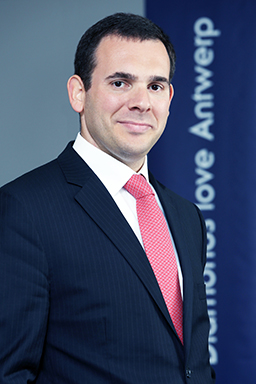
 In early September, ALROSA hosted a meeting on New Development Drivers of Global Diamond Business in the framework of the Asia Pacific Eastern Economic Forum meeting in Vladivostok. The panel session looked at the current state and future prospects of the diamond industry. Leading diamond and jewelry industry figures took part in a debate on the challenges facing the business on September 3, including Ari Epstein, CEO of Antwerp World Diamond Centre (AWDC), who was interviewed by Rough & Polished on this occasion. Epstein shares his views on demand recovery in the diamond market, competition with India and the establishment of a diamond bourse in Vladivostok.
What is your outlook for the diamond market? When do you expect the market to recover?
I think the problem is indeed in demand and the problem is certainly at the polished side at the moment. The miners have acted responsibly. They have been able to give buyers the right to defer part of rough diamonds they committed to off-take. In my opinion, the big issue for the moment is the market volatility, when it comes to polished diamonds.
As for demand, certain areas in the world actually performed relatively well. Other areas are currently under pressure. There is certainly a decline, but it is not as fundamental as the volatility in other commodities.
I think it will take a few months before the pipeline is cleaned up again and demand volatility gets out of the system. I suppose we shall see it in two or three months. I think the important thing is to produce enough generic and brand marketing effort, so that the consumer actually joins the holiday season – one of the most important seasons in our business.
If we talk about rough prices, what kind of dynamics do you expect by the end of the year?
If I knew it, probably I would not be sitting here. I believe there has been some price decrease, but I think that we are stabilizing now. The trend looks to be positive in the long run.
You said that diamond prices had not fallen as much as other commodity prices. But maybe the problem is that the miners, like ALROSA and De Beers, do not want to reduce their prices to the levels adequate to the current situation? How fair are the prices offered by miners? Do you think another correction is possibly needed?
Of course, any trader wants to buy diamonds at the cheapest price possible, and every seller wants to sell at the highest. These are the pure market economics. But the producer also wants to have a sustainable business. Diamonds are an extremely rare product. I believe we should avoid any rush to maximize output. It needs to be done with a long-term vision. And I believe it is being done with a long-term vision. Of course, the right equilibrium is something like bringing supply and demand into balance and this is the instance when market forces come into the play. If the right equilibrium in prices is found, people will start pursuing goods. If not, they will defer. The market needs to find a new equilibrium. Equilibrium in our business is found sooner than in other commodities. There is volatility like in other commodities, but this volatility is less than in other commodities.
The low profitability of diamond manufacturers is one of the big reasons for current weakness in demand. When will this situation change?
The decreasing of demand for polished diamonds is the reason why the market is not performing as well as it should be. But I believe that now the production side is being looked at carefully and miners are paying attention to the need of restricted supply. After some months, the pipeline will be cleared and consumption will pick up. Yes, currently there are some problems with margins in the polished segment, but it is a short-term perspective in the industry. And in the long-term perspective, our industry does not look bad at all.
How important is generic marketing now?
I think that the industry is actually tackling this issue and it is the right moment for generic and brand marketing. I think everybody needs to assume this responsibility and look for the best way to create value addition. I personally believe that part of the value addition should be in generic marketing too, because all the industry benefits from consumer awareness for diamonds. Today, we are competing with other luxury goods and I believe that generic marketing essentially explains our pipeline goods as it does in the case of other commodities. I think that generic marketing needs to be done in a professional way. I am sure that some initiatives, like DPA and others, will be able to tackle this issue.
What do you think about the prospects of polished business in Russia?
Russia is a developed country where people have salaries, which are not comparable to countries where diamonds are polished for $10 per carat. You polish diamonds at a price between $100-150 per carat. This is the economic reality. Can you compete with those prices? In my opinion, history has proven that you cannot.
The Russian government is discussing the creation of a diamond exchange and trade center. Your comments about it.
There are forty diamond bourses worldwide. They are playing a very important role in regulating the industry offering the highest possible standard in making deals. So, the question is about adding one more bourse. I think that our industry is quite scattered and in time like today, we need strong unity. Initiatives to strengthen the value addition in Russia are certainly worth looking at. But let us also not forget that initiatives like opening a trading floor or beneficiating local production have already taken place in the past. In Russia, it was done in 1970. In Botswana, Namibia it has been done lately, and I have to say the success of such initiatives is a big question. In my opinion, this could create some value addition but was not a real game changer. I am not a politician; I am simply talking as an economically realistic person.
In itself, it is certainly a very smart move. But do not expect too much of it. You have the most important part of the pipeline – production. ALROSA is the biggest producer in the world. We have been doing business with the Russian Federation since 1955. We are very proud of that and we are going to continue to be a reliable partner. There are only ten producing countries in the world and Russia is the biggest. You have this beautiful natural resource – diamonds. You have cool competence in mining, like nobody else in the world. You have been doing that for many years and you are the champions in that. Cherish that and do whatever is necessary to create growth in your country, of course. But don’t expect miracles by diversifying into areas, which are not your competences. It is only the matter of creating a few jobs and some value addition but it will not change the lifestyle or the way of living of thousands of people in the diamond industry.
After obtaining dominance in cutting, India seeks to outperform in trading competition. How much dangerous is this competition for AWDC?
I do not worry about it. I think competition is good. Every buyer finds a seller, and every seller finds a buyer at the best point. We can offer full price transparency, we can give access to the critical mass and we present $58 bln of import and export per annum. If you have no access to the critical mass, you will pay for that. We have 1 700 companies that come and look at goods, bid on goods, etc. We have 72 different nationalities doing business hand in hand in our center. And we are able to give the best price. That is more important than any other discussion and debates on the political level.
What is important is the interaction between different segments of the pipeline – miners, trading centers, manufacturers and retailers – when everything is in harmony and everybody specialized in creating the maximum value addition for his segment in the pipeline. That has been our specialty in Antwerp for over 550 years.
I am lucky that we are actually dealing in a product where people are still falling in love, still get married. Once people make a big decision in their life, they decide to give a diamond as the ultimate symbol of love. This is something that we are actually cherishing and I believe it will pick up.
Sergey Bondarenko for Rough & Polished
