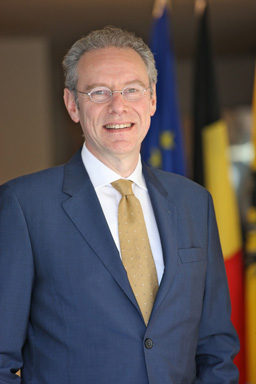
 The annual general meeting of the World Diamond Council (WDC) held at the Ritz-Carlton Hotel in Moscow last week discussed and approved the organization’s strategy guidelines for the coming two years, focusing its further activities on efforts to ensure compliance with the Kimberley Process Certification Scheme in order to prevent conflict diamonds from international trade. The Council members paid particular attention to the need for higher transparency, responsible business practices and image building in the diamond industry. In an interview to Rough & Polished on the sidelines of the WDC general meeting, Stephane Fischler, President of the Antwerp World Diamond Centre stressed the importance of cooperation between various industry bodies and the Kimberley Process in promoting the System of Warranties established by the WDC, which may add a refurbishing touch to the entire diamond pipeline.
What are the issues discussed by the annual general meeting of the World Diamond Council in Moscow?
First of all, it is important to take stock of the actions that have taken place this year. Of course, we have to look at the membership, the budget and, most importantly, this year we look at the strategy. What is the evolution we want at the WDC? In what position will it be in the future? And we have to see to it that our positions are aligned with our capabilities. Of course, there is a lot of talk of public relations and communication. We feel that we should improve our communication. These are really the main issues discussed at the meeting.
Now that the Kimberley Process has the Administrative Support Mechanism to which the Antwerp World Diamond Centre (AWDC) provides extensive assistance, what can you say about the results of such cooperation?
It was remarkable how the Kimberley Process and the members themselves started to appreciate the contribution of the ASM. It was quite apparent that this creation of the ASM has meant a huge difference for the work of the Kimberley Process. So, in a sense, we are happy to have been able to contribute to that and we will continue to do so. But as you know, it is not only the AWDC, but there are other assisting bodies, including the Israel Diamond Institute (IDI), India’s Gem and Jewellery Export Promotion Council (GJEPC) and the Diamond Development Initiative (DDI), which are collectively providing such services to the Kimberley Process. And I modestly believe they have made quite a positive difference.
In what way does the System of Warranties established by the WDC help to increase the efficiency of the Kimberley Process?
I think it is quite important to stress that the story doesn’t end when a rough diamond, accompanied by a Kimberley Process Certificate, is transformed to polished. It is very important that everybody in the industry understands the responsibility of carrying on the good work performed by the Kimberley Process, as well as additional issues related to general compliance and corporate social responsibility built into this kind of chain of warranties. I think the chain of warranties is defined by KP’s readiness to continue these KP certificates along the line up to retail and consumers. I believe we should look at the chain of warranty as a solid ally of the Kimberley Process. Of course, it can be more than this as well, building this chain of confidence further down towards the consumer.
Amnesty International said there is a high risk that Sodiam, which is the biggest buyer of rough in the Central African Republic (CAR), is still purchasing diamonds used to finance one of the rebel groups over there. What is the view of the World Diamond Council on the situation in this country?
The Kimberley Process has done its work quite well and proved its efficiency in blocking the exports of goods that were clearly involved in potential financing of rebel activity. Today, the situation is quite clear and all those goods have been blocked. As you know, there are some zones called ‘green zones’ in this country that have been identified and recognized. What we are doing now is to ask the government of the Central African Republic to cooperate fully with the Kimberley Process Certification Scheme in starting an audit and control process, which will have full support from the World Diamond Council. The diamond stockpiles that are in the Central African Republic are owned by private companies. We expect the Central African Republic working with these companies to create the right framework for this forensic audit to take place. Once there is conclusive evidence that goods have not been contaminated and are originating from within those green zones, they finally can be exported. That maybe a lengthy process, but we insist on it before export.
Recently, the Antwerp World Diamond Centre criticized the report of Amnesty International saying Antwerp’s Diamond Office was in total control over all shipments coming through the Centre. Your comments?
We were quite disappointed by the way Amnesty International failed to recognize the work of the Diamond Office in Antwerp. They were invited, they were offered explanations, they know that it was Antwerp where those shipments were intercepted. Diamond experts there are extremely well versed to identify such goods and they have done so. Hence, we found it quite surprising that Amnesty in its report did not recognize that, being fully informed of the depth of controls at the Diamond Office.
Could you elaborate on the role played by the Kimberley Process Task Force in banishing conflict diamonds from the trade?
The Kimberly Process Task Force of the World Diamond Council is a committee where all the expertise of the industry is brought together to contribute to the Kimberley Process and its various working groups. All the members of the WDC Kimberley Process Task Force are assigned to particular working groups where they contribute to their workings. So that is really the idea behind it.
Vladimir Malakhov, Rough & Polished
