By Albert Robinson
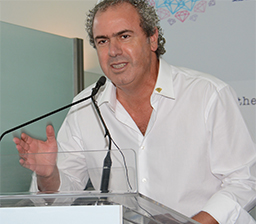 As Chairman of the Israel Diamond Exchange's (IDE) Industry Committee for the past two years, Yoram Dvash has played a leading role in several initiatives. He was one of the major forces behind the creation of a modern manufacturing plant near the IDE complex that was officially opened earlier this year. Now, he is leading the charge for the establishment of another manufacturing center for Israeli diamantaires – this one for the production of diamonds of 10 carats and larger. He tells Rough & Polished about the importance that he, IDE President Shmuel Schnitzer and the IDE's board attach to bringing manufacturing back to Israel.
Given the fact that Israeli diamantaires have become used over the past two decades to sending their rough diamonds abroad for manufacturing, how did the idea come about for cutting and polishing factories in Israel?
As stated, and it is no secret, Israeli diamantaires, and many others across the world, are continuously looking to reduce costs and have their rough stones cut and polished at the lowest price and the best quality they can find. Israeli firms are polishing everywhere from Russia to Vietnam, including China and India.
However, this is not as straightforward and simple as it sounds. You need to find a high-level polishing plant that will do the work exactly as you want. That takes time and effort. Can you always be certain that the polisher will always do the work precisely as you require? Will he keep you updated and show initiative?
Clearly, diamond firms have long been sending goods abroad for polishing because it is financially worthwhile to do so. How will the new center persuade them to manufacture at home? What is the financial justification for doing so?
As mentioned, the financial benefits are perhaps not so strong as they once were. Specifically regarding larger diamonds, we know that the cost of labor is not as big an element as it is for smaller diamonds. Bigger polished stones are sold for tens or hundreds of thousands of dollars per carat. As a result, the money being saved by sending it abroad for polishing is not as significant.
Then there is the point that lower-cost polishing plants are not immune from rising expenses. As those countries develop and secure more work, their costs rise because their workers demand better salaries and conditions.
Add to that the issue of time. Sending goods abroad might take a couple of business days or more at both ends of the process. And what about the cost of shipping and insurance? All of a sudden you have a situation where the advantages have become less powerful and there is room to consider other options. That is where the new plant fits into the equation.
What do the insurance companies say about the new manufacturing plan?
They are very happy with the project. As far as they are concerned the new plant is part of the diamond bourse, and this helps reduce costs for diamantaires.
You have a situation where diamantaires have to take goods to polishing plants in Ramat Gan that are near the diamond exchange. Those diamonds can be worth $300,000 or $3 million or sometimes even more. That is a terrible headache for insurance firms which insist on the diamantaires having two security guards to accompany the stones.
What has been the response from Israeli firms? Are they persuaded that there is a strong case for manufacturing at home?
We have had a very positive response. Companies understand very well the advantages of having close control of the manufacturing process and the cost advantages.
It also means that there is no need to leave the IDE complex to check on diamonds. There is the convenience of not having to go out of the building in the heat or the rain, but simply to go to the Maccabi building and go down to the factory. There will be easy access to the factory via a special passageway from the Maccabi building.
It is true that diamond firms have been sending their goods abroad for manufacturing, but since 2008 there has been less of that going on. Shipping and costs are high, and if you do not send a certain volume of goods for manufacturing then the cost is higher, and that caused some people to buy more goods than they needed in order to have a minimum volume.
Not only that, but you have a situation where nowadays you may have a period of several months where you do not have a lot of orders and work but where you are committed to send goods every month for polishing. That compares with the past when you might have one month per year when there was not a great deal of work. In that case you could cover that month with 11 months when you were OK.
With the new center, you are not committed in the same way. The companies selected will be given a room and they can put whatever equipment they want in there which allows them to manufacture whenever they want, or polish goods as sub-contractors for other firms.
Can you give us an indication of the nature of the new manufacturing plant? Where will it be based, what is the size of it and how will the space be divided?
It is a space of 400-450 square meters and its planning use has been approved by the local municipality.
There will be 15-18 tailor-made rooms for polishing, and each company/individual will be in his room and can do whatever they want in terms of their polishing activity within the center. They can polish their own goods only or they can do sub-contracting work for other firms from the bourse.
Will the Israeli diamond sector be investing a great deal of money in this project?
We do not intend to invest a lot in it. Initially, there will be a pilot project. We know from the talks we have held that interest is strong. There is no support or subsidy from the domestic diamond industry organizations. Our target is simply to make life easier for manufacturers of large diamonds. Our aim is to provide the conditions for them to work in.
How will the decision be made about which firms can use the center's facilities?
There is going to be a committee to decide on who is accepted to manufacture in the new plant. Anyone can register and the person will be checked for suitability for acceptance. There will be no polishing of small diamonds even of 1 carat and one-and-a-half carats. The whole aim is to give priority to manufacturers of large diamonds.
There is already great demand for the factory, and we are also checking another place and permits for it if, indeed, it is needed. We aim to start pushing the idea forward straight immediately. So far 57 firms have applied for the 15 rooms available. When we see how many applicants are accepted, we will have a draw if needed to decide who gets a room.
Can you outline the specific acceptance regulations?
The following criteria have been set and they will be strictly adhered to:
- It is only for manufacturers of large diamonds – of 10 carats and more
- That the applicant has a valid manufacturer/trader license
- There is priority for members of the Israel Diamond Exchange
- At least three years of experience as a manufacturer of large diamonds is required
- Three recommendations are needed from IDE members
- Impeccable past/reputation is critical
- There is a commitment to renting for at least 30 months in advance with the possibility of extending it by a further 30 months
- Firms must be registered with the official Companies Register
- They must be legally allowed to employ workers
- They must abide by conditions relating to insurance, including the acquisition of supplementary insurance where needed
- Applicants must not have debts or be the subject of complicated claims
- The IDE is not responsible in any way for the work of the factory or relations between suppliers and manufacturers
- Each company that is approved by the Acceptance Committee will be required to pay a fee to show its seriousness
