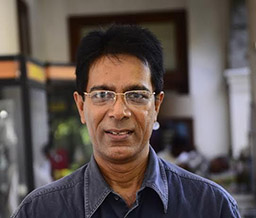
 A multi-faceted businessman and consultant, Anura Dharmaratne not only comes armed with the requisite education and a wide range of experiences in the diamond trade, he has also garnered accolades from all he associated with globally, including the Achiever’s Award 2003 from the National Gem and Jewellery Authority of Sri Lanka.
Here, in an interview with Rough & Polished, Anura takes us through his long journey in the industry; and also gives an insight into the relatively small but emerging Sri Lankan gem and jewellery industry, which promises numerous opportunities for global investors.
I understand that you entered the Sri Lanka diamond industry in the 70s. Where you technically qualified prior entering the industry? Was it an inherent interest in you for the industry or you had a family link to the diamond industry?
First of all, I have to state that very few people in the Sri Lankan diamond industry have had access to handle and produce more than 10 million stones in their career. I feel very lucky to be one of them. The vast knowledge and experience I gained after I joined the industry as an employee.
Please take us down the path from the beginning of your education; and later your work experience in the industry.
In July 1976 while I was in college studying for advance level in science stream, I read an article published in the newspaper describing the diamond industry and calling for candidates who wish to build up a career in diamonds. From my very young age I was fascinated by the colored stones in Sri Lanka. I left college in the same year and joined Blue Peacock Diamonds Limited.
At Blue Peacock Diamonds I was trained by the Belgian experts in Diamonds. A complete diploma in polishing and finished grading was conducted by the Belgian experts for Blue Peacock Diamonds Limited. I completed all six stages in the course with honors. During the late 70’s the Belgians left the company and the company was named Blue Diamonds Limited, due to necessity of continuation and conducting the business. I was nominated for further training in Belgium to master all aspects of diamond production.
Upon my return I designed, trained and managed the production of the first diamond pre-shaping unit in Sri Lanka handling the most complicated brown goods.
In the later part of 1980’s again the necessity arose to master the makeable production. Accordingly, I left to India to learn the makeable production and traditional cleaving of diamonds. In 1988, I had my first opportunity to design and build a modern diamond polishing facility consisting of all production aspects of diamond production for John Keells Limited. This was the memorable time of my career. I was bestowed upon the responsibility of recruiting, designing training programs and training staff to polish makeables. The management forecast was to be able to polish and ship the first parcel within the first 7 months. After planning and fabricating the factory, I completed the task in 4 months with a trained cadre of 150+ workers. Within 2 ½ years we build up a cadre of 450 workers for makeable production. John Keells project was one of the greatest achievements in my life and unquestionably one of the greatest achievements in the diamond trade in Sri Lanka.
Further at John Keells, I invented a deep boiling unit for diamonds where 400 carats of diamonds could be boiled in the same unit in separate compartments.
In 1994 I joined Ceylon Diamonds at their request to facilitate the expansion of the production plant and redesign the production flow to achieve higher output. As a result, I managed to train more staff and increase the cadre from 350 to 650 workers. The production output was approximately increased by 300% just by increasing the work force by approximately 50%.
In 1997 I designed and started my own facility in collaboration with two partners. To produce fine quality very tiny brilliant cut diamonds ranging from 100 to 200 stones per carat for the Swiss watch industry. In the same production plant I opened a specialized section to produce the most elegant Argyle pink diamonds. The pink diamonds were very tricky makeable stones. In a nut shell, I had to produce top fine make out of complex twined and cleavage diamonds.
As a result of my successful and long standing production quality and trust, the superintendent of production at Argyle issued a personal recommendation letter on behalf of Argyle Diamonds before they withdrew production from Sri Lanka as a whole.
When did you start your own diamond polishing factory/business? With Sri Lanka having a relatively small diamond polishing sector, what challenges did you face at that time?
While retiring from the polishing industry I helped my son put up his own polishing plant Chris Diamonds (Pvt) Ltd in the year 2005, I consulted for the company whenever required, it was a family business. Chris Diamonds was a small yet very capable factory still producing for Argyle Australia and for the Israeli and Belgian companies.
The biggest challenges we faced were labor retention and training program financing. The workers at Chris Diamonds were highly trained and capable of handling difficult stones on their own. As a result, the competing factories were fishing for workers from Chris Diamonds. We were constantly spending so much money on training workers to suit our needs.
What are Chris Diamond’s activities right now? And how is the company faring at the moment? What are the challenges that you face as of today?
Chris Diamonds ceased diamond production in 2011 and now we trade and market Natural Diamonds and colored stones. The company conducts business on order and on demand which is secure and minimal risk. Thereby I would say we are in safer shores.
The challenges that we face today are to find good quality natural stones and fluctuating cost factor of conducting business.
Can you explain your ‘consulting business’ that is also active and thriving; and what areas in the diamond business that you ‘consult’ in? What are your accomplishments in this field? Can you name a few?
I consult companies on all aspects of diamond production. Pre-Production, Polishing, Finishing, Work Flow Designing, Machinery Maintenance, Work Force Training, etc. Normally, the kind of work that I do is not published as no polishing plant would like the idea that they needed help.
A foreign polishing company who were producing Hearts & Arrows on 5 pointer stones told me that their quality percentage was down to 25%. After visiting factory, I calibrated their machinery and tools and sorting and fixing. Just after the correction the quality has increased to 78%. They were satisfied with the results and I was substantially compensated.
Can you help us understand the Sri Lankan diamond as well as other precious stone industry’s growth for say last 4 to 5 decades? What is the percentage of business that diamonds, colour stones and jewellery hold in the country?
The Diamond sector was a stable revenue for the Sri Lankan economy till the year 2011. Colored stones have been a local business which has been around long before the diamond industry and is still thriving. The jewelry sector is a small and yet a stable industry in Sri Lanka.
Which section of the manufacturing sector is thriving in Sri Lanka now? Diamond cutting and polishing, trading; colour stone cutting and polishing, trading or jewellery manufacturing, trading?
Currently, the colored stones sector is thriving in Sri Lanka followed by diamond polishing and jewellery manufacturing and trading in Sri Lanka.
Are diamond and colour stones or gold mined in the country? If not, from where are the raw materials sourced for the jewellery manufacturing industry?
Diamonds and gold are not found in Sri Lanka. They are imported. Natural colored stones are mined in Sri Lanka.
What is majorly exported from Sri Lanka currently? And what is in demand - Sri Lanka’s diamonds, colour stones or finished jewellery?
Colored stones and jewellery are in demand currently. There is a great demand for Sri Lankan blue sapphire all over the world. Jewellery fixed with blue sapphires and sometimes mixed with diamonds are in great demand.
What is the current state of Sri Lanka’s domestic sector? What types of jewellery sell well in the country? Are jewellery from other countries imported? And what is the preference of the Sri Lankan jewellery consumers?
The younger generation in Sri Lanka prefer cheap colored stones fixed on either 18 carat or silver jewellery. However, the Sri Lankans prefer 24 carat gold jewellery fixed with gems or diamonds for weddings and any other special occasions.
There are no major jewellery imports in Sri Lanka, although some of the cheap jewellery are imported from China.
What promotional activities like Jewellery Shows, etc., are undertaken by the Government of Sri Lanka to grow the industry? Five years down the line, where do you see the Sri Lankan gem and jewellery industry in terms of growth, in the global arena?
The government conducts a show named Facets Sri Lanka organized by the Gem and Jewellery Authority of Sri Lanka. The Sri Lankan jewellery industry is relatively small compared to other countries and mostly concentrated to the western province. Nevertheless, the colored stones industry is thriving locally and as well as internationally. Jewellery fixed with colored stones are exported by various companies to Europe, America and other Asian countries.
Due to increased demand for authentic natural stones I see the Sri Lankan colored stones and jewellery sector thriving to greater heights in the next five years.
What are the investment possibilities available in Sri Lanka for overseas companies to set up manufacturing units and trading businesses in the country?
There are immense investment opportunities in the country for jewellery and colored stones manufacturing and trading businesses.
Aruna Gaitonde, Editor-in-Chief of Asian Bureau, Rough & Polished
