Historical diamonds have intrigued humans for centuries, especially those which are attached to dark, ominous stories of ‘curse’ attributed to them. People have always got ‘sold’ on sinister and doomy stories for centuries…surprisingly even to the present day. As part of our series on ‘Historical Diamonds’, we bring to you the story of ‘Hope Diamond’…
Incidentally, has anyone in the world not read of or at least heard of Hope Diamond? Not many I would guess, as it is one of the most spectacular gems in the world. The awe and fascination for the stone is many times more than other historical diamonds that are associated to folklore and thrilling stories around them. Why? Because this beautiful, rare blue diamond, weighing about 45 carats, has many more stories that have baffled mankind till today.
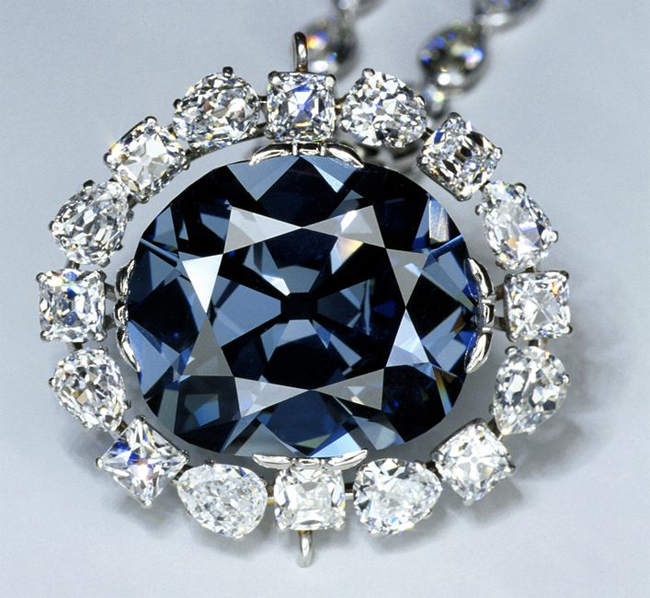
The blue stone is estimated to be worth more than $0.25 billion as of today. But, are there any buyers? NO… because, the gem is said to be ‘cursed’! History says that this gem, like Kohinoor, was also unearthed in the Kollur mines in South India. According to folklore, a Hindu Priest stole the gem which used to be studded on the Temple deity, but met a gory, slow and agonizing death for the evil deed. So, here began the story that the blue stone was cursed.
Like all other historical diamonds, the blue diamond had its European sojourn too when a rich French jeweler Tavernier purchased the uncut stone weighing about 112.5 carat but was soon mauled to death by wild dogs. Cursed stone?
Tavernier sold the cut and polished to the next owner, King Louis XIV who got it re-cut to 67 carats, valued at that time to Frs. 3 million, treasured as a French crown jewels. But, the King too died a shattered man after his empire fell to ruins. The diamond then passed on to his heir Princess de Lambelle, who was eventually beaten to death by street mobs. And, what happened to Louis XIV and Marie Antoinette who inherited the stone? They were beheaded. Victims of the curse?
It is said that the Blue diamond remained with the French royal family till 1792, and was stolen during the French Revolution. From here on, the Blue diamond was not heard of for a few decades; and was said to have been recut into a smaller gem, reducing to 45.52 carat by Wilhelm Fals, a Dutch diamond cutter. His own son stole the gem and finally committed suicide. Some historians even say that it belonged to Britain's King George IV who died penniless, and whose estate sold the diamond to pay off his enormous debts. Curse at play?
Whatever may be the case, in 1839, the blue diamond was acquired by Henry Thomas Hope, a rich banker from London, from whom it got the name. After Henry Hope's passing, the inheritor Lord Franci Hope led a wasted life and having become bankrupt, had to sell the gem.
No, there’s more…the diamond is said to have passed through several owners like an East European Prince, who gifted it to an actress Folies Bergere, and later shot her. When a Greek man bought the diamond, his entire family supposedly perished in an automobile accident. Next, the Turkish Sultan Abdul-Hamid 11, who acquired it, was overthrown by his own army
Meanwhile, countless stories of misfortunes attributed to Hope Diamond owners made the rounds… ranging from: committing suicide, bankruptcy, were murdered and many more misfortunes. Not with just owners, but stories that even those who came in contact with the diamond had to suffer major calamities like death of children, mental illness, broken marriages, drug addiction and probably every little mishap, spread far and wide.
In the year 1909, when the Hope Diamond was put up for auction, there were no takers… no surprises there. But, the lure of the Blue gem was so great that finally a diamond merchant from Paris bought and later sold it after just two years. An American tycoon’s wife, Evelyn Mclean bought the gem for $180,000 and wore it as a pendant on her necklace, brushing aside the backgrounder of the Hope Diamond. It’s here that the Hope diamond went on a rampage. Little did Evelyn know that soon her mother and two household servants would die in quick successions; her young son would die in an accident and her 25-year-old daughter would commit suicide. Finally, after being divorced by her husband (who died in a mental hospital), Evelyn too succumbed to pneumonia. Later her grand-daughter died at a young age as well. Hope’s ravage or what?
Hope Diamond may be the most famous cursed diamond in the world but there are many more. So much so, that Eastern superstition dictates that simple possessing extremely large diamonds always brings misfortune. And with historical proof to support the superstition, the fact only strengthened the belief in the minds of people. Coincidence? Maybe…
The Hope diamond’s curse story is actually attributed to journalists in the late 1800s, sensationalizing the ‘cursed diamond’ to sell their newspapers. Though, some of the disastrous stories attached to the stone were true, most of the others were just hearsay. But, the diamond’s history and highlighting anything bad always created a sensation. People were quick enough to list anything bad or tragic events happening to an owner of the diamond, and attribute them to the Hope diamond.
In later years, ’Hope curse’ became more a morality story and said that only a person with a pure heart could escape a doomed fate. In other words, someone who was generous enough to gift it away and not sell it for profit would escape the curse. But, no one dared to come forward to buy Hope Diamond knowing its precedence. At least not until Harry Winston, an American jeweler came along to buy it, along with all the Mclean estate. He was one modern thinker and a non-believer in superstition. Curse’s nemesis?
Eventually, the curse apparently ended when jeweler Harry Winston bought the Hope Diamond in 1949. Not believing in all the superstition around the gem, Winston is reported to have travelled around the world with the Hope diamond for more than nine years. The Hope Diamond’s journey carrying ‘curses’ along finally came to an end in 1958 when Winston donated the ‘Hope Diamond’, valued then at $100 million, to the Smithsonian Institution in Washington DC. Today, the gem is on display at the National Museum of Natural History, Washington, USA.
Aruna Gaitonde, Editor-in-Chief of Asian Bureau, Rough&Polished
Courtesy: Data from Dr. T.M. Babu’s book “GLORIOUS INDIAN DIAMONDS” (published by D.K. Printworld (P) Ltd) with Dr. Babu’s permission.
Dr. Babu, who is an exploration geologist (babutm@hotmail.com), is associated with GSI and several international organizations. He wrote books on diamonds, platinum, tin and has also co-authored the book “Mining and Metal Production Through Ages” published by British Museum, London.
