Though history claims that the diamonds were first produced, traded, and used as jewels in India thousands of years ago, no new mining projects that mined or commercially produced diamonds ever happened in modern times. India has always depended on sourcing rough diamonds from overseas producers for its diamond and jewellery manufacturing sector.
Here, we feature a few mining Projects that ‘started and got stalled’ as well as new projects that have the potential to take shape – someday.
Rio Tinto’s Bunder Project
Rio Tinto discovered the Bunder project in 2004, but it was only in 2010 that a State Support Agreement was signed with the Government of Madhya Pradesh (MP), India.
The Mining Lease however, was applied in June 2008 and with the MP Government recommending the mining lease for approval to the Government of India (GoI) in October 2009, Rio Tinto received the in-principle approval from the GoI in November, 2011.By January 2012, Rio Tinto had in its possession the “Letter of Intent” from the Government of MP to grant the Mining Lease, conditional on obtaining all other approvals. It received mine plan approval for Bunder from the Indian Bureau of Mines in July 2013.

Currently, Rio Tinto is in the process of obtaining environmental clearances in accordance with the laws of the land.The company has asked the Indian government for 954 hectares of land to develop a medium sized open pit operation in the Chhattarpur district of Madhya Pradesh. The deposit is located in an uninhabited forest region with the proposed mine lease area covering 0.005% of the total forest area of Chhattarpur.
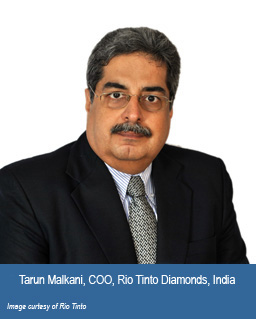
Many NGOs in the State were up in arms against the Project as it was presumed to destroy not only the flora and fauna, but adversely affect the health of the people living in the villages in the surrounding areas.Tarun Malkani, Chief Operating Officer, Rio Tinto Diamonds-India, however, reassures that “Scientific mining methods will be used to set a new benchmark for mine development in India. This involves using minimal land and water, recycling as much as possible, using the latest equipment and techniques and cleaning up as soon as we go along.”
 Rio Tinto has not yet commenced mining for diamonds in MP as it is stalled for want of necessary permissions, mainly due to the protests from the NGOs . On February 12, 2014 at a public hearing at the Kasera village, Madhya Pradesh, Rio Tinto emphasised its scientific mining approach would set a new benchmark for mine development in India. The meeting was an Indian government sponsored event and the next stage in the process towards gaining permission for a mining lease.
According to Rio Tinto, India is inextricably tied to Rio Tinto’s diamond business and share a history. Over the past 25 years Rio Tinto and India have developed a strategic partnership that continues till today. More than 70% of Rio Tinto’s diamonds are cut and polished in India and sold into all established and emerging diamond consumption markets. More than 300,000 Indians are reportedly involved in cutting and polishing Rio Tinto’s diamonds in Gujarat. In addition, the diamond manufacturing technology – diamond-impregnated scaifes - developed in India for the Argyle production has revolutionized the Indian diamond cutting industry.
Tarun Malkani sees the Bunder Project as a continuation of the strategic partnership between Rio Tinto and India and is confident that the Project will put India among the top 10 diamond producing countries in the world. “Bunder will be the first mine in India in more than 40 years and will strengthen India’s position in the mining, manufacturing and marketing of diamonds” he proclaims. “Rio Tinto’s 25 year strategic partnership with India and the Bunder project are perfectly aligned with Prime Minister Modi’s recently announced ‘Make in India ‘campaign, focussing on manufacturing to help achieve high growth and job creation. Bunder is estimated to deliver around US$7 Billion in economic benefits to India during its lifetime,” he adds.
Tarun Malkani, who is optimistic that Rio Tinto will see the Project through says, “The Bunder project is already making a positive difference to the lives of many people in this traditionally under-resourced region of Madhya Pradesh. Today, you can see water flowing to homes in 15 villages for the first time and farmers reaping the benefits of improved agricultural practices.“

It is obviously clear that India will benefit in more ways than one with the Bunder Project starting production as early as possible. Direct employment at Bunder is expected to be some 700 employees; with hundreds of other local jobs created to provide the necessary goods and services to support a mine. And, most importantly, the rough diamonds from the mine would also support thousands of jobs in diamond and jewellery manufacturing sector, which is continuously facing shortage of ‘rough’ to feed its factories.
“Rio Tinto’s investment in developing a world class diamond mine at Bunder is estimated at approximately US$500 million, for a capacity of around 5 million tonnes a year of ore processed. Rio Tinto has already invested some US$90M in exploration and evaluation activities to date. And assuming that we will receive the Mining Lease in place by end 2015, we will be able to start construction by end 2016, with first commercial production towards the end of 2020,” assures Tarun Malkani.
That’s still many more years away, but better late than never!
Aruna Gaitonde, Editor in Chief of the Indian Bureau, Rough&Polished
