Despite history’s estimate that diamonds (vajra, Sanskrit for "adamantine") were discovered in India during the 4th century B.C., and it was one of the first countries to mine the gem, the country today has no diamond producing mine. Nevertheless, diamond production within the country may augur well for the Indian diamond and jewellery industry by not only easing the rough shortage situation, but also help manufacturers as they would earn better margins.
Vajra Diamond Mining Pvt. Ltd. (VDMPL), a privately held mining company looks towards becoming a major diamond producer in India, and generate wealth for its stakeholders. This vision of the company also embraces a direct participation in downstream value-added processing of the company’s diamond production, thus gaining a large economic advantage from India’s dominance in diamond cutting. It is anticipated that high value diamonds will be recovered from the Dharwar Diamond Project during production activity and the Company will establish its own marketing network to maximize prices for their product.
 Charles Devenish, Chairman of VDMPL, is also the Chairman of Australian Indian Resources Pvt. Ltd and Deccan Gold Mines Ltd, listed on the Mumbai stock exchange. He is currently involved in developing a number of mining projects in India; among all, VDMPL will bring together a consortium of Indian diamond interests, including companies controlled by Anil Poddar, who is a leading Mumbai diamond businessman. Charles, who is also currently involved in developing a number of gold mining projects in India, is confident of the diamond projects in India. On Vajra projects in India, Charles says, “We are adapting to changes and progressing towards the future. Vajra projects are predominantly underground; and in implementing our plans we give greater emphasis on the social aspects besides add value to our company.” On new technology being implemented at the projects sites, he adds that the company is continuously striving to improve employee safety, keeping in focus consumer culture.
VDMPL has some exciting diamond projects in India, and the Dharwar Project (CC4 Kimberlite) is the one of them. This pipe has reported a micro diamond grade (MiDA) of 14 cpht to 35 cpht (Lakefield Research Limited, Canada). Grain geochemistry of the chromite and garnet from this kimberlite is highly favourable and shows economic potential with regard to diamond preservation perspective. The GSI has reported macro diamonds from this kimberlite through the surface bulk sampling of weathered kimberlite.
The company has plans to bulk sample this kimberlite pipe and evaluate a Macro Diamond Count (MaDA). If this pipe is economically viable, it could lead to a small but high quality diamond mine. The PL application is awaiting extension and mining licence fully guaranteed.
VDMPL through a 100% owned subsidiary company has recently discovered a new diamond cluster in India, which has shown good mineral chemistry and diamond potential. What makes this so exciting is a large diamond found downstream of this kimberlite cluster.
The GSI has reported macro diamonds from this kimberlite through the surface bulk sampling of weathered kimberlite, please, see the comments on CC4 diamonds from the world known Diamond Geologist, Bram Janse:
“The four diamonds from CC-4 shown are crystallized stones and indicate that this pipe will contain gem quality diamonds. From the photographs it is not realistic to put a value on them and moreover only the best and most interesting were selected to be shown but their presence indicates that it is warranted to spend money on evaluation of this pipe.”
 Tarun Rautela, Managing Director of VDMPL is a visionary who foresees the project’s success, “We feel confident that our work in India is leading in to a possible source for the originals of some of the Krishna River Diamonds. We believe this is a rare opportunity for us to put our Company at the forefront of diamond production in India. VDMPL is expected to bring together a consortium of Indian diamond interests.”
With a decade-plus of hard-core experience in the exploration and mining environments, Tarun has been involved with global projects across various countries like South Africa, Angola, Zimbabwe, Democratic Republic of the Congo, Russia and India. He has worked with Anglo American, De Beers Group of Companies, Vajra Diamond Mining Private Limited and SRK Consulting, UK. His profound knowledge in diamond exploration and setting up the early and advanced exploration capability will help him realise his dream to discover an economic Diamond Mine for India.
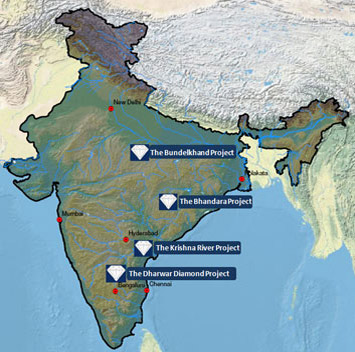
The Dharwar Diamond Project is the most important project for the company. VDMPL lease area falls within survey of India toposheet nos. 57 F/10 & F/11. The area is located in the Anantapur District of Andhra Pradesh. Nearest airport to the VDMPL lease area is Hyderabad. In general, the area comprises wide-open valleys characterized by a very gentle topography with subdued relief. Extensive areas are developed as agricultural land of which part is irrigated.
The VDMPL tenements are underlain by peninsular gneiss (PG), Ramagiri-Penakacherla metamorphics (RPM), granites and acid and basic intrusive. Banded and streaky gneiss and granitoid represent the peninsular gneiss. The gneisses are mainly hornblende gneiss, hornblende biotite gneiss, biotite gneiss and migmatite. The granitoid are seen among the PG and are massive or foliated. Metavolcanics and metasediments represent the Ramagiri Penakacherla metamorphics. The metavolcanics are dominantly mafic volcanics with subordinate acid volcanics. The mafic volcanics are locally pillowed. The metasediments are quartzite, BMQ and ferruginous quartzite.
 K-rich granites of lower Proterozoic age, both grey and pink varieties intrude the PG and RPM. The granites are medium to coarse grained and locally porphyritic. Large number of dolerite and gabbro dykes traverses PG and RPM. The general foliation trend is NNW-SSE with sub vertical-to-vertical dips.
Chigicherla kimberlite is a circular body with outcrop dimensions of 100m x100m, and is emplaced into basement granitoids. The bulk of the body comprises a hard melanocratic, greenish-black material, though a weathered, carbonated and clay-rich variety is also widespread. This kimberlite is diamondiferous.
The company has been engaged in a comprehensive evaluation of all former activities undertaken by the Dwyka/ BHP Billiton Joint Venture, which included the current areas now covered by VDMPL prospecting licenses. VDMPL has identified the potential of a diamondiferous kimberlite in the PL area. The Chigicherla field exhibits the geological and mantle conditions appropriate for hosting economic diamondiferous kimberlite and this offers the opportunity for a potential diamond mine
This pipe has reported a micro diamond grade (MiDA) of 14 cpht to 35 cpht (Lakefield Research Limited, Canada). Grain geochemistry of the chromite and garnet from this kimberlite is highly favourable and shows economic potential with regard to diamond preservation perspective. The GSI has reported macro diamonds from this kimberlite through the surface bulk sampling of weathered kimberlite. The company has plans to do the bulk sample of this kimberlite pipe and evaluate a Macro Diamond Count (MaDA). If the economic potential of the pipe and the results are positive, it could lead to small but high quality diamond mine. Currently, the PL application is awaiting extension-mining licence fully guaranteed. MiDA result indicates that more than 90% diamonds from the pipe are high quality and the project can be economically viable. Limited surface bulk sampling done by GSI has produced Macro Diamonds.
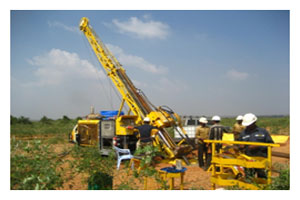
 Detailed Magnetic and EM ground surveys were conducted over Chigicherla kimberlite in 2003 and delineated 1.4 ha body with the help of geophysics. The analytic signal indicates a very strong response just to the west and south of the only known kimberlite outcrop. During December’09 the, Chigicherla kimberlite survey indicated better response with regard to size of the body. Detail investigation suggests that extension of the body appears to be 2-3 ha in size. The calcrete overlying the kimberlite could be seen over a length of about 200m and width of about 75 to 100m. There is a possibility that the pipe may also extend to the south indicated by the two question marks and the grey outline. Further drilling work will help to understand the exact size extension of the kimberlite body. Chigicherla kimberlite pipe has very thin overburden (7 to 25m), which can be considered as an economic factor for possible open cast mining. Diamond preservation potential from MiDA sampling results and other above parameters is sufficient to warrant additional 3000-ton bulk sample extracted from the kimberlite pipe by sinking three mine shafts in kimberlite along with the combination of drilling large diameter holes (LDD).
This work will enable the company to evaluate a Macro Diamond Count/ Economic Potential of the pipe and if results are positive, this work will lead to mining.
Aruna Gaitonde, Editor-in-Chief of the Indian Bureau, Rough&Polished
