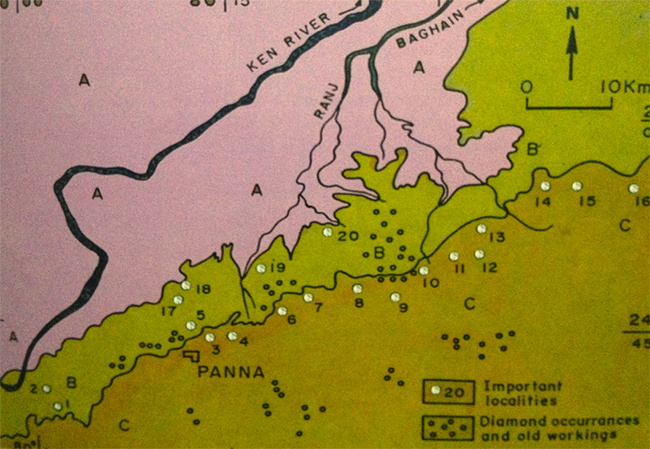
Diamonds bearing areas in Panna, as mentioned in Part 1 of this series, is located in Madhya Pradesh, a State in the central part of India, covering about 4000 sq.km. The potential Panna diamond province of about 20 km wide and about 100 km long, is spread over in north-easterly direction parallel to the Ken River. The main diamond belt is 6-10 km wide and 80km in length, where kimberlite/lamproite source rocks, secondary conglomerates, and Quarternary to Recent placers are found around Panna town.
The Majhgawan and Hinota pipes are the main primary source rocks for diamonds, though there are several localities in and around Panna where diamonds are recovered, both from conglomerates and from recent placer depositions of gravel beds.
History has it that in the year 1827, Captain Franklin first reported the Majhgawan pipe as diamond bearing followed by Sinor who identified the kimberlite pipe rock of Majhgawan in 1930 and furnished petrographic details. Post Indian independence, The Geological Survey of India’s (GSI) investigation established the mineralogical characters, dimensions of the pipe and its diamond-bearing potential. Panna Diamond Mining Syndicate, a private company took up mining for a short stint till 1959. Later, in 1966 the National Mineral Development Corporation (NMDC) a Government of India Enterprise undertook mining activity. It is estimated that more than 1 million carats of diamond have been produced till today from this mine.
The Majhgawan pipe, located about 20 kms south-west of Panna town, is a pear shaped body measuring 515m x 330m in size on the surface, capped by yellow and blue ground beneath 5 to 6m of top soil. At places the upper yellowish coloured top soil grades into blue ground below 14m from surface. The kimberlite body is found within horizontal sandstone country rocks with sharp contacts. The western and southern contacts of the body are highly fractured and sheared with ramifications of secondary veins, mainly of calcite and has a cone shaped body with vertical zones.
Sometime in 1956, GSI carried out bulk sampling tests on 40 tonnes of samples from which an average of 12.79 cpht (carat per hundred tonnes) was recovered from 9 bulk samples. Later, NMDC further deepened the pits in 1959 and reestimated an overall average of 9.73cpht. Mining commenced by NMDC in 1966 and regular production began in 1968 in the Majhgawan open pit. Two shafts of up to a depth of 96m and three dirves at an interval of 66m excavated in 1966. Treatment of 7709 tonnes of the pipe rock yielded a grade of 8.45cpht. From certain prospective and potential area an average 10cpht of production have been projected. It is found that there is higher concentration of diamonds in the centre of the pipe at the yellow tuff and red lapilli area than in the peripheral contact zone, which is enriched in carbonate veins and xenoliths of country rocks. On an average, the core portion of the pipe yielded 13 -14 cpht dropping to 6-7 cpht in the periphery. The bulk treatment of the samples indicated a slight fall in overall yield at depth compared to the samples collected from the surface.
The present mine pit is about 80m deep and kimberlite is now mined exclusively by opencast mechanized mining. That is, about 10m high benches are developed and operate from the centre and then move towards the periphery of the pipe.
NMDC acquired Heavy Media Separation (HMS) plant of 50 tonnes per hour capacity in 1994. The plant was equipped with crushing mechanism, HMS and X-ray sorter units to produce about 100,000 carat per year. The kimberlite mined is subject to two stages of crushing with primary and secondary crushers. The fine material of less than 1 mm is pumped out in a slurry form and the coarser 1-20mm size material is transported through conveyor belts to the two hoppers of 50 tonnes per hour capacity to HMS. While the floats of HMS are rejected, the dried diamond bearing concentrates are dried passed through magnetic separators. The non-magnetic concentrates are passed through x-ray sorters and grease tables to recover the final product – diamonds.
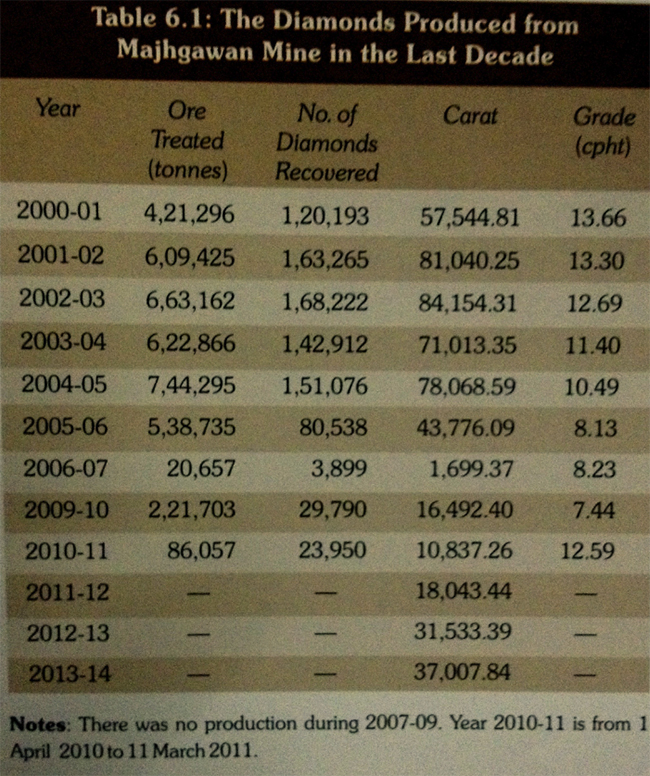
It is estimated that about 2-7 lakh tonnes of kimberlite ore is treated and about 10000 to 80000 carat of diamond are being produced from the Majhgawan mine annually. The overall average grades worked out to around 10 carats per every hundred tonnes of ore. The diamonds of Mahjgawan pipes are mostly transparent, free from flaws, have good crystal faces and occur in combination of right-faced crystals (octahedron) and twelve-faced crystals (dodecahedron) forming sharp edges. Mostly Twinned crystals and flat crystals found here and the diamonds from this area are considered to be very high quality. On an average, the rough uncut diamonds of Majhgawan are priced at US$200 per carat, the highest cost in the world during that time.
It is computed that nearly 1/3 of the diamonds recovered from Majhgawan pipe are of gem variety. The general size of diamonds are 0.22 -1.78 carats with an average of 0.5 carat. The largest gem recovered from this pipe till now weighs 34.37 carat. Another 30.33 carat diamond of gem quality is also reported to have been recovered. The main productive zone measured 320x280m covering an area of about 6.5 hectare.
The Hinota kimberlite pipe, discovered by the GSI, occurs about 3 km North-West of Majhgawan. It is an almost circular shaped body measuring 200x180m at the surface and elongated in northwest and southeast directions. The body is capped by 2.5m soil with detritus material. Below that there is 25m thick earthy yellow and greenish clayey horizon. Typical blue ground is encountered upto a depth of about 70m grading onto massive hard compact kimberlite. Here, the rock is mainly micaceous kimberlite grading into that of kimberlite breccia at depth, mineralogically similar to that of Majhgawan. Drilling investigation carried out established that the kimberlite body is more than 160m deep. A shaft sunk to the depth of 18.5m has exposed dark grey clayey horizon with concretions upto 2m, highly weathered kimberlite body grading to massive rock.
Besides these 2 main pipes, a number of diamond bearing locations and ultramafic bodies similar to that of kimberlite are found around Panna town. The Madhya Pradesh State Mining Officer allots plots to locals for digging and recovering diamonds with certain terms and conditions.
Several diamond bearing localities are found in the vicinity of the conglomerate and ultramafic bodies. Though the rock exposures at the surface are scanty, the wide extent of the potential area reported to have incidence of diamonds indicates that there is ample scope for discovering new concealed larger kimberlite bodies.
Many mafic to ultra-mafic rock bodies similar to kimberlites can be found around this area like Angore, Bariapur, Donghaha, and other areas. In 2004, Rio Tinto, a multinational giant company explored the area around Panna and discovered a cluster of eight diamondiferous bodies at Bunder. Rio Tinto taken up detailed exploration of Bunder Diamond Project and projected a resource of 37 million carat of diamonds at a grade 0.7 carat per tonne. This deposit is considered to be seven times richer than Panna Diamond Mine. While Rio Tinto has obtained prospecting licence from the Indian government, the company has applied for a mining lease. And having also earmarked Rs. 2000 crore for the project, this region is likely to become one of the top ten diamond producing centres in the world in terms of volume as well as in value.
Finding a solution and restarting mining activities in the stalled mining projects in India may not completely solve the rough diamonds shortage in the Indian industry, but will it bring some solace to the ‘rough starved’ cutting centres sometime in the future?
It certainly will.
Aruna Gaitonde, Editor in Chief Indian Bureau, Rough & Polished
Courtesy: Data and images extracted from Dr. T.M. Babu’s book “GLORIOUS INDIAN DIAMONDS” (published by D.K. Printworld (P) Ltd) with Dr. Babu’s permission.
Dr. Babu, who is an exploration geologist (babutm@hotmail.com), is associated with GSI and several international organizations. He wrote books on diamonds, platinum, tin and has also co-authored the book “Mining and Metal Production Through Ages” published by British Museum, London.
