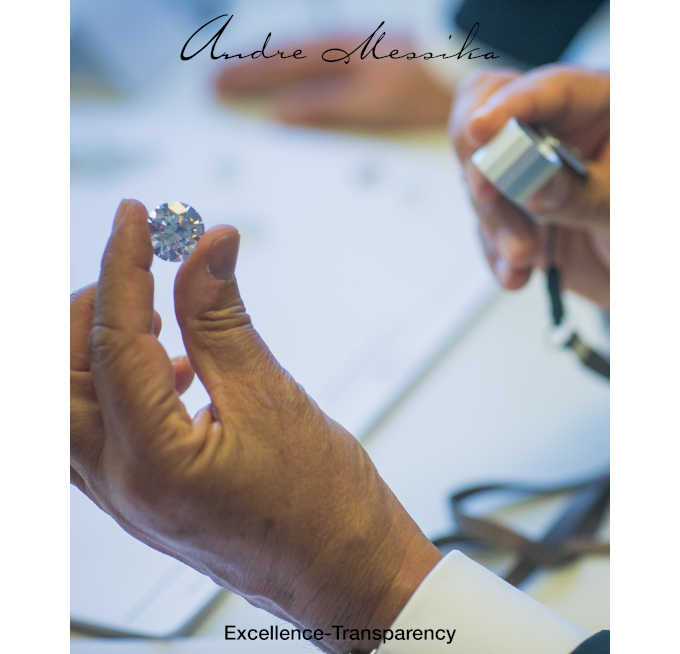
Image credit: Andre Messika Diamonds
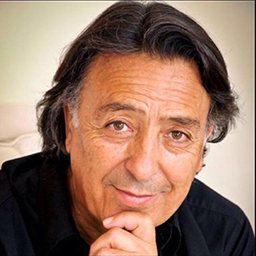 Andre Messika, a Paris-based topnotch distributor of polished diamonds migrated to Israel in 2003, to establish Andre Messika Diamonds in the Israel Diamond Exchange in Ramat Gan …and has not looked back since.
In 2012, in recognition of the continuous rise in turnover and a robust cashflow, Andre Messika Diamonds was honoured as Outstanding Exporter. A member of the Responsible Jewellery Council since 2012, the company adheres to its principles and code of practice. The company manufactures diamonds into exquisite gems, not just white diamonds, but all fancy colours, be it yellow, blue, red, pink and many of the other stunning hues.
Today, as the Founder/Chairman of Andre Messika Ltd., he steers the company that has grown into one of the largest manufacturer and distributor of rough and polished diamonds.
Here, in an exclusive Interview with Rough&Polished, Andre Messika talks about his company with immense passion, having nurtured it for many decades…
Some excerpts:
Globally, the diamond/diamond Jewellery industry bore the brunt of the COVID-19 pandemic but is gradually returning to normalcy. Recently, miners have increased rough prices; polished prices are steady and demand for jewellery is also picking up. What are your views on this?
As for many other industries, COVID-19 was a wake-up call. It was a time for the market to reevaluate its priorities and come to grips with a different reality. The rapid global recovery in markets is also felt by the diamond industry and many of its core actors.
With a stagnant consumer base, manufacturers and miners were forced to re-adjust their production rates, giving the industry a much-needed breath of fresh air. I perceive this last year as a true rebirth for our industry, and an accelerant to sustainable growth for the diamond industry as a whole in the coming decade.
What is the current status of Andre Messika Ltd? How as the pandemic affected the workings of your company? And, how has the company fared in its export performance this fiscal year? Can you give us an update?
Andre Messika Ltd has performed remarkably well throughout the COVID-19 period and continues to support our market's recovery. My son Ilan, has taken an executive position in the company and continues to scale our operations with a fresh and deeply specialized approach.
Expanding on the principles of the RJC of which we are members for nearly a decade now, and together we have increased the level of transparency and traceability as we have become an official partner in the Sarine Diamond Journey initiative as well.
Please also tell us about your diamond cutting and polishing factory in Namibia. Are there any new initiatives on the horizon going forward?
We are now very active and focused in Namibia, where we proudly have a polishing factory, which is the largest company employing physically challenged and hearing-impaired polishers.
We believe in empowering people and communities with opportunities that will help them shine as bright as the perfectly crafted diamonds for which we have become world-famous.
Our goal is to support the entire value chain, and we will continue supporting local communities through our numerous operations in the industry. We intend to share more of our thinking on this issue very soon.
Which diamond consuming country is the biggest market for your company currently? And, globally which markets, according to you, are worth looking at as prospective markets for diamond/diamond Jewellery? Your opinion?
Our operations are truly global, with a client base that we have built and serviced for more than 55 years. As the world continues to globalize with growth across the board, we see diamonds and jewellery attracting more consumers in various markets in which we are already active in. I am particularly excited to expand our work into mainland China, one of the most powerful and dominant consumer bases in the world.
The lab-grown-diamond (LGB) sector is finally being accepted worldwide as a legitimate entity. Will natural diamonds and LGDs grow amicably as two sides of the diamond industry? How do you see this panning out in the future? Your thoughts?
I do not see lab-grown diamonds posing a real threat to natural diamonds. While similar on an atomic level, lab-grown diamonds represent an entirely different asset. A large part of a natural diamond's value comes from its unequivocal and provable rarity - something which lab diamonds will never possess. I expect the popularity of lab-grown diamonds to increase in tandem with natural diamonds, as a low-market alternative to what will remain a premium product.
Analysts see LGDs as a tough competitor to Natural diamonds, especially from Gen Z which prefers LGDs against mined diamonds for obvious reasons of human and environmental issues. Your opinion?
The natural diamond industry today is one of the most transparent, regulated, and ethical industries in the world. It creates millions of jobs worldwide and is the very bedrock of a large number of national economies. Thus, I do not agree with the assertion that the natural diamond industry is currently a cause of humanitarian issues.
As stated in the above answer, I believe that lab-grown diamonds will grow into a substantial, vivacious market. Lab-grown diamonds do not have the fundamental characteristics of a rarity for them to ever become as valuable as natural diamonds, leaving a meaningful opportunity for growth across both markets.
Aruna Gaitonde, Editor in Chief of the Asian Bureau, Rough&Polished
