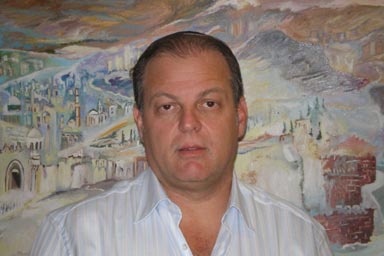
 Rough&Polished: Moti Ganz – President of the Israel Diamond Manufacturers’ Association (IsDMA), Vice-President of the International Diamond Manufacturers’ Association (IDMA), Chairman of the Israel Diamond Institute (IDI).
Moti Ganz joined the diamond industry in 1982 and in 1989 received the Outstanding Exporter Award; later on, he was elected to the IsDMA Executive Committee and then Chairman of its Organizing Committee. In 1991, Moti Ganz became a sightholder of the DTC. In 1995-98, he was the IsDMA representative on the Israel Diamond Institute’s Board of Directors; in 2002-2003, he chaired the IDI Finance Committee. In 2007, Moti Ganz was elected Member of the Board of Directors of the Israel Diamond Exchange. Currently, he manages diamond factories in China, India, Botswana and Israel and owns an international chain of jewelry stores. In 1999, he launched his own private registered diamond brand in the USA, the Elara Diamond, which is already recognized as one of the leading diamond brands in the world. After being successfully launched in Hong Kong and Japan, and with expansion plans for Europe, Elara Diamond is taking part in trade fairs in Hon Kong, Shenzhen and Shanghai.
We met Mr. Ganz in his elegant office at the Diamond Exchange in Ramat Gan. Moti Ganz is an affable and plain person – incidentally, the accentuated democratic attitude is a feature common to all Israel diamantaires irrespectively of their ranks and regalia.
- Diamond business is mainly a family business, is it? As we know, you continue your family tradition.
- I have been in this business for 25 years already and we are the second generation creating the diamond industry in this country. My father and uncle are working together with me. In 1989, our company was recognized as the best in the Israel diamond industry. We are processing the entire diamond segment and we were the first of Israel diamantaires who created a brand in the diamond industry; Tiffani is following our steps. This is only possible if you have well-trained personnel. All of our top managers are brilliant professionals well versed in finance.
- What is the situation in the Israel diamond market today?
- Our diamond industry accounts for 50 000 employees. We are producing $5 billion worth of polished diamonds. Our main problem today is the shortage of rough diamonds, especially high quality jewelry diamonds.
- How is developing the cooperation between Russia and Israel? Is it possible to make it more efficient?
- We contribute a lot of time to this matter. Recently in Antwerp, I talked to ALROSA President Sergey Vybornov and this was a constructive dialog. We regularly visit Russia and Russian representatives come to us. We need each other. Israel is not a bad place to integrate ALROSA into the industry market. However, we need them even more than they need us. We understand this and I think that the ALROSA management see and value our efforts to facilitate the work of ALROSA in this country and abroad as much as possible. Essentially, our relations develop rather briskly and we believe that our cooperation has a great future.
- What problems of the world rough and polished diamond market are of the highest priority in your opinion?
- During the last 27 years, the diamond marked was stable living without recessions or booms. However, the problem is that the well-known old diamond fields in the world are gradually beginning to exhaust, while there are no new large fields discovered for a sufficiently long period. In about 10 years from now, this may result in rough shortage for the diamond-cutting industry, and if there is no rough, there is no business. However, I believe in diamonds and I believe in future. In diamond business, future may be planned and this is good. Although the rules in the diamond market are changing, every its participant knows his place. Israel, for example, has always been the best place for diamond cutting and I am sure that in future it will preserve this position despite the changing conditions.
- Many African diamond-mining countries decided to establish diamond-cutting industries, partially solving the local unemployment problem in this way and increasing the added value of their currently developed natural resources. What is your opinion to this effect?
- This is the greatest ever challenge to Israel that Angola, Namibia, Botswana and South Africa are seeking a possibility to cut the diamonds they extract. Of course, such business cannot be done without professionals both in diamond cutting and in trading finished products. Israel has enormous potential both in the first field and in the second. We are trying not to be left on the outside of events taking place in Africa. For example, I proposed that in the context of the new amended Diamond Act in South Africa we could establish there diamond-cutting factories and sell polished diamonds in Israel. This would be helpful to South Africa and us. However, so far there has been no official reaction to my proposal.
Our business is rather conservative – all of us know each other and are not very glad to new faces. However, the process of changes cannot be stopped; some people come, other people go. The diamantaires’ strength is in knowing everyone. For instance, I am trying to know everyone.
- At present time, many Israeli companies are processing a significant part of diamonds abroad. What are your plans in this direction?
- I have built a factory in Botswana: it employs 20 experts from China and 140 local people. This will be a successful enterprise. The Botswana government is ready to help us because they see that this is important for the country. Besides, recently I set up a factory in China and opened a chain of jewelry stores employing 1000 people. By the way, we are expanding our presence in Chinese exhibitions. The demand in China is growing every month. The Chinese actually cancelled the diamond import tax.
- The Israel diamond business demonstrates a tendency towards steady growth and the ability to adapt to the environment. Could you, having that remarkable experience of yours, share the secret of success?
- The secret is in what you said; the diamond business in Israel attracts clever people, so they easily adapt themselves in the world market. We like to live here and this is why we develop our business here and provide good conditions for our partners’ business. For example, in Moscow diamonds are sold by whole boxes containing different and from our point of view very often incompatible categories of goods. If you want to buy something what you need you have also to buy what you do not need at all. In Israel everything is much easier; it is also easier here to buy those goods which you really need – from the largest stones, which in Russia are sold by way of bidding only, to the smallest ones, which may find their buyers only in India.
- Please, say a few words about your activities as Chairman of the Diamond Institute.
- I was elected one year ago. During this time, I managed to implement several projects; for instance, we have set up our own site in the Internet – now it is visited by almost 400 000 people; it has an English version and a Russian one; there is also a Chinese version. We have opened branches of our Institute in the U.S.A. and Hon Kong. Last week, there was opened a school for diamond industry managers in Israel. The next Sunday GIA will open its school at the Israel Diamond Institute. We are reconstructing the Oppenheimer Diamond Museum and plan to open it in February timing this event to coincide with the International Diamond Conference, which we are going to hold on February 12-13, 2008.
- What are your plans for the future?
- During the next year, we shall be consolidating what was achieved in the current year. Now the Israel Diamond Institute is engaged in organizing the third “International Rough Diamond Conference: Tribute to the Producers” in Tel Aviv. We have invited the representatives of the African diamond-mining countries holding the rank of ministers or higher to speak at the Conference. On the Israel part, the Conference will be attended by its prime minister and major ministers supervising trade, finance and economy. This will be a key event of the year, which may show to the producers all the advantages of trading rough diamonds through our industrial center. The close ties traditionally preserved between the diamond industry and our government is the key to success for world producers of rough diamonds working in Israel. Besides, staying in Israel the diamond producers may optimize their trade flows and increase their profit dealing directly with the Israeli diamond-cutters. The Israeli diamantaires are also closely cooperating with their government in developing Israeli laws, which are to regulate money laundering in the diamond industry.
Rough&Polished from Ramat Gan
News
South Africa mining output falls 12.7% in August on weak PGMs, coal and iron ore
South Africa's mining output declined 12.7% year-on-year in August, according to Statistics South Africa, with platinum group metals, coal, and iron ore accounting for the largest negative contributions.
Today
Aterian expands copper footprint at Azrar project in Morocco
Aterian has identified multiple copper showings and substantially expanded the known mineralisation footprint at the Amane Target of its 85%-owned Azrar Copper-Silver project in Morocco, following initial exploration fieldwork.
Today
Russia’s Ministry of Natural Resources identifies region with largest platinum and palladium deposits
Russia retains second place globally in terms of platinum and palladium reserves, while the largest deposits of these metals are concentrated in Krasnoyarsk Territory, according to the Russian Ministry of Natural Resources.
Today
Tharisa meets FY2026 guidance, Karo Platinum fully funded as net debt swings to $51m
Tharisa has reported full-year production in line with guidance for both platinum group metals (PGMs) and chrome concentrates, while confirming its Karo Platinum project in Zimbabwe is now fully funded following a $300 million bond issue.
Yesterday
Israel’s diamond sector poised for revival following tax reforms and De Beers comeback
De Beers, one of the world's major diamond market players, has announced the resumption of its operations in Israel after a nine-year absence, which became the latest sign of revival of the diamond industry in the country.
Yesterday
