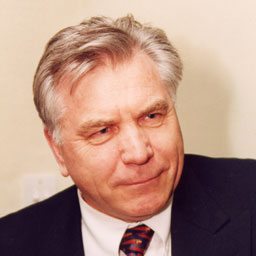
 Alexander Matveyev, Member of the Federation Council of the Russian Federal Assembly, First Deputy Chairman of the Federation Council Committee on Northern Territories and Indigenous Minorities, Mining Engineer, Academician of the Russian Engineering Academy, Doctor of Economic Sciences, Professor, worked as Chief of Industry Department of the Yakutsk Region Committee of the CPSU, Chairman of the Yakutia Planning Committee, Vice-President and First Vice-President of ALROSA.
- Yakut diamonds permitted the USSR and Russia to occupy one of the leading positions in the world diamond market. What did the diamond industry give to this region?
- The diamond industry contribution to development of Yakutia changed depending on history periods. Western Yakutia received a colossal impetus in the USSR times. During that period, there were built new cities, settlements, airports, roads and a chain of hydroelectric power stations. Diamond mining also served to raise the Yakutia political status to a significant degree, which in its turn provided additional opportunities to assert the interests of this province in the central government.
After 1991, the Republic managed to survive only at the expense of its diamond industry. It should be kept in mind, that the early 1990s were marked by a deep crisis in the coal and gold mining industries – the two other major components of Yakutia’s economy. For example, gold mining dropped down from 34 to 12 tons a year. Only during the last three – four years, these industries came to life due to growth of world prices for coal and gold. Starting from the early 1990s, the Republic was given an opportunity to command a significant part of financial flows in the diamond industry, and this money was mainly used to develop large-scale projects in the social field. Education, medicine, sports, cultural and humanitarian projects and construction of communal buildings – such were the priorities in that period. Such a policy seemed highly equivocal to many, me included, but after so much time passed it should be admitted that if those projects were not realized in those years they would never be implemented. Taken as a whole, it was an unprecedented breakthrough in the social sphere of Yakutia; it may be that there is not a single diamond mining area in the world, which can boast of such socially oriented use of profits received by the diamond industry.
Today as before, the diamond industry is making a decisive contribution into the development of Yakutia, but already in the nearest decade, the situation is expected to change in a radical manner, since the economy of this Republic is being rapidly and profoundly diversified.
- Do you mean the implementation of the “Schedule of Complex Development of Productive Forces of the Republic of Saha/Yakutia up to 2020?”
- Yes, I do. Yakutia has at its disposal enormous prospected and estimated deposits of minerals, like uranium, iron ores, coal, gold, oil and gas and rare earth metals. At last, the hour has struck for all this wealth. In South Yakutia there will be erected the Seligdarsky and Elkonsky Mining and Chemical Integrated Works, Yakutsky Gas Processing and Gas Chemical Integrated Works and Aldansky Synthetic Motor Fuel Plant. All this, without taking into account the coal works and the two mining-and-processing works, which being near coal and ore deposits permit to establish the largest metallurgical base in the Far East Federal Circle. A network of railroads and highways will be built in this area as well as the Kankunskaya Hydroelectric Power Station, the first in the chain of South Yakutia hydroelectric power plants.
In Western Yakutia, there will be erected oil-and-gas, gas processing and gas chemical plants. North-East Yakutia will develop a large complex of gold ore and polymetal deposits.
All these projects will be implemented in less than fifteen years.
- Such grand outlooks mean fist of all that Yakutia will see the advent of powerful corporations. If the Republic owns 40% of ALROSA stock and has some seats in its Supervisory Board thus having a real possibility to control the business of this diamond mining company, it will not have such an opportunity as far as, say, Mechel or Surgutneftegaz are concerned. It is quite evident that coming companies will be mostly interested in their profits, while the region will be interested in developing its infrastructure and social sphere – this is a straight contradiction. In what way will it be solved in Yakutia?
- A rational compromise in this matter will mostly depend not on the size of owned stock and number of seats on the Board of Directors, but on competence of negotiating parties. We had a negative experience dealing with YUKOS, which pursued an openly colonist policy towards Yakutia, and we have a pattern of wonderful relationship with Surgutneftegaz. Now, this company’s facilities in the Republic employ about 7 500 people, of whom over 1 000 are local residents; the company sent scores of Yakuts for training to prominent higher educational institutions of this country specialized in oil business; Surgutneftegaz will partially participate in building a school in Vitim and a sports complex with a swimming pool in Lensk. Vitim, being an entrance base for Surgut, has caught the second wind and it is now engaged in large-scale construction, including housing construction. Today, Surgutneftegaz is second to only ALROSA in payments made to the Yakutia budget and the gap is clearly narrowing. There is always a way to find a rational solution if you wish it and if you approach it professionally.
- Nevertheless, lately the general trend in the legislative process has not been in favour of deposit rich provinces; for instance, the “two keys” concept has been discarded. Have the federal and republican authorities enough leverage today to keep the big business on a socially oriented path, taking particularly into account that many Russian companies have foreign shareholders for whom the social development, say, of Yakutia is far from being the main task?
- Today, the government has possibilities to correct the activities of mining companies in the right direction, but certainly, the legislative process in this field should be improved. The majority of questions could be solved by the Mining Codex if it were passed. This document is ready and I deem its discussion and approval to be a major task of the Federal Assembly. Without such a legislative basis, development of mineral wealth in Eastern Siberia and particularly in Yakutia may be complicated by a good deal of utterly undue problems.
- Yakutia has parted with its coal assets and its 49% share in Almazy Anabara. At the same time, it managed to preserve a 40% block of stock in ALROSA. Would it be necessary to sell this block or some part of it to finance the mega-projects in Yakutia?
- The mentioned deals were expedient for the Republic in terms of both their pattern and their price. Elgaugol and Yakutugol have been sold as one package; this means that to develop the gigantic Elginskoye deposit the investor will have to use the Neryungry potential and then this city will have another impetus for development. The Republic’s share in Almazy Anabara has been bought by ALROSA and consequently the share of the Republic in ALROSA has proportionally grown. After re-formatting ALROSA’s authorized capital, the share of the Republic in absolute figures went up from 5 billion roubles to 150 billion roubles. There are all the reasons to believe that after the company will be open the share of the Republic will significantly go upwards. I do not think that there is any need to sell an asset, which has a good outlook. The Yakutia economy will become diversified, but diamonds will always remain the visiting card of this Republic.
