 TanzaniteOne is the largest and most scientifically advanced miner and supplier of rough tanzanite, a unique position that affords it the opportunity to support and influence the entire tanzanite channel, from mine to market.
This blue-violet gem is only found in one place on earth, in an area stretching only 6km in length in the foothills of Mount Kilimanjaro in Tanzania. It is not found in any other place around the world; geologists say that the chance of another discovery is less than a million to one. Tanzanite has become one of the world’s most cherished and sought-after gemstones. This rare and precious gemstone is a variety of the mineral zoisite. Tanzanite is trichroic in nature, meaning that it radiates three different colours from each of its crystallographic axes, namely blue, violet and burgundy.
The tanzanite mining area is divided into five blocks: - blocks A, B, C, D and D-extension. TanzaniteOne owns block C which represents about one third of the known strike approximately 2km in length. The largest mining license area in the Merelani Tanzanite Complex. Between Block’s B and D there are approximately 400 small scales miners, each of whom own title over a surface area of approximately 50m by 50m. TanzaniteOne currently represents around 60% of all rough tanzanite supplied to the worlds markets, 50% being mined by the company and the additional 10% being bought from smaller scale miners and dealers in Arusha.
We asked Mr.Ian Harebottle, TanzaniteOne’s President and Chief Operating Officer to answer for few our questions:
How is the market of rough tanzanite?
TanzaniteOne Trading is a Group subsidiary based in Arusha that purchases rough tanzanite from smaller miners, brokers and dealers. We operate under the guidelines of the Tucson Tanzanite Protocols. In support of more stability in terms of rough prices and supply, TanzaniteOne Trading is able to pays a small premium. This strategy has been well received in the local market and as a result has helped our trading division to become one of the market leaders.
Our tanzanite is distributed via a sightholder system, rather similar to that used in the diamond industry. We have initially appointed 8 sightholders each of whom are offered parcels of rough tanzanite at regular “Sights”. From this year the location where the sights are held will be moved to Dubai. This is in line with our vision to ensure that TanzaniteOne remains a global leader in its field. The company, which is run and managed from Tanzania, is now well positioned to cope with the growing demand from new (Eastern) and older (Western) markets: “from Tanzania to the world”.
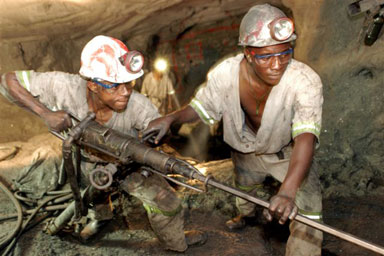 As a company our focus is on the mining and marketing of Premium Coloured Gemstones. We focus on getting the material out of the ground and then on working with the existing down stream channel to ensure the most effective rout to market for our product. Our current sightholders include companies with a base in Germany, America, Tanzanian and Indian, 95% of all of the world gemstones, including diamonds, are cut and polish in India, this is purely as a result of economics. India is able to cut and polishes gemstones very competitively. The margins in cutting and polishing of gemstones are not high, the distribution costs are significant and there are long delay times in terms of payments, so it is not easy for developing countries to compete in these areas, especially not while we still have to focus significant resources on the marketing and promotions of our products.
More and more countries are beginning to talk about local beneficiation, which is important, but is not easy. Not when one considers the need to remain competitive in the hotly contested luxury goods market.
Do you polish tanzanite in Tanzania?
 Yes, we currently have 8 people involved in cutting and polishing but this represents only a very small percentage of total production. We have plans to increase our local cutting facility to up to 50 benches in the near term, and one of our down stream distribution partners also cuts the rough material they acquire from TanzaniteOne, in Arusha.
Do you think that mine profit is better than the sale of polished stones?
Certainly, the profit in gemstones lies in the mining and retail segments. While each segment in the down stream channel is unique and requires its own set of skills, the largest margins are achievable at the mining and retail ends.
The current best estimate in terms of annual rough tanzanite produced is around 80 million USD per year. Once cut and polished this goes up to approximately 95 million USD per year, with the final estimated retail value of annual tanzanite jewellery sales (which would include the gold, platinum, diamonds and retail margin) ending up at approximately 700 million USD per year.
TanzaniteOne’s vision is to be very focused on developing knowledge, skills, science and technology in gemstone mining, and then on working together with the down stream jewellery channel so that we can improve the competitiveness of these magnificent gems, which we believe are undervalued, especially when considered against the many fashion goods that are made of steel and plastic and yet are able to achieve top dollar prices on account of their branding.
Do you think that one day tanzanite will be more popular than diamond?
Most likely, they are different; while tanzanite is at least 1000 times rarer than diamond. Diamonds have a long story. However, there is a significant opportunity to increase the general level of consumer awareness and appreciation for tanzanite and other premium gems. Lets consider tanzanite, first of all tanzanite is extremely beautiful. Secondly, it is extremely rare; each tanzanite gem is more that 500 million years old and is found in one place in the world. It embodies romance, being found at the foothills of Mnt. Kilimanjaro where the Masai walk the planes. Tanzanite thus exudes rarity, legacy, romance and beauty; it has got everything going for it. The only challenge that remains is that tanzanite was only discovered in 1967, it is still young and thus the fact that it is a great investment product needs to be communicated to the world.
Diamonds were discovered 1000’s of years ago, if you open a Bible, the Koran or a history book, you will see that Genghis Khan, the kings and the queens of old; all used diamonds. So diamonds have been ‘promoted’ for many years and with many million of dollars have been spent on their marketing and promotion.
Tanzanite was discovering in 1967, only 40 years ago now, and it has only really formerly market by TanzaniteOne over the past 5 years. We believe in the opportunity for growth in production at the mine and in popularity.
What does the future hold for the tanzanite mining industry?
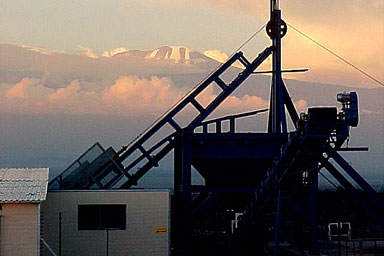 We are put a lot of energy into research and geology, we now know that the tanzanite ore body extends to 1.2km underground, on dip. So there is roughly another 25 years life of mine, which means that after 25 years all tanzanite will be gone. And that is why we refer to our generation as “the tanzanite generation”. Through our marketing efforts we are positioning tanzanite as the gemstone to celebrate new life: “Be born to tanzanite”. If you give up smoking and you want to celebrate – buy tanzanite! If you started a new business - buy tanzanite! If you have a baby - buy tanzanite! Why? Because it is beautiful gem, it is something you can wear with pride and it is a good investment. One day when your child has their first child - there will be no more tanzanite still being produced at that time so you can pass this gem on to them so that this moment can be remembered from generation to generation. Tanzanite forms the bases of your own personal legacy.
How difficult to mine tanzanite? What more difficult to mine diamonds or tanzanite?
It is generally more difficult to mine tanzanite than diamonds. Diamonds are largely found in kimberlite pipes which contain a relatively constant grade of diamond throughout the known extent of the pipe. Once the position and extent of the kimberlite is defined, the mining of diamonds becomes largely a tonnage game. With tanzanite, and most other Premium Coloured Gemstones, it is far more difficult, as the gems are not scattered evenly across the deposit, but isolated in certain high grade pockets. Specialised techniques have to be applied in order to access these pockets, sustainably and economically. The increase in difficulty can be evidenced when one considers the many millions of carats of diamonds that are mined each year in comparison to the relatively few coloured gems that are produced.
Will be a success if some new company comes to mine tanzanite? Is there a chance?
As previously mentioned, TanzaniteOne supports the growth and development of the mining end of the tanzanite pipeline; we would not look at other companies who are committed to the growth of our industry as competitors, but rather as joint stakeholders. We would welcome them into our market. At current prices, however, this seems unlikely since the smaller scale mining methods that have been applied in the past have largely eroded the near surface resource. Accessing the resource that remains at depth would require a long term commitment of considerable value.
We are not competitors with our neighbors, the other smaller scale miners in Tanzania. In order to support the growth of the global market we need all stakeholders to be successful.
What is the biggest size of tanzanite that has ever been founded?
In 2005, TanzaniteOne was announcing the discovery of single tanzanite weighing over 3 kg, the world’s largest piece of rough tanzanite from its Merelani Tanzanite Mine in Northern Tanzania.
The discovery was made 270 meters underground. Weighing in at 16,839 carats (well over 3 kilograms) and measuring 220mm x 80mm x 70mm, the rough tanzanite piece is impressive in both size and structure, and according to known records, is the world’s largest single piece of tanzanite to have ever been mined.
The piece has been named “The Mawenzi” after Kilimanjaro’s second highest peak. This really is a sizeable stone, comparable to what the Cullinan Diamond is to the diamond industry.
Reported by Veronica Novoselova,
Rough&Polished Africa Bureau Editor in Namibia
