A fortnight after the event, R&P’s special envoy Ya’akov Almor looks back with a critical eye at the event’s discussions
Two weeks after the fifth Dubai Diamond Conference (DDC) - a one-day event held on February 21st at the illustrious Atlantis, The Palm Hotel, our world has been turned upside down. The discussed topics, however, remain relevant.
At the heart of the DDC were four panel discussions. The first panel discussed the rough diamond supply market. Two more panels addressed the state of the consumer market and the latest developments and their application of advanced technology in the manufacturing industry. During the fourth panel, heads of industry associations and organizations were queried about their insights into the industry’s future.
The new consumer and changing demands
In the panel entitled “The new consumer and changing demands,” three participating industry leaders answered questions about how consumers feel about diamonds; if consumers have changed their mind about diamonds; and what do they think and know - or think they know - about lab-grown diamonds (LGDs)?
The panelists consisted of Beryl Raff, Chairperson and CEO of Helzberg Diamonds; Stephen Lussier, Chairman and Executive Vice President of Forevermark of the De Beers Group; and Shamlal Ahamed, Managing Director – International Operation, Malabar Gold & Diamonds.
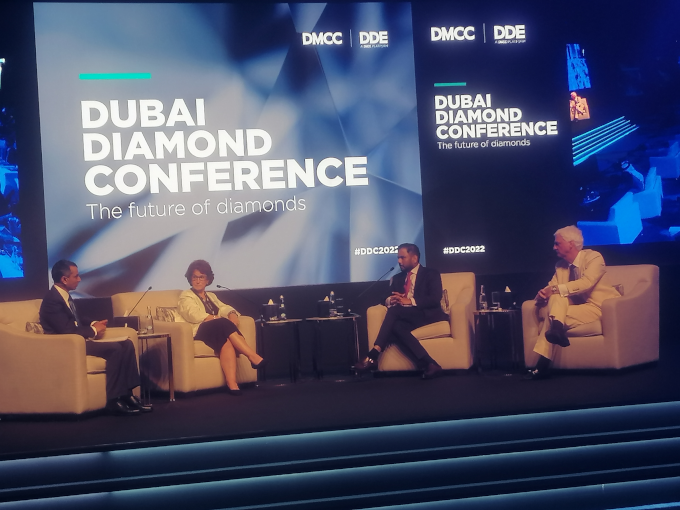
From left: Anish Aggarwal, Beryl Raff, Shamlal Ahamed, and Stephen Lussier
During his introduction, moderator Anish Aggarwal noted that since the diamond industry and trade’s marketing messaging of diamonds had continued to focus on marketing emotion, it had left the door open to the LGD industry to emphasize the importance of origin, and, by extension, of sustainability, traceability and consumer confidence in general. He noted that most of those working in the midstream do not interact with the consumers, but the retailers do. Are diamonds still on consumers’ minds, and if so, what has changed during the pandemic, Aggarwal mused?
In India, Ahamed said, the diamond and diamond jewelry market has seen consumers turning away from their traditional purchases of solid gold jewelry to diamond-set jewelry.
Ahamed heads his family-owned company Malabar founded in 1993 by his legendary father M. P. Ahamed, who turned a single retail operation in Kerala into a $4.5 billion corporation that employs 13,000 and operates more than 200 shops all over Asia. Shamlal Ahamed was listed number 20 on Arabian Business Indian Power List 2021, not far behind other significant Dubai-based Indian jewelers such as Amit Dhamani or Firoz Merchant.
“There is a clear shift in consumer behavior in India. Indian consumers increasingly purchase diamonds and diamond jewelry for festive occasions and family celebrations.” He noted that Indian consumers have also begun to adopt and celebrate holidays and other western festivals that had not been on their radar before. “For instance, this February, we’ve registered a significant growth in diamond jewelry sales for Valentine’s Day,” he said.
The pandemic has demonstrated that there are always new opportunities for diamonds and diamonds jewelry, De Beers’ Lussier pointed out. The pandemic changed the consumers’ mindset in various ways. First, the pandemic impressed the importance of relationships and their appreciation. “That appreciation was celebrated with the gifting of diamond jewelry,” Lussier said. Next, that same mindset led people to decide that “they better get on with what we really want to do. Who knows what is going to happen?!” Third, Lussier emphasized that the health crisis has changed how people choose to buy things, as they want to know how they impact the world. “The [health] crisis has shown us that we live in a connected world! Here, we discuss the topic of sustainability rationally, but “the consumer wants products to reflect the values of the era we live in!” he stated. Asked if sustainability was factored into the consumers’ decision to buy diamonds, he said: “Sustainability is all about status!”
Beryl Raff, however, wouldn’t have anything of it. Raff leads Helzberg Diamonds, a 200+ store chain with a presence in 36 US states that is owned by Warren Buffett’s Berkshire Hathaway. Buffett personally headhunted Raff from Zales to head Helzberg Diamonds in 2009.
“Consumers are only moderately educated,” she countered. “They have a lot of questions but are not always aware of the issues that the midstream is concerned with,” she continued, suggesting that for retailers, to put too much of an emphasis on sustainability may be counterproductive and not be beneficial to sales. Her remarks on the topic, which were far more extensive than reported here, earned the only applause by the audience during all the panel discussions.
A few days later, these very same sentiments were echoed by Ronnie VanderLinden, President of the International Diamond Manufacturing Association (IDMA), in his address to the Opening Ceremony of the 22nd Presidents’ Meeting, February 24-25, at the Almas Tower, the headquarters of the Dubai Multi Commodities Centre and the Dubai Diamond Exchange in Dubai’s Jumeirah Tower Lake district.
“Beryl Raff …accurately pointed out that it is predominantly at the counter of retail jewelry stores that consumers make purchases of their diamonds and diamond jewelry. And in making that purchase, while compliance and transparency are undoubtedly substantial, it is equally, if not more, important that the consumer… interact with a member of their retailers’ sales staff. It is the salespeople of our products who are answering consumers’ questions, giving them product advice, guidance, and at the end of the day, producing the sales that drive our businesses. They are a crucial component of our industry. We must continue to educate and support them.
Let’s face it: at the end of the day, sales at the retail counter are not driven by sustainability or traceability; they are complemented by it. While these are very important elements that we continue to support and build on, sustainability and traceability are not the engines that promote sales.”
Aggarwal asked the panel why sustainability is pushed so strongly to the foreground by the producers and organizations [such as RJC – ed.]. Was it indeed because of the rise of the LGDs?
Lussier negated that contention flat out. “We were way past that. It is not about ‘us against them,’” he argued. “It is about the storytelling [of natural diamonds]!”
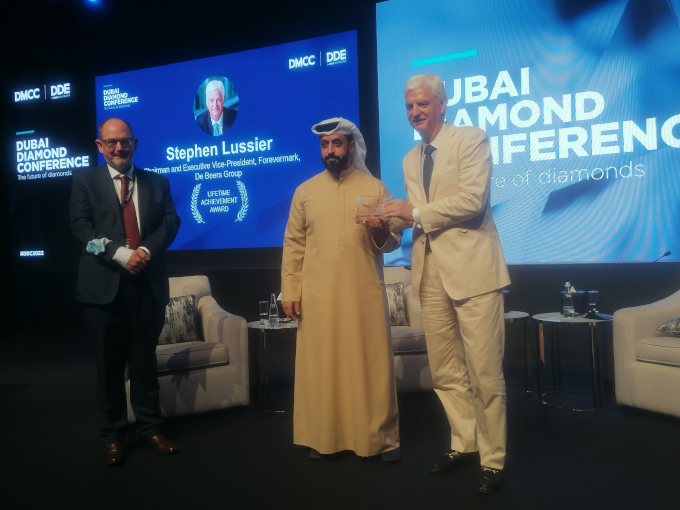
A few days before he stepped upon the stage at the 5th Dubai Diamond Conference, Stephen Lussier, Chairman and Executive Vice President of Forevermark of the De Beers Group, announced his retirement. It gave Ahmed Bin Sulayem, Executive Chairman and CEO of the Dubai Multi Commodities Centre (DMCC) and the Dubai Diamond Exchange (DDE), the opportunity to present Lussier with the DMCC’s Life Time Achievement Award. From left: Dr. Martin Leake, DMCC Special Advisor; Ahmed Bin Sulayem, and Stephen Lussier.
Asked why Helzberg Diamonds had decided to begin selling LGDs and LGD-set jewelry Beryl Raff said: “We felt that we needed to test it. It took lots of training of the sales staff. We decided to approach LGDs as a ‘fashion business’ product.” Raff admitted that this particular approach may not have worked very well. In the end, it is also about educating the consumer, setting one product next to another, and explaining the difference, she noted. Concerning the Indian consumer markets, Malabar’s Shalma Ahamed said that, like in the US, in India, too, LGDs would pick up market share.
Another topic that caused some disagreement among the panelists was the lack of focus and effectiveness of the Natural Diamond Council (NDC) promotional activities, formerly the Diamond Producers Association. Raff criticized the NDC’s insistence on featuring and promoting high-end market diamond jewelry instead of the diamond jewelry products of the middle market where most of the retailer jewelers’ sales are made. She asserted that the NDC is failing in its tasks, especially in social media. “How is it possible that the NDC’s Instagram account only has 89,000 followers while an LGD company such as Diamond Foundry has 750,000,” she asked?
Coming back to VanderLinden’s speech, IDMA’s President underlined Raff’s plea for the return of television advertising.
“Beryl [Raff] recalled De Beers’ history of success with its classic diamond advertising, beginning with the marketing concept of “A Diamond Is Forever.” She pointed to the effectiveness of television advertising for diamonds and diamond jewelry, especially when it comes to American consumers. Regrettably, the success of those past advertising campaigns is sorely missed by our industry.
I ask you this: on your flights to Dubai, did you find a single diamond ad appear on the video screen in front of your seat. Moreover, when was the last time you viewed a commercial for diamonds or diamond jewelry on prime time television, with any frequency?
We all know the answer.
Television advertising brings enormous strength, recognition, and consumer demand to any industry. Ask any adult or child in North America what the words “Just do It” mean, and they will instantly tell you “Nike.” That speaks to the success of product advertising. The same is also true for products such as Coca-Cola. Why do these brands spend so much of their resources on product advertising? The answer is simple. It produces sales, which is exactly what this industry needs more of.”
Rethinking the diamond supply chain
The DDC’s third panel was entitled “Rethinking the diamond supply chain.” David Block, CEO Sarine, Technology Group (Israel), Bernold Richerzhagen, Founder and CEO of Synova (Switzerland), and Rafael Papismedov, Co-founder, Managing Partner HB Antwerp (Belgium), discussed changes in technology that are affecting the diamond industry, how technology is changing, and how the midstream reacts to consumer developments.
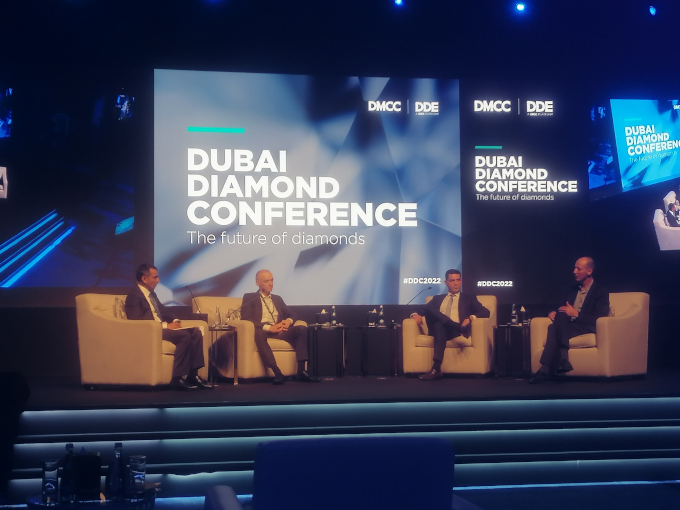
From left: Anish Aggarwal, Bernold Richerzhagen, Rafael Papismedov, and David Block
Moderator fired off a whole set of questions at the participants: What is going to happen with the manufacturing and other production technologies in the supply chain in the coming years? How will it evolve? What can it do, and where is it needed? How quickly can new technologies be adopted?
Bernold Richerzhagen recalled the 4th DDC of 2019. “We announced Synova’s Leonardo diamond laser cutting machine during the past DDC, and now, it is up and running. We can polish a stone in a single day – any round or fancy, from three grainers and up,” he stated. “Of course, when we announced this a few years ago, the industry was skeptical. Nobody really believed - in an industry that basically has been polishing diamonds in the same manner for more than a century - that we could do this. But now we can, with a laser.”
HB’s Rafael Papismedov: “At HB, we recognized that technological innovation is a driver to create something better. It’s why we took over the R&D facilities [of HRD Antwerp] as technology needs to be in the hands of those who need it.”
Sarine’s David Block also recalled the DDC of 2019. He said the last time we met here in 2019, we announced Sarine’s automated diamond grading technology. Since then, we have introduced our AI-based e-grading™ technology that is now fully integrable into the diamond manufacturing workflow.
Aggarwal then asked if automation in manufacturing and grading will eliminate the human factor. “Will India lose its manufacturing power? Will technology ultimately replace humans?”
Richerzhagen smiled as, pointedly, he answered the question: “When the moment arrives that machines become twice as cheap as human labor, what is the question?” Block commented that India has used and employed technology to perfection. “The know-how that India has accumulated will remain.”
Can technology be employed where it is needed, Aggarwal asked the panelists?
“The pandemic has demonstrated the need for local production. Produce where you have the product. Just think about the havoc the shortages of chips from Taiwan and China caused [in the markets] due to lack of supply of rough materials!” Richerzhagen said. “This presents a chance for the [diamond] producing countries and could add tremendous value. For retailers [selling diamonds polished in Africa], this presents great marketing opportunities, as they can show how they were produced, he added. Block concurred: “There is no reason African countries cannot do this!”
And what about trust, Aggarwal asked Block. After all, diamond grading reports are subject to trust. Can you generate trust with your AI-based automated grading reports?
“Of course,” Block replied. “The consumers’ trust in technology is high. At the same time, recognition [and trust] of grading labs are low. Technology builds trust very fast!”
Papismedov agreed. “Third-party diamond grading confirms that the seller doesn’t know enough about the product he sells. In addition, grading has become a commoditized product. In these processes, it’s all about disruption. In this case, we [Sarine and HB ed.] have taken ownership of the process. And by adding traceability to the mix, we further contribute to that trust-building,” Papismedov explained.
How positive is the midstream about traceability, Aggarwal asked?
“It can be proven to be profitable, also in the midstream,” Block contended.
“But it has to be used with passion,” Papismedov added. “Don’t see it as if it is ‘imposed’ on you. View it as an incentive. It is a tool to give consumers a look into the supply chain. It is wonderful when used right. After all, the consumer wants to close the ‘black holes’ in the process and see and understand the value chain!”
In a final question, Aggarwal asked the panelists where they see the supply chain five years from now.
“A much shorter supply chain,” Block deadpanned.
“Consumers want to see a flawless process,” Papismedov answered.
“I have a message for the midstream: See the changes; the time is now, be open to them!” Richerzhagen concluded.
