In the end of 2007 and in the beginning of 2008, the top managers of leading diamond-mining companies ALROSA and De Beers expressed the idea to transfer settlements in the rough diamond trade from the dollar area to some other currency. At first sight, such a proposal seems reasonable taking into account the downward dollar rate tendency in recent years. If we examine the changing movement of prices for Russian diamonds and the rouble rate in U.S. dollars (Fig. 1), we may also arrive at a similar conclusion.
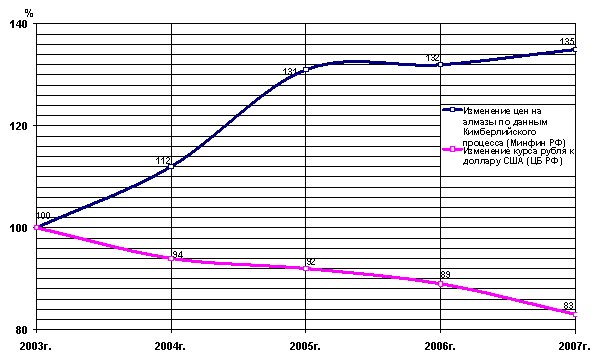
Fig. 1. Movement of prices for diamonds and movement of rouble/USD rate in 2003-2007
(blue curve – Movement of prices for diamonds according to Kimberley Process data (Russian Ministry of Finance);
pink curve – Movement of rouble/USD rate according to the Central Bank of Russia).
However, the problem is not that simple. To avoid resemblance with the character in the animated film “38 Parrots,” who said that “when being among parrots I was quite longer,” let us consider this problem from another angle.
To get to the gist of this problem, that is to find out the real value of diamonds, here are the comparative data related to the value of Russian diamonds, as well as the data concerning the rate movement of basic currencies and the price of oil in 2003-2007 (Table 1).
|
Years |
2003 |
2004 |
2005 |
2006 |
2007 |
|
The price of 1 diamond carat (according to the Russian Ministry of Finance, Russia in Kimberley Process) | |||||
|
USD |
50.8 |
56.7 |
66.6 |
67.1 |
68.6 |
|
Euros |
45.2 |
45.6 |
54.2 |
53.5 |
50.0 |
|
Roubles |
1559 |
1633 |
1883 |
1824 |
1754 |
|
Rouble rate | |||||
|
Rouble/USD |
30.68 |
28.81 |
28.28 |
27.18 |
25.57 |
|
Rouble/euro |
34.47 |
35.82 |
34.76 |
34.11 |
35.01 |
|
The price of one barrel of oil (according to BP) | |||||
|
USD |
31.5 |
41.5 |
56.7 |
66.2 |
72.5 |
|
Euros |
28.0 |
33.4 |
46.1 |
52.8 |
53.0 |
|
Roubles |
966 |
1196 |
1603 |
1799 |
1854 |
Table 1. Value of diamonds and oil expressed in different currencies in 2003-2007.
To be more apparent, below there are given the following linear dependencies (Fig. 2) and (Fig. 3) derived on the basis of the above table.
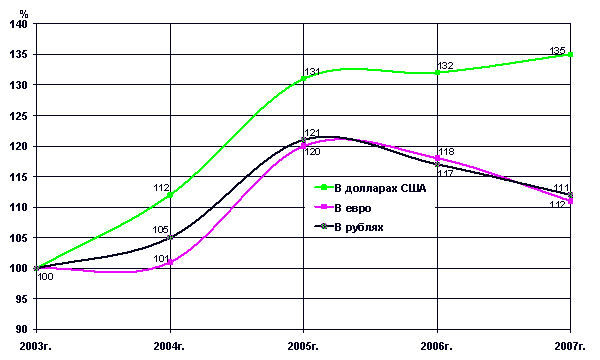
Fig. 2. Comparison of changes in diamond value in different currencies (green curve – USD; pink curve – euros; blue curve – roubles.)
From Fig. 2 it is clear that if the diamond value in USD after its sharp increase in 2003-2005 was still rising, it suffered a serious drop in euros and roubles. Thus, switching payments to euros or roubles on the background of this trend is utterly undesirable for the diamond-mining industry. If we take into consideration that the dollar drop in relation to other currencies may have reached its limit, then in the course of its consequent rise this move to other currencies may bring about additional losses for rough diamond suppliers.
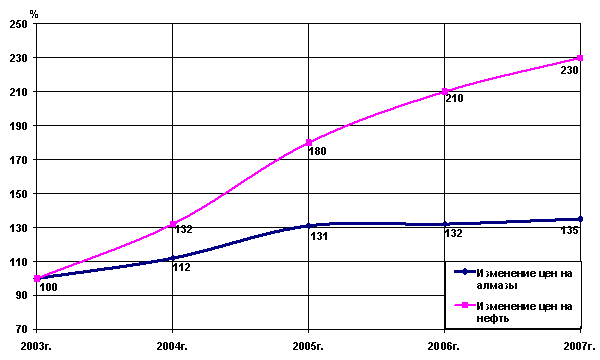
Fig. 3. Movement of prices for diamonds and oil (in USD) in 2003-2007
(blue curve - Movement of prices for diamonds;
pink curve - Movement of prices for oil).
In recent years, there occurred a fast growth of prices for mineral and energy resources. In 2003-2007, oil prices went up by 130% as compared with the 35% price rise for rough diamonds. The diamond mining costs due to the general complication of mining and geological conditions and accompanying increase of expenses for fuel and energy have experienced a significant rise. This, together with the growing shortage of rough diamonds, is expected to cause an inevitable surge of prices for diamonds in any currency.
This is why the problem of passing to other currencies in the diamond trade is devoid of any sense.
Yuri Danilov, Senior Research Fellow,
Department of Rough and Polished Diamonds Complex Economics,
Institute for Regional Policy of the North (Federal State Scientific Entity)
