Anglo American and De Beers
As a rule, the majority of mining industry experts engaged in research of diamond mining companies of the world keep under review De Beers only, unaware that it is just the visible part of the iceberg. Actually, it turns out that it is a certain part of Anglo American, the biggest mining holding established by Sir Ernest Oppenheimer in 1917. Starting off from a joint stock capital of one million pounds sterling raised in Great Britain and the U.S.A. (hence the holding’s name), the company won leading positions in 1920-1930 having implemented a range of significant projects in gold and diamond mining. In 1926, it became the largest shareholder of De Beers, a diamond company founded in 1888 by Cecil Rhodes, and from that time on it put under its control diamond mining and sales all over the world.
Anglo American
At present time, Anglo American is one of the world’s major versatile mining companies producing platinum, gold, diamonds, coal, ferrous and non-ferrous metals, and industrial minerals, as well as engaged in paper and package making. Diamond mining is only one of its businesses now reduced to 4.6% of its operating profit derived from basic activities (Table 1).
Table 1
Operating profit of Anglo American in 2005-2007 by businesses
USD million
|
Years |
Platinum |
Gold |
Diamonds |
Coal |
Non-ferrous metals |
Industrial minerals |
Ferrous metals and processing |
Paper and packaging |
Total of major businesses |
|
2005 |
854 12.6 |
332 4.9 |
583 8.6 |
1019 15.0 |
1678 24.7 |
370 5.4 |
1456 21.5 |
495 7.3 |
6787 100 |
|
2006 |
2398 23.4 |
467 4.6 |
463 4.5 |
864 8.4 |
3876 37.8 |
336 3.3 |
1360 13.3 |
477 4.7 |
10241 100 |
|
2007 |
2697 25.5 |
202 1.9 |
484 4.6 |
614 5.8 |
4338 41.1 |
474 4.5 |
1432 13.5 |
324 3.1 |
10565 100 |
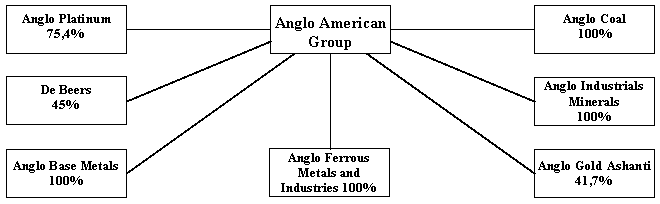
It is evident that such an organization pattern allows independence from a business in some single industry. Temporary decreases of profit in some industries are offset by its increases in others. The high degree of business diversification along with specialization in the mining industries permits this company to maintain successful competition with other major world companies. Consequently, Anglo American is a huge holding possessing interests in large-scale mining companies, including a 45% share of interest in De Beers (Fig. 1)
Fig. 1. Anglo American structure
De Beers
After re-organization of 2001, when De Beers was divided between the Oppenheimers (via the Central Holdings Group), Anglo American and the Government of Botswana, it turned into a private (closed) company owned by three shareholders. The company was then valued at USD17.6 billion and its shares were split as follows:
• Anglo American plc – 45% of stock;
• Central Holdings Group – 40% of stock;
• Government of Botswana – 15% of stock.
The currently existing pattern of the diamond business belonging to the De Beers Group is shown in Fig. 2. The company’s major performance and economic indicators for 2006-2007 are given in Tables 2 and 3.
Fig. 2. Diamond business pattern of De Beers.
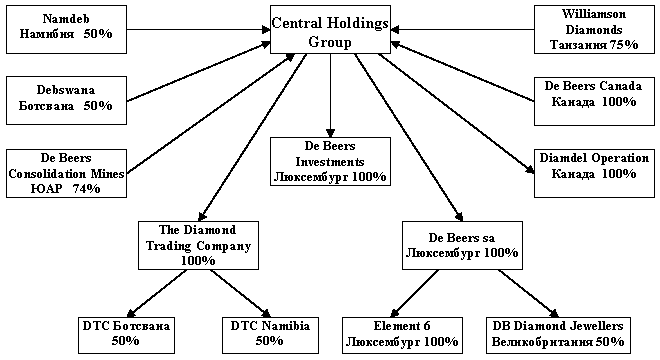
Table 2
Major performance and economic indicators of De Beers in 2006-2007
|
Denomination of indicators |
2006 |
2007 |
|
Proceeds, USD million |
7030 |
6836 |
|
Diamond sales, USD million |
6626 |
6422 |
|
Total profit, USD million |
1432 |
1375 |
|
EBITDA, USD million |
1232 |
1216 |
|
Net profit, USD million |
730 |
521 |
Table 3
Performance of De Beers’ diamond mining enterprises in 2006-2007
|
|
De Beers Consolidated Mines |
Namdeb |
Debswana
|
Williamson Diamonds
|
De Beers Canada |
Total |
|
Diamond output, thousand carats |
14 569 14 998 |
2 085 2 176 |
34 293 33 638 |
189 220 |
- 81 |
51 136 51 113 |
|
Processed ore, thousand tons |
32 610 29 586 |
25 356 24 224 |
33 735 35 612 |
2 963 3 205 |
_- 113 |
94 664 92 740 |
Note: 2006 is in the numerator; 2007 is in the denominator.
Yuri Danilov, Senior Research Fellow, Department of Rough and Polished Diamonds Complex Economy, Institute for Regional Economics of the North (Federal State Scientific Entity)
