The BHP Billiton Group was founded on June 29, 2001 by way of a merger between the Australian BHP Billiton Limited and the British BHP Billiton Plc. Legally, it consists of two companies, which have separate arrays of owners and are independently quoted at the stock exchange. At the same time, they are managed by two completely identical boards of directors and one control body. The Australian company owns 60% of the joint company’s business, while the British one owns about 40%.
Currently, BHP Billiton is the world’s biggest mining company extracting aluminum, coal, copper, manganese, iron ore, uranium, nickel, diamonds, silver and titaniferous minerals, as well as oil and natural gas. Its production units are located in 25 countries including Australia, Canada, Chile, Mozambique, South Africa, Pakistan, U.S.A. and others.
Thus, BHP Billiton is a transnational mega holding incorporating interests in large mining companies all over the world (Fig. 1). It is evident that this diversified portfolio of top quality assets ensures its higher stability and growth prospects independently of a business situation in a single industry. Temporary decreases of profit in some industries are offset by its increases in others. The high degree of business diversification along with specialization in the mining industries permits this company to maintain its leading position among other major world companies.
The company’s manpower reached 39 000 workers. Its proceeds in 2007 amounted to USD 47.5 billion and its net profit was USD 13.7 billion. The company’s capitalization as of beginning of 2008 was USD 173 billion. The company’s major performance and economic indicators for 2005-2007 are given in Tables 1 and 2.
Fig. 1. BHP Billiton structure.

Table 1
Major performance and economic indicators of BHP Billiton in 2005-2007
|
Denomination of indicators |
2005 |
2006 |
2007 |
|
Proceeds, USD million |
31 150 |
39 099 |
47 473 |
|
EBIT, USD million |
9 921 |
15 277 |
20 067 |
|
Net profit, USD million |
6 426 |
10 154 |
13 675 |
The reporting year ends on June 30 of the appropriate calendar year.
Table 2
Operating profit of BHP Billiton in 2005-2007 by businesses
USD million / %
|
Years |
Aluminum |
Base metals |
Diamonds and specialty products |
Energy coal |
Manganese |
Iron ore |
Metallurgical coal |
Petroleum |
Alloy products |
Total of major businesses |
|
2005
|
4651 15.3 |
5043 16.6 |
1509 5.0 |
3842 12.6 |
1439 4.7 |
3382 11.1 |
2776 9.1 |
5515 18.1 |
2274 7.5 |
30431 100 |
|
2006
|
5084 13.2 |
10294 26.7 |
1263 3.3 |
3965 10.3 |
1037 2.7 |
4782 12.4 |
3941 10.2 |
5230 13.5 |
2955 7.7 |
38551 100 |
|
2007
|
5879 12.4 |
12635 26.7 |
893 1.9 |
4576 9.7 |
1244 2.6 |
5524 11.7 |
3769 8.0 |
5885 12.4 |
6901 14.6 |
47306 100 |
The reporting year ends on June 30 of the appropriate calendar year.
As seen from Table 2, diamond mining is not one of the major businesses of BHP Billiton and currently yields less than 2% of the operational profit in its basic businesses. Diamond mining is performed from 1998 in the Ekati Mine located 200 kilometers south of the Arctic Circle in the North-West Territories of Canada and based on two diamond fields (Fig. 2). From December 2007, there started underground development of the Koala Kimberlite pipe. BHP intends to bring the enterprise to its full operating capacity – 3 300 metric tons a day - by mid-year 2009. The Koala mine will recover a total of 9.8 million carats of diamonds over an 11-year period. BHP approved this project in mid-2006 having invested USD 220 million.
Since natural environment and development methods of Canadian and Yakut diamond fields are similar, the diamond mining experience of BHP Billiton may be of interest to the Russian diamond industry experts.
Fig. 2. Diamond business pattern of BHP Billiton.
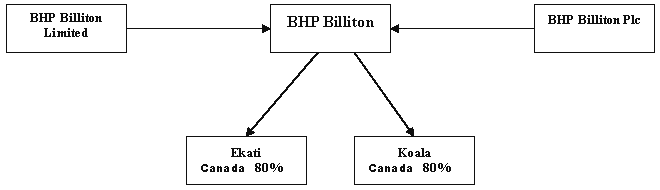
Table 3
Diamond mining performance of BHP Billiton in 2005-2007
Thousand carats/ USD million
|
|
2005 |
2006 |
2007 |
|
Diamond mining |
3617 700 |
2 515 622 |
3 665 521 |
The reporting year ends on June 30 of the appropriate calendar year.
Yuri Danilov, Senior Research Fellow, Department of Rough and Polished Diamonds Complex Economy, Institute for Regional Economics of the North (Federal State Scientific Entity)
