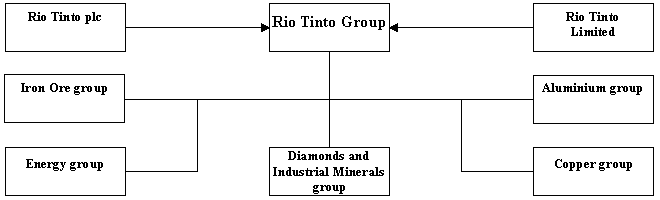
Rio Tinto, an Australian and British concern, established in 1873, is the second largest transnational mining group. It is an amalgamation of Rio Tinto plc and Rio Tinto Limited managed from Melbourne and London. Structurally, Rio Tinto is similar to BHP Billiton and also holds interests in a range of large-size mining enterprises (Fig. 1). This similarity in organizing business is evidently playing a certain role in the attempted acquisition or merger lately aggressively carried out by BHP Billiton in relation to Rio Tinto.
Fig. 1. Rio Tinto structure.
Rio Tinto is the world’s leading company in the field of geological exploration, extraction of commercial minerals and their beneficiation. It mines iron ore (2nd place), coal (4th place), copper (4th place), gold (5th place), aluminium (7th place), as well as a range of non-metallic minerals (diamonds, uranium, borates, salts, talc, and others). A high degree of business diversification along with simultaneous specialization in mining industries permits the company to hold a leading place among the world’s largest companies. As of the beginning of 2008, Rio Tinto’s capitalization reached USD 136 billion. The company’s major performance and economic indicators for 2005-2007 are given in Tables 1 and 2.
Table 1
Major economic indicators of Rio Tinto in 2005-2007
|
Denomination of indicators |
2005 |
2006 |
2007 |
|
Proceeds, USD million |
20 742 |
25 440 |
33 518 |
|
EBIT, USD million |
7 301 |
9 912 |
10 517 |
|
Net profit, USD million |
5 215 |
7 438 |
7 312 |
Table 2
Operating profit of Rio Tinto in 2005-2007 by businesses
USD million / %
|
Years |
Iron ore |
Copper |
Diamonds and industrial minerals |
Energy raw materials (coal, uranium) |
Aluminium |
Others |
Total of major businesses |
|
2005
|
1722 31.6 |
1987 36.4 |
438 8.0 |
730 13.4 |
392 7.2 |
186 3.4 |
5455 100 |
|
2006
|
2251 28.5 |
3538 44.9 |
406 5.1 |
706 8.9 |
746 9.5 |
241 3.1 |
7888 100 |
|
2007
|
2651 30.4 |
3479 39.9 |
488 5.6 |
484 5.5 |
1097 12.6 |
526 6.0 |
8725 100 |
It is evident that diamond mining is not the primary business of Rio Tinto and currently it yields about 5% of the operational profit in the company’s basic businesses.
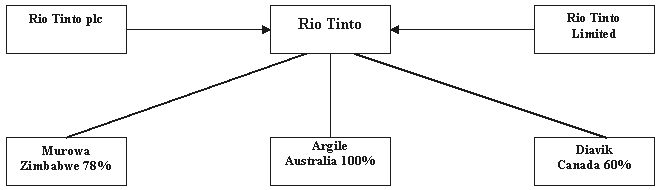
The company is engaged in diamond mining operations in the diamond fields of Australia, Canada and Zimbabwe (Fig. 2).
Fig. 2. Diamond business pattern of Rio Tinto.
In recent years, Rio Tinto’s diamond output decreased to a significant extent due to the depletion and increased depth of the quarries under development (Fig. 3).
Table 3
Diamond mining performance of Rio Tinto in 2005-2007
Thousand carats/ USD million
|
|
Murowa |
Argile |
Diavik |
Total |
|
2005 |
0.195 44 |
30.476 572 |
4.963 460 |
35.635 1076 |
|
2006 |
0.187 33 |
29.087 345 |
5.897 460 |
35.162 838 |
|
2007
|
0.113 25* |
18.744 345* |
7.166 650* |
26.023 1020 |
* Author’s estimation.
In 2008, the Australian Argile mine will continue open mining, but at the same time it will switch over to underground mining methods, which will extend its operation life up to 2018. In 2009-2010, underground mining operations will be launched at the Argile mine and at the Diavik mine in Canada. In Zimbabwe, diamond mining in the Murowa field was started in the end of 2004 after the completion of a beneficiation factory with a rated capacity of 200 000 tons per year, but the complicated political situation inside the country, hyperinflation and disruptions in electric energy supply brought the output down to a total of 145 000 carats in 2007.
On the whole, Rio Tinto’s diamond business is currently experiencing a natural drop in the diamond output, which is being leveled in terms of price by the growing demand and, correspondingly, by prices for rough diamonds. In the first quarter of 2008, the company’s output was 3 296 million carats (a 24% decrease compared with the similar period of 2007).
Yuri Danilov, Senior Research Fellow, Department of Rough and Polished Diamonds Complex Economy, Institute for Regional Economics of the North (Federal State Scientific Entity)
