Innovative processes facilitate qualitative changes leading to higher production efficiency which provide for greater competitiveness of an enterprise particularly important in a globalized economic environment. For an export-oriented industry, such as diamond mining has always been, competitiveness is the decisive factor and the urgency of innovations is evident, since it is instrumental to successful business under current conditions. Thus, evaluation of innovative activities in the diamond-mining industry is a burning problem, which, if solved, will bring about higher efficiency and define its development tack.
However, the absence of hard-bitten methods for evaluating innovative processes and the qualitative indicators describing them does not permit to speak without bias about the influence of innovations on general economic indicators of an entity being examined. There are often and numerous writings in recent economic literature about innovations without any exact measurements of innovative activities. As a rule, studies on this subject use monitoring methods of evaluation. This basis allows only general conclusions and recommendations and their results cannot be employed in perspective planning at enterprises.
There has been done a comprehensive analysis of innovative activities in the diamond-mining industry performed by its authors on the basis of ZAO AK ALROSA, a key enterprise in the industry producing 72% of diamonds (97% including its subsidiaries) and employing advanced techniques in mining and management engineering. The input data for analysis have been taken from the company’s reports for 2000-2007 (see Table 1). Out of these, there have been selected economic indicators related to innovative activities. The latter provided the basis for calculating returns on assets, capital investment percentage for retooling as well as production costs for geological exploration and scientific research.
Table 1
Engineering and Economic Performance Indicators Describing ALROSA’s Innovative Activities in 2000-2007
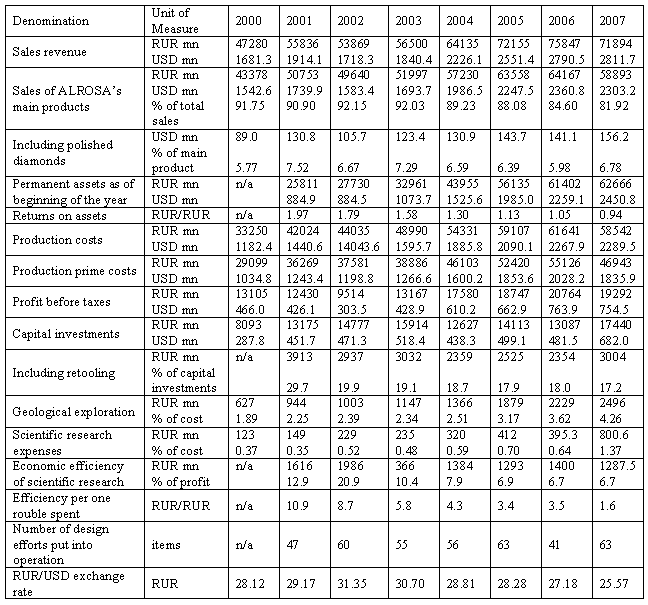
For greater visualization, the above data have been used to draw up dependency curves of some indicators, which are utterly determinative for the company’s innovative activity (see Fig. 1, 2).
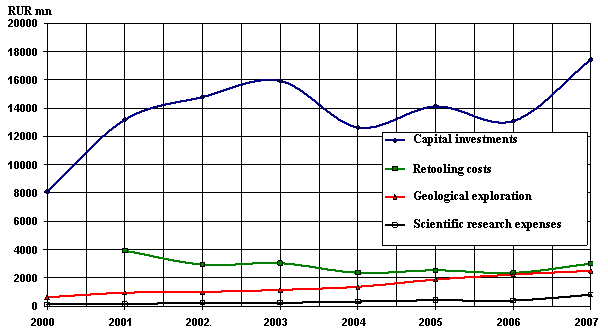
Fig. 1. ALROSA’s cost movement in 2000-2007.
The analysis of ALROSA’s cost movement allows the following conclusions:
1. The decrease of capital investments and expenses for the company’s retooling in 2003-2006, which was leveled only in 2007, may be implicitly indicative of a lower-level innovative activity practiced by the company in recent years. There is also a possibility that the capital investment peak points in 2003, 2005 and 2007 are tied to the company’s large-scale transition to underground diamond mining.
2. The continuous growth of expenses for geological exploration and scientific research work may be viewed as a positive factor of innovative development.
Other factors should also be taken into account to give final evaluation of ALROSA’s innovative activity (Fig. 2).
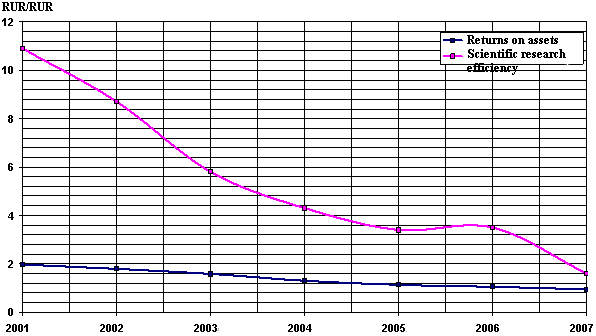
Fig. 2. Variation of ALROSA’s returns on assets and scientific research efficiency in 2000-2007.
Despite the growing scientific research expenses, their efficiency has been continuously decreasing along with returns on assets. The decreased number of engineering design efforts put into operation and a downtrend in economic efficiency of recent engineering design efforts is evidently connected with natural attrition of highly qualified personnel, which particularly affects the scientific field and consequently innovative development of the enterprise proper.
Conclusions and recommendations:
1. For a competitive way of development with a view to the ongoing cardinal changes on the world diamond market, ZAO AK ALROSA should further pay special attention to innovative development. The more so, because the comprehensive analysis of its indicators for 2001-2007 points to a lowered level of innovative activity of this enterprise.
2. The management of the company will probably have to review its strategy of long-term development. This is particularly pressing amid the evolving financial crisis, which has already begun to impact the integral parts of the diamond business, including diamond sales.
Yuri Danilov, Senior Research Fellow, Department of Rough and Polished Diamonds Complex Economy, Institute for Regional Economics of the North (Federal State Scientific Entity)
