Up to now, there are no persuasive hypotheses explaining the origin of primary diamond deposits. The first thing you read in experts’ works published on the subject is that of explosion pipes. Since the formation and growth of diamonds occurs under great pressure and geologically during a long period of time (millions of years) no explosion can be conceded on this basis. In an explosion the pipe material would be burst out and could not be preserved as a cone-shaped pipe. Moreover, diamonds would then be found in extinct volcano craters, which is not proved by practice. Reflecting on this subject the author of this article came across a hypothesis, which is offered to experts in the hope it may help in their further research.
In the process of the Earth’s formation, when the Earth’s crust cooled down on the edge bordering the mantle there were and probably are formed magma incursions, which have a natural cone shape (like an inverted pipe). While these incursions melting the appropriate layers of the Earth’s crust are cooled down there occurs formation of diamond crystals and associated minerals in a high pressure environment (Fig 1).
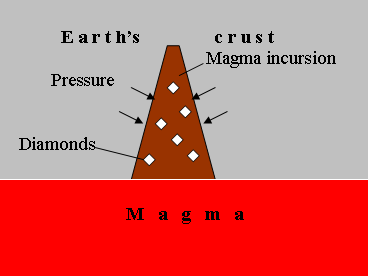
Fig.1. Diamond crystallization pattern.
Further deposit formation is connected with facts, which are known to science. It is common knowledge that the Earth’s early history was marked by cataclysms of a cosmic scale, when this planet was hit by enormous asteroids. As a result, the Earth’s crust plates went split, some of them capsized capturing huge masses of ocean water together with the then existing flora and fauna. Besides, such collisions produced tremendous amounts of energy, which melted the Earth’s crust. In the aftermath, solid fragments, including diamond pipes, could “float” in the sea of magma for some time. Due to the established laws of physics, such a diamond pipe cone was to roll over to gain balance and when the melted area of the Earth’s crust cooled the ongoing process produced Kimberlite pipes (Fig. 2).
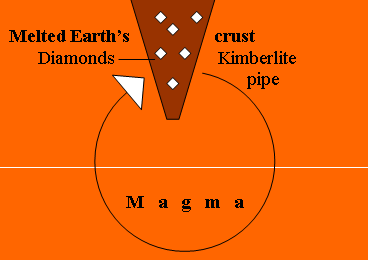
Fig.2. Pattern of primary diamond deposit formation.
Such a substantiation for the origin of diamond deposits permits to furnish answers to many problems obscure to this day and to explore for diamonds consciously.
According to modern perceptions, the Earth’s lithosphere consists of solid moving plates shifting over the mantle. Modern geology uses the term of subduction meaning the process when one tectonic plate moves under another sinking into the mantle for hundreds of kilometers. However, subduction even followed by reduction (this is the author’s term), i.e. by possible reverse movement of the plate does not explain many facts known today. According to the author’s hypothesis, when plates moved one onto another forced by a global cataclysm they were split and mixed with magma and gigantic masses of ocean water. This is confirmed for instance by the sensational discovery of Michael E. Wysession, Professor at the Washington University, of a vast water reservoir in the mantle beneath the eastern part of Eurasia at a depth of roughly one thousand kilometers – an underground ocean.
Formation of mineral deposits was going due to alternating global natural cataclysms followed by long periods of evolutionary development equal to geological eras. Their location and distribution across the continents resting on tectonic plates correspond to their initial location on the ancient continents to a significant extent. Therefore, exploration for new diamond deposits may be performed along the established deposits discovered earlier.
Yuri Danilov, Senior Research Fellow, Department of Rough and Polished Diamonds Complex Economy, Institute for Regional Economics of the North (Federal State Scientific Entity)
