Lately, cluster-based economic development is turning into an alternative strategy in the regional policy of Russia. Yakutia’s President Vyacheslav Shtyrov presenting the “Schedule of Complex Development of Productive Forces, Energy and Transport in the Republic of Sakha (Yakitua) up to 2020” to the Russian government stressed the need for a cluster approach. This approach should have been used as an underlying strategy for efficient deployment of resources used for regional development and industrial diversification.
The diamond cutting industry includes a network of diamond cutting enterprises located in the republic and Brillianty ALROSA, a subsidiary of ZAO AK ALROSA. In the first years of its existence in the early 1990s, the diamond cutting industry displayed a wonton growth, which was first and foremost due to the support rendered by the state. At that time, diamond-cutting factories were established across the whole republic without the required attention to their personnel needs, marketing policy and management. The cardinal changes taking place in the world diamond business on the verge of the millennium did not skirt the diamond cutting industry of the republic. In that period the government developed a target-oriented program called “Development of Jewelry and Gem Processing Industry in the Republic of Sakha (Yakutia) in 2002-2006.” This program, which could be considered a strategy for developing the diamond cutting industry in the mentioned period, did not foresee any changes on the rough diamond market, which were evident due to aggravated competition. Rough diamonds went up in price, the growth being 39% in 2002-2005, whereas polished prices increased merely 5-10%. Besides, while drawing up the program, the U.S. currency rate was assumed as having an upward trend only, which later on turned out to be a serious error. On the contrary, in 2002 it started to drop going down up to this day.
However, besides the objective reasons there came in subjective reasons: many enterprises of the industry having spent some time in a “hothouse” environment appeared unprepared to higher competition and a radical change in the market situation. Many of them were brought on the brink of bankruptcy by inapt strategic management and marketing policy. At the turn of two centuries there was an abrupt reversal: if in the beginning of 2000 there were over 30 operating factories, by the end of 2008 there remained just 23. The highly competitive medium of diamond-cutting business will bring about further retrenchment of diamond-cutting enterprises in the republic.
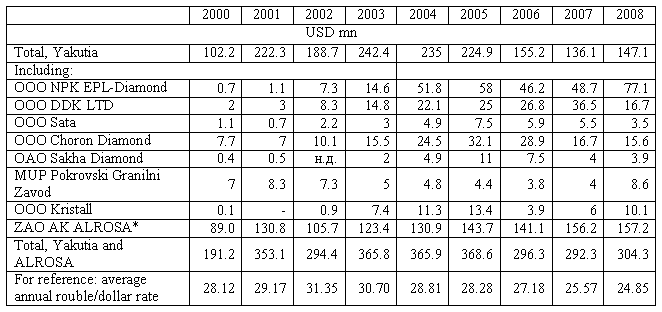
Table 1 shows diamond-cutting industry output and sales in 2000-2008.
Table 1
Polished diamonds produced by diamond-cutting enterprises of Yakutia and ALROSA in 2000-2008
According to Yakutia’s Ministry of Industry and ALROSA’s annual reports
As is seen from the table, the diamond-cutting industry of the republic reached the peak of its development in 2003-2005, which was due to remunerative market for rough and polished diamonds. This was followed by a slump. Excluding the continuous growth in ALROSA’a polished diamond output (Table 2) it may be said that Yakutia faced decline in polished diamond production as far back as 2003.
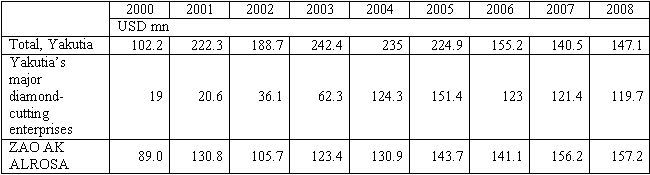
Since the current rugged competition on the domestic market let the survival of the most competitive companies in the industry this will help in their further successful operation on the outer markets as well as facilitate effective development of the Rough and Polished Diamond Cluster. This may be illustrated by comparing performance of Yakutia’s diamond-cutting companies with that of ALROSA’s (Table 2, Fig. 1).
Table 2
Polished diamond output by major diamond-cutting enterprises of Yakutia and ALROSA in 2000-2008
According to Yakutia’s Ministry of Industry and ALROSA’s annual reports
The table and diagram above are a good proof that the scale of diamond cutting in ALROSA is continuously expanding, while the republic’s diamond-cutting industry is in a systemic crisis. The local government’s Institutional Target-Oriented Program for Development of Diamond-Cutting and Jewelry Industry in the Republic of Sakha (Yakutia) in 2007-2009 will evidently go flop due to the global economic crisis as was the case with the previous similar program.

Fig. 1. Polished diamond output in the Republic of Sakha (Yakutia) as well as by Yakutia’s major diamond-cutting enterprises and by ALROSA in 2000-2008.
Yakutia’s government continues to pay special attention to developing diamond cutting in the republic. OAO Nizhne-Lenskoye and six diamond-cutting enterprises are to be the basis for a holding having a vertically integrated structure including diamond mining, processing and sales of diamond jewelry. Currently, a feasibility study is underway to set up a special economic zone to manufacture jewelry and polished diamonds in the City of Yakutsk for the amount of $500 million with a possible participation of German companies in the project. Further aggravation of competition in the diamond-cutting industry heated up by similar programs being fulfilled in some of the African countries should be taken in account while implementing the above mentioned plans. The experience with the previous Program is to be considered as well.
The new strategy of developing the republic’s diamond-cutting industry is currently determined by the institutional target-oriented program called “Development of Diamond-Cutting and Jewelry Industry in the Republic of Sakha (Yakutia) in 2007-2009.” The goal of the new program is to create economic, social and legal conditions to stabilize and develop the diamond-cutting industry as one of the promising export-oriented fields in Yakutia’s economy. The Program for jewelers and diamond cutters pursues the following basic tasks:
- to expand the Russian jewelry sales market reaching out to foreign markets via participation in specialized and international jewelry exhibitions and by way of promoting the brand of “Jewelry and Diamonds of Yakutia”;
- to increase jewelry production and consequently jewelry sales beyond Yakutia.
In our opinion, cluster-shaped development of the diamond industry as a whole may be a way out to solve its problems. It should be taken into consideration that with the global crisis affecting the world’s diamond industry the cluster approach may not only help to avoid a crisis in the Rough and Polished Diamond Complex of Russia, but will further on give an opportunity to become a world leader in the global diamond business.
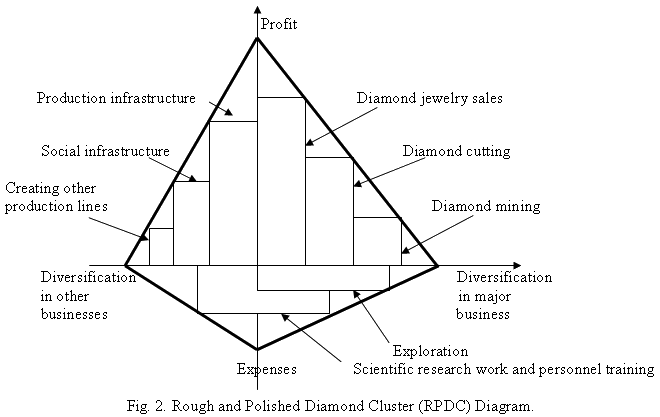
Under present conditions, Yakutia’s diamond-cutting enterprises should closely cooperate with diamond-mining companies on the basis of cluster approach. The Rough and Polished Diamond Cluster (RPDC) is a group of interconnected diamond enterprises and companies and associated organizations in the field of diamond mining and cutting and diamond jewelry sales, as well as public and scientific institutions and state bodies planning and coordinating their activities in pursue of one goal, which is higher competitiveness of the cluster’s products based on synergistic effect. The cluster is characterized by the solidarity of purpose among its complementary participants which allows them to be active on international diamond jewelry markets where they can get maximum profit form diamond sales.
The diamond-mining and diamond-cutting industries should become the backbone of RPDC. The diamond-mining industry is represented by ZAO AK ALROSA along with its two subsidiaries, OAO ALROSA-Nyurba and OAO Almazy Anabara, as well as by OAO Nizhne-Lenskoye and characterized by the greatest level of stability and the smallest level of competition.
ZAO AK ALROSA as the most competitive company on the world market may be considered to be the core of RPDC. Besides the ALROSA Group, the cluster should include OAO Nizhne-Lenskoye as well as the social and production infrastructure of the region and Yakutia’s diamond-cutting enterprises (see Fig. 2).
Yuri Danilov, Senior Research Fellow, Department of Rough and Polished Diamonds Complex Economy, Institute for Regional Economy of the North (Federal State Scientific Entity)
Nikolai Konstantinov, Junior Research Fellow, Department of Rough and Polished Diamonds Complex Economy, Institute for Regional Economics of the North (Federal State Scientific Entity)
