The past year, 2008, in the history of the world’s two biggest mining companies will be remembered not so much due to record-high annual economic results, but because of their luckless attempt of merger. The similarity of their organizational frameworks could permit Rio Tinto and BHP Billiton to transform into a transnational mega-group bolstering their in any case leading position in global output of iron ore, copper and aluminum, in production of metallurgical and energy coal, as well as in turning out other types of raw minerals, including diamond mining. A united BHP-Rio Tinto featuring a $350-billion worth share capital could become the world’s third-biggest company in terms of value being inferior in this respect only to Exxon Mobil and General Electric. However, the initial refusal of Rio Tinto to merge followed by a slump in prices for raw materials in the second half of the year due to the world financial crisis finally resulted in aborting the biggest ever merger.
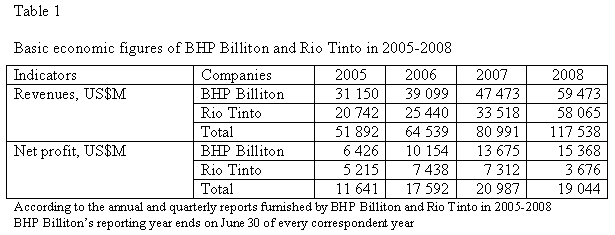
Below the basic production and economic figures of BHP Billiton and Rio Tinto in 2005-2008 are grouped together to illustrate how the merged mega-company could look like (Table 1).
Tables 2 and 3 display how operating incomes of BHP Billiton and Rio Tinto were distributed between the basic commodities they produced in 2007-2008.
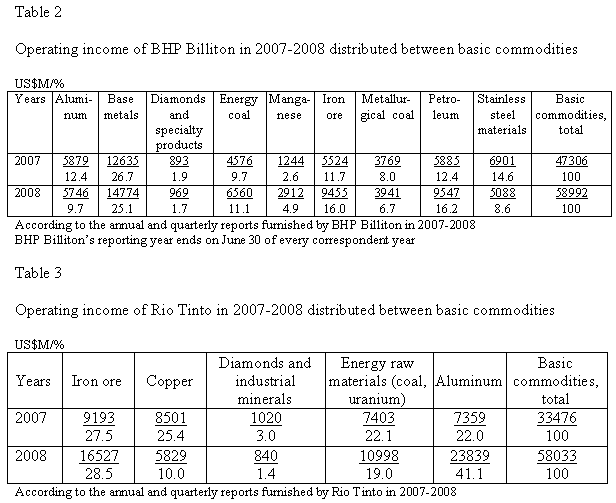
As is seen from the above tables, diamond mining for BHP Billiton and Rio Tinto is not the primary business and it brought less than 2% of the operating income from all the major businesses of these mining companies. Still it should be said that in case of their merger the BHP-Rio Tinto Group could become a serious competitor to ALROSA and De Beers both in their financial results and in physical diamond output (Table 4).
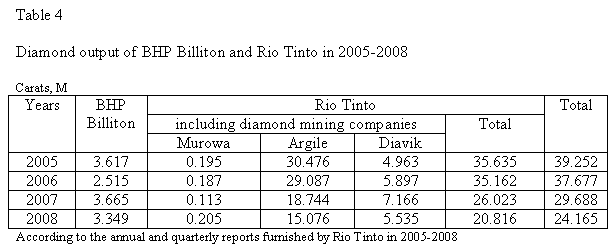
In 2008 there was an 8.6% decrease in BHP Billiton’s diamond output due to the start of underground mining on the Koala kimberlite pipe in
The diamond business of Rio Tinto in 2008 continued its natural decline caused by impoverishment and deepening of quarries as well as by transfer to underground mining in the company’s major diamond fields, which was to a certain extent leveled off by prices for rough diamonds. Rio Tinto plans to commence underground mining in the Argile and Diavik diamond fields in
Thus, there is a clear evidence of a general crisis in the world diamond industry, which will result in decreased diamond output by all the major diamond mining companies. In this connection it is expected that average prices for rough diamonds will remain at their earlier level.
Yuri Danilov, Senior Research Fellow, Department of Rough and Polished Diamonds Complex Economy, Institute for Regional Economics of the North (
