Diamond mining performance figures reported by major global companies in the first six months of 2009 are compared with those posted in 2008 in Table 1.
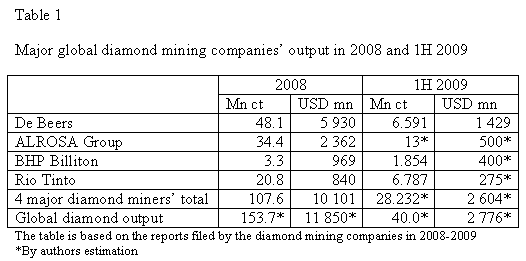
The table reflects the state of general crisis in the world diamond industry resulting in decreased diamond output by the world’s leading diamond miners. This may bring the average price of rough diamonds on the world market to its pre-crisis level.
In the first half of 2009 the four pace-setting producers of rough diamonds accounted for more than 90% of the total worth of rough mined in the world and for 70% of its physical output. In the first half of 2009, ALROSA’s output of rough diamonds equaled to 32.5% in physical terms and 18.0% in terms of value; that of De Beers – 16.5% in physical terms and 51.5% in terms of value; that of BHP Billiton and Rio Tinto – 4.6% and 14.4% in physical terms and 17.0 and 9.9% in terms of value.
BHP Billiton and Rio Tinto
BHP Billiton and Rio Tinto were the first two major diamond miners to post their results in the first six months of 2009. Their business diversification and structural identity permit to display their performance indicators in one pattern. BHP and Rio Tinto are significantly lagging behind their main competitors, ALROSA and De Beers, in their financial results and physical output of rough diamonds (Fig. 1 and Table 2).
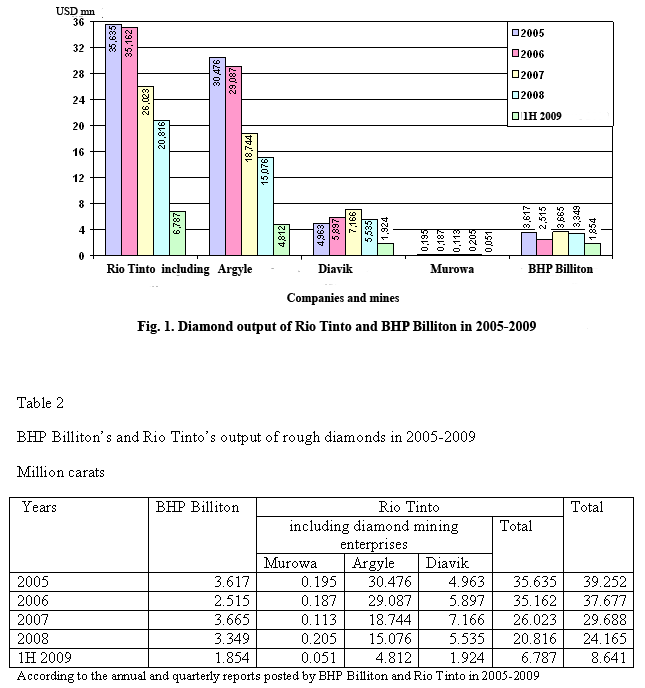 In the first six months of 2009 BHP Billiton’s diamond output even somewhat rose due to putting the underground mine in the Koala Mine Field (Canada) into full-scale operation. The slumped demand for rough diamonds has so far produced no effect on BHP’s diamond mining which may produce 3.6 million carats of diamonds this year.
In the first six months of 2009 Rio Tinto registered a continuing slowdown in its diamond business which was especially weak in the second quarter of the current year. This was the result of the global economic crisis, which made the company suspend operations in its major enterprises from March to May. Besides, the slowdown was also caused by lower content of diamonds in the ore and by deeper development of quarries as well as by transition to underground mining at Argyle and Diavik in Canada. In Zimbabwe, at the Murowa Mine Field diamond output decreased to 51,000 carats in the first half of 2009. The total amount of diamonds produced in the first six months of 2009 was 6.787 million carats (less by 28.5% compared with one year ago). Due to the world crisis Rio Tinto’s diamond output in 2009 may drop to 15 million carats.
These companies’ sales in this year also dipped in a significant way. According to FT (FT Global 500 March 2009), BHP Billiton’s annual sales amounted to $118.2217 billion (a 32.6% drop) and Rio Tinto’s sales reached $51.5906 billion (a 66.7% drop).
Yuri Danilov, Senior Research Fellow, Department of Rough and Polished Diamonds Complex Economy, Institute for Regional Economics of the North (Federal State Scientific Entity)
