Russia’ international (gold and foreign exchange) reserves, which were continuously growing from 2000 and on 08.08.2008, by the time the crisis started to affect its national economy, were fixed at a record level of $598.1 billion, are an important factor of stability in the Russian economy. Having such a great amount of financial reserves Russia has virtually not invested them in its own economy but instead rendered an indirect assistance to the economies of the United States and Eurozone investing its reserves into dollars, euros and securities of these countries. On the other hand, Russia has spent much effort to attract foreign investments.
Earlier I have noted that the international reserves of the Russian Federation were mainly composed of foreign exchange assets (over 70%). Their remaining part was in deposits of monetary gold, special drawing rights, IMF reserve and other reserved assets. Russia occupied the tenth place among other countries by the amount of gold in its gold and foreign exchange reserves.
In the period of economic growth it would have been more logic to allocate funds taken from the country’s international reserves for large-scale strategic investment projects via a government-owned financial corporation.
Besides, it would have been reasonable to increase the gold part in the reserves (up to 4-5%) since the price of gold during recent years was continuously rising. It would also have been expedient to use some part of these reserves for purchasing diamonds and other gems from mining companies [1].
The economic crisis has drastically changed this state of things. The Russian government was forced to use the accumulated reserves to prevent the country’s economy from collapse. By mid-March 2009, Russia’s gold and foreign exchange reserves dropped to their minimal level - $376.1 or by 37%. Nevertheless, by its international reserves Russia was on the third place in the world as of 31.03.2009 making way only to China and Japan. According to the World Gold Council, as of March 31, 2009 all the countries accumulated in their reserves $5,135.0 billion or 7.4% of the global GDP by purchasing power parity in 2008 (Table 1) and 26,355.5 tones of gold or 10.5% of the total amount of their gold and foreign exchange reserves.
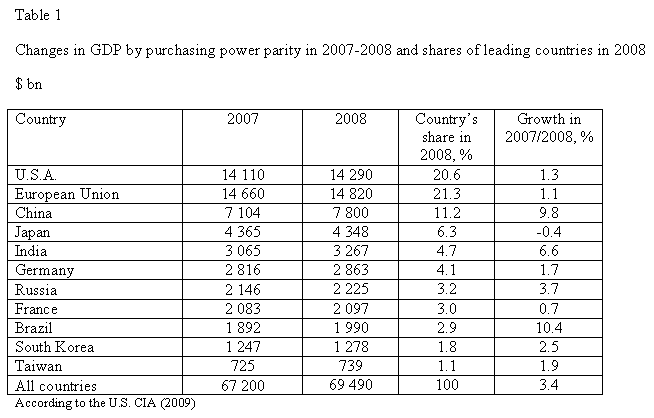 The world financial crisis resulted in a major abridgment of gold and foreign exchange reserves in all the countries of the world and changed their structure. Every country has different proportions of monetary reserves and its main aim was to preserve them and increase their value (Table 2).
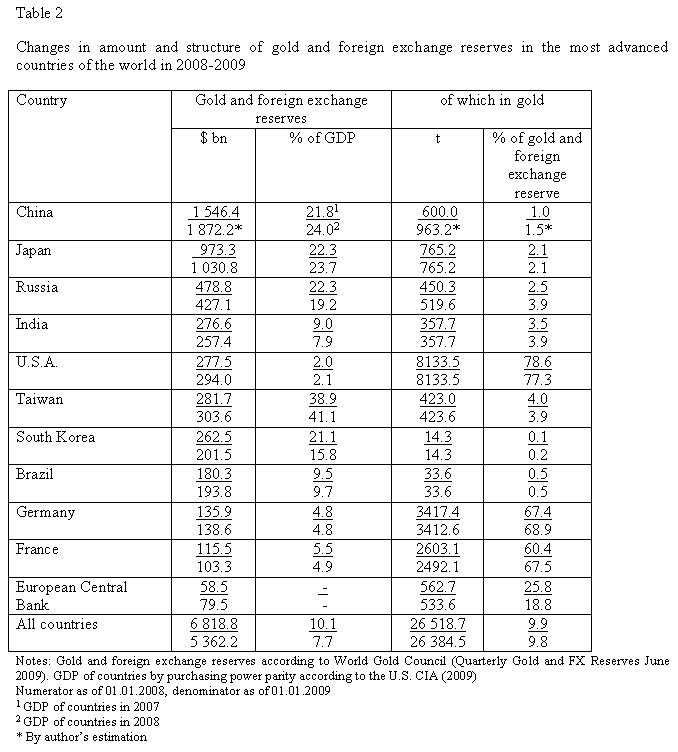 The above table gives ratios of gold and foreign exchange reserves to GDP by purchasing power parity in the world’s most advanced economies according to the U.S. CIA (Table 1). Their analysis shows that if before the crisis gold and foreign exchange reserves in countries were on the average one tenth of the GDP and almost one tenth of these was gold, during the crisis these reserves decreased to 7.7% of the GDP, while their gold part virtually did not change in amount and share.
Since the Russian economy to a great extent depends on export of raw materials, including mostly fuel and energy products, its indicators, the amount of international reserves among them, are mainly influenced by oil prices (Fig. 1).
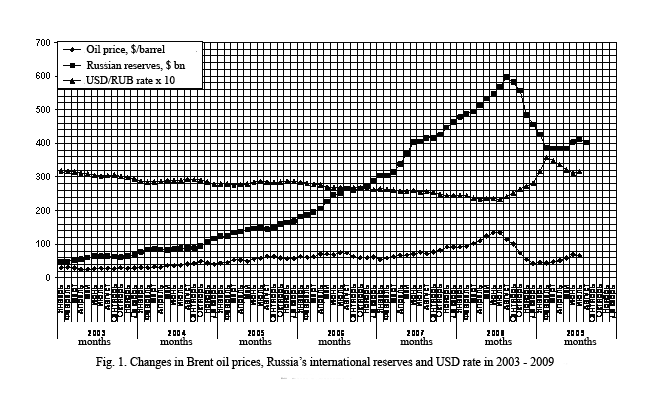 The above diagram is graphically demonstrating the direct dependence between Russian international reserves and oil prices. From May 2009 when oil prices started to climb, Russia’s international reserves also went up. It is also obvious that growing oil prices stipulate a stronger rouble rate.
Yuri Danilov, Senior Research Fellow, Department of Rough and Polished Diamonds Complex Economy, Institute for Regional Economics of the North (Federal State Scientific Entity)
