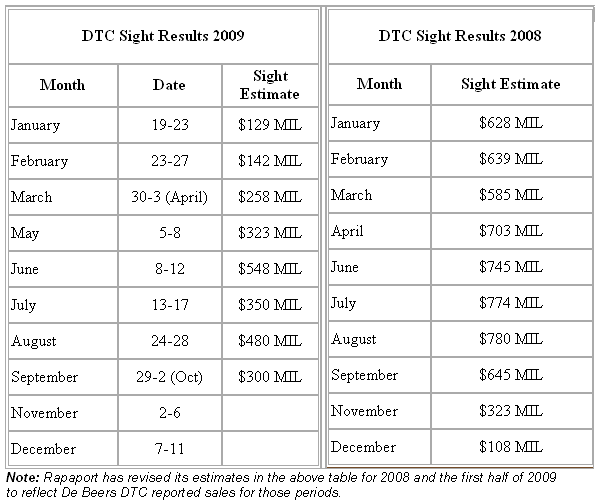
The Diamond Trading Company (DTC) September sight ended Friday with an estimated value of $300 million as the rough market remained somewhat upbeat, relative to polished, despite the decline in sales, RAPAPORT reported. The value represented an estimated 38 percent drop in sales from August, and was 53 percent below the September 2008 sight estimated amount.
Sight participants reported little change to DTC prices and assortments. There was no ex-plan and no additional sales made during the week. Similar trends were observed during Rio Tinto's sight in September, although a slight price increase was reported.
Market Paradox
“There is demand for rough at the moment but no one seems to know why, because the polished hasn’t followed,” said one Rio Tinto ‘Select Diamantaire.’ A DTC sight participant defined a “paradox” in the market, which people cannot explain as the polished market lagged behind rough in terms of sales and prices.
Most manufacturers who spoke with Rapaport News pointed to the recent September Hong Kong Gem & Jewelry Fair where there was strong price resistance from the polished market. The show fell short of seller expectations, despite busy visitor traffic, and profit margins remained low.
While the rough to polished price gap has created some nervousness in the market, a DTC sight participant noted that the uncertainty has been less than expected. “I think there is some equilibrium as people are moving some polished and they are therefore buying rough,” he said.
DTC spokesperson Louise Prior reported that there were strong applications for rough ahead of the September sight adding that “it seems that there is a building confidence in the market.”
Less Enthusiasm
One manufacturer noted, however, that while there was a willingness to buy rough, DTC sightholders bought the goods with less appetite this month. “Their enthusiasm to buy has dropped since the last sight as there is no profit on goods at the moment,” he said.
Similarly, an independent South Africa-based rough tender facilitator reported some declines for demand and price in the market at a tender he hosted on September 21, compared with two others held within the preceding month. “As signs developed that economies were moving out of recession, it seems to me that there was an over-enthusiastic response by rough dealers,” he said, explaining the previous increases.
While the facilitator reported a 5-to-10 percent decline in prices, at the latest South Africa sale, after an approximate 10 percent rise at each of the two previous sales, it appeared that prices set by the mining companies have not followed suit. Reports from BHP Billiton and Rio Tinto tenders at the end of September indicated an approximate 3-to-5 percent increase in their respective prices. Sightholders conceded that DTC prices were “within the market range,” but that premiums remained small. The price increases and relative demand for rough led one Rio Tinto ‘Select Diamantaire’ to forecast a softening of prices in the coming months. “I just feel the rough market is a bit too aggressive at the moment,” he said.
What’s Driving Demand?
Sightholders reasoned that demand is being driven by more liquidity in the market, and due to depletion of old stock they couldn’t sell in the first two quarters. Some cautioned, however, that the market is playing to speculators again.
“I feel that an artificial bubble is being created in rough as the miners have a lot of goods and are restricting supply to create some excitement in the market,” said a DTC sightholder. “The market is not booming, but they are restricting supply.”
“There is demand at a price but polished hasn’t followed. So in the rough market, the speculators are playing along again while the cautious are standing aside,” he added.
Supply Restrictions
Manufacturers reported some shortages at DTC in September. Prior confirmed this too, adding that any shortfalls in the current intention to offer (ITO) will have been resolved by the end of the ITO period, as new supplies begin to flow in from the mines. DTC reportedly told sightholders that the remaining two sights of the year would also be smaller and without ex-plan.
Sightholders felt that DTC is keeping the sights small as a result of lower De Beers mine production but also as part of the company’s strategy to keep up demand. De Beers led the way among the major diamond mining companies to respond to the economic downturn by limiting production to align with the fallen demand. As evidenced from the September sight, most agreed that demand currently outstripped supply, even as sales fell.
To counter this, and as their forecasts have improved in the third quarter, the mining companies have slowly increased production - De Beers recently cancelled a planned December shutdown of its Snap Lake mine, after Harry Winston and Rio Tinto did this at Diavik mine. However, it appears that most are holding out to see how the diamond industry performs through the Christmas season.
Forecasting Christmas
De Beers is again investing heavily on its Christmas campaign – the Everlon Diamond Knot Collection - which was presented to sightholders at the September sight, and the company has forecasted that jewelry retail sales will at least match the 2008 holiday season. Analysts including at Deloitte & Touche, the International Council of Shopping Centers (ICSC), and researchers Retail Forward, have predicted basically a flat retail sales package for Christmas 2009.
Some feel, however, that diamond manufacturers are sending a different message to the market. “September should be the last great push to buy rough for Christmas and we are not seeing it,” said the facilitator from South Africa. “If you haven’t got the goods into manufacturing by early October, they are not going to be finished in time to be in stores by early November so that they can be affectively marketed for Christmas.”
“I’m concerned that Christmas will be worse than people are forecasting,” he added.