Currently the economies of the United States and leading countries of the Eurozone, and also Japan, due to their anti-recessionary policy has reached certain stabilization and begins gradual growth. These countries have already announced that the recession is coming to an end and economic results for the third quarter of 2009 are expected to confirm it. As early as March-April, analyzing basic performance of the U.S. and Russian economies, we predicted that the world economy would recover from crisis before the end of 2009. This was confirmed by the gradual growth of the Dow-Johns Index and by the price rise on the raw market, as well as by the change in dollar exchange rates towards other world currencies, first of all to the euro, which was proved that the U.S. economy was beginning to recover from crisis.
In Russia whose economy depends on the raw market the rising prices for oil also gave a chance to say at that time, that the sharp phase of crisis for the Russian economy was left behind and that further increase in oil prices would lead to a stronger rouble and that the Russian economy was also on the rise. Less than six months later, at the end of September, Russia’s top leaders were saying that the country was recovering from crisis and its economy started its upward movement. Thus, Vice-Premier and Minister of Finance of the Russian Federation Alexey Kudrin stated, “Russia has come out of recession and investment activity is starting to grow in the country”. And Vladimir Putin, Russian Prime Minister, speaking at the Investment Forum of the VTB Capital Bank sloganned “Russia is calling you” said, “Of course, there are still some factors of uncertainty in the global economy and they are many and sufficient. But still we cannot leave unnoticed the first signs of recovery in the global economy”.
At the present time it is important and necessary to pay attention to the Chinese economy in connection with those dangers which can await the world during the post-crisis period. There are serious fears caused by the slump of the Shanghai Composite Index which began last August at the Shanghai Stock Exchange and which had been forecasted by the econophysics. At the same time, tracing the movement of the Shanghai Composite Index (Fig. 1) in the period since July 2009, so far it is only possible to speak of a coincidence of the date predicted by the econophysics and the time when the highest peak went down. Any further trend of the Shanghai Stock Exchange for a longer period as well as the performance of the Chinese economy may give a chance to arrive at more certain conclusions.
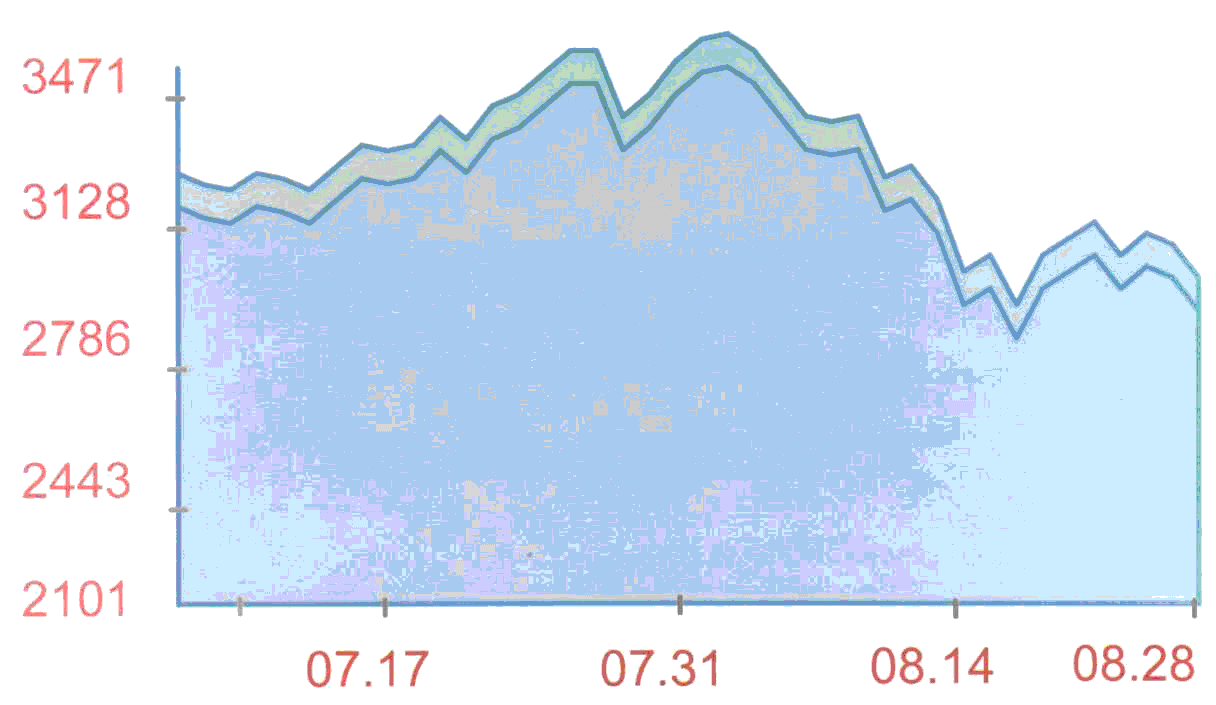
Fig. 1. Movement of Shanghai Composite Index in July-August, 2009
(http://www.sse.com.cn/sseportal/en/home/home.shtml)
According to our latest research, this could be a harbinger of a general slowdown in the economy of the People’s Republic of China, since stock indices reflecting a plenty of factors are usually the first to react to adverse economic changes in the country. China, being the largest manufacturer and consumer of raw materials in the global economy, in case of crisis is capable to produce a greater impact than the United States which is the world’s major consumer. For this reason it is quite obvious how it is important to monitor any changes in the Chinese economy. The rise in prices on raw materials in the last months is mainly connected with the Chinese expansion on the raw market.
According to the inflationary model of the world economy developed by the Institute for Regional Economy of the North, there is an obvious interrelation between its three basic components, monetary funds, raw materials and stock markets, which gives a possibility to use a ternary diagram for research purposes. Using this method to analyze basic indicators in the Chinese economy may give an early answer to the question of a possible crisis in China and another wave of global crisis.
Yuri Danilov, Senior Research Fellow, Department of Rough and Polished Diamonds Complex Economy, Institute for Regional Economics of the North (Federal State Scientific Entity)
