Diamond Mining in South Africa
Diamond mining is among the oldest mining industries in the Republic of South Africa that started with discovery of kimberlite deposits in 1867. Till the 1930s, the country ranked first in the global mining in terms of carats and value (in 1928, it accounted for 57% of the total production). With the increase in the diamond production in Congo (Zaire), South Africa’s share declined (in 1938, it was 11% only). The production rose substantially after World War Two.
At present, South Africa remains one of the leaders in the diamond mining in terms of sales in spite of the double decrease in the physical diamond production in 2012 compared to that in 2006 (Table 1).
Table 1
South Africa's diamond production and exports in 2006-2012
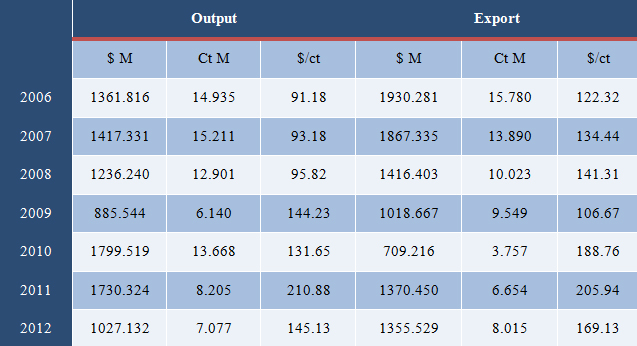 Based on the Kimberly Process data.
It should also be noted that the physical diamond production reached the peak in 2010-2011 but plunged in 2012, which is attributed not only to the diamond price instability but also to the political actions taken by the diamond industry workers. As for the diamond value, 2009 was the worst among the crisis years for the global diamond industry. However, in 2011 the value of the diamonds produced and exported grew thanks to higher diamond prices. The South Africa diamond exports declined almost 1.5 times compared to that in 2006-2007. It is partly due to the consumption by the national cutting industry, but mainly due to the economic problems in the country and the world.
Diamond Cutting in South Africa
As far back as the beginning of the last century, the government of the country took their decision to set up and develop the cutting industry by introducing a 10% tax on the rough diamonds. In late 1980s, a large number of cutting operations were set up in South Africa sourcing the rough diamonds directly from the miners and De Beers actively opposed to this. While in 1989, they manufactured 1.5 mln carats of polished diamonds, in 1994, the production dropped down to 0.571 mln carats reflecting the change in the priorities of the South African cutting industry that switched over from low-profitable small stoned cutting to cutting the bigger-size gems.
Israeli diamantaire Lev Leviev and his company LLD Group contributed to the further development of the beneficiation in the African countries; he was eager to take the leading position in the global diamond business and initiated the setting up of the marketing systems and manufacturing factories in the diamond mining countries that could receive the rough diamonds directly from the local diamond producers without dealing with the De Beers distribution network. The system proposed abolishes the existing marketing structure and diamond export under the contracts with DTC and instead, it offers setting up national systems with the participation of the LLD Group subsidiaries.
After the abolition of the apartheid in 1994, the South Africa Diamond Council granted about 1,000 licences to black citizens, most of them having no experience and money for setting up the operations, and their business was buying and reselling diamond.
Under a new Diamond Law of November 2005, all the diamonds mined in South Africa are subdivided into three groups depending on their quality. The first group comprises the diamonds over 10.8 carats and priced over $450 per one carat and the fancy coloured diamonds of all sizes. The second group comprises all the other diamonds suitable for cutting in South Africa. The third group comprises the diamonds not suitable for cutting in the country. In compliance with the law, all Group 1 diamonds should stay in South Africa for local cutting and also part of Group 2 diamonds that are in demand for the local cutting industry. The Group 3 diamonds only could be exported freely and without a tax. Group 1 diamonds account for 4% of the production by weight, the Group 2 stones – about 10% and the Group 3 gems – over 86% but as for the value, the Group 1 and Group 2 diamonds make 51% of the De Beers production in South Africa.
In the recent years, the SA cutting industry shows continuous decline in the polished diamonds output. In 2010, the cost of the diamonds cut in South Africa, according to the Rapaport data, amounted to $354 million. At present, the South African Diamond and Precious Metals Regulator (SADPMR) introduces the programme aimed at the development of the beneficiation in the country. It involves the assistance to local small-scale cutting operations in marketing their products on the global market and investing the money in the procurement of the equipment for diamond cutting and handing it over to the diamond beneficiation companies.
The number of workers in the cutting and polishing industry in SA is about 1,200 persons that is much less than before the crisis of 2008 when 2,000 cutters worked in the country. Out of these, 70% of the SA cutting industry workers are busy in the 16 companies that are the Diamond Trading Company (DTC) sightholders.
In 2007, the State Diamond Trader (SDT) was established to provide the supplies of the rough diamonds to the local beneficiation companies. However, out of 100 companies and individual entrepreneurs registered as the SDT customers, at present, 15 companies only operate on the market and purchase diamonds.
Thus, the development of the cutting industry in South Africa reminds the state of affairs in the diamond cutting industry in Yakutia: the same scale of production, similar challenges and performance.
Diamond Deposits in South Africa
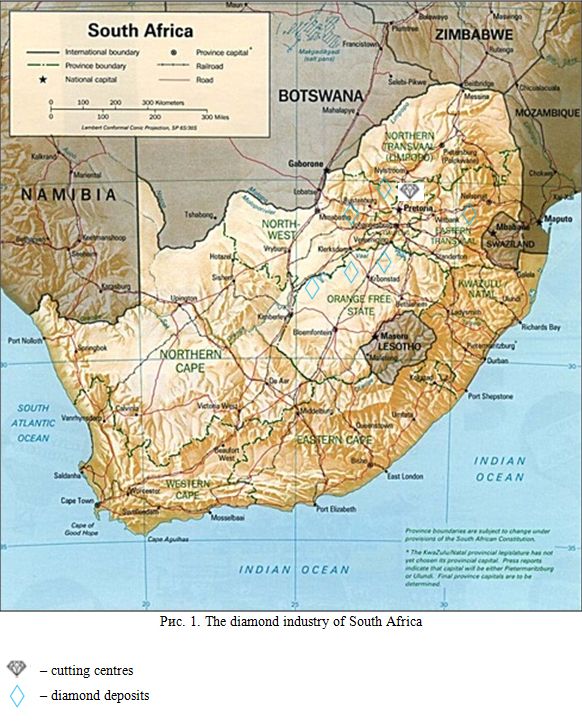
Prospects in the development of the diamond business in South Africa
The present day stage of the SA diamond business is characterized by the following factors:
1. The cutting industry is in crisis due to abolishing the apartheid in the country and the fact that the local population having no experience and adequate qualification is involved in the diamond business.
2. The diamond production is mainly carried out by De Beers, which allows the diamond mining industry be among the leaders in the mining industries in the country.
Yuri Danilov, Director of the Department of Subsoil Management Economics, Institute for Regional Economics of the North at Ammosov North-Eastern Federal University
