How the diamond miner’s sales policy and construction of underground mines first drove it into a deep crisis, and then helped to come out of it
(INTERFAX.RU) - Five years ago the operating results of ALROSA were so disappointing that many predicted an imminent default to this company. ALROSA completed 2008 having nearly $ 1 billion of net loss, while its net debt approached $ 5 billion by mid-2009, with almost no sales on the world market.
Since then, much has changed - the company reports it is reducing debt, increasing production and sales. ALROSA, which in the recent past was a closed corporation, held an IPO avoiding frenzy subscription and assisted by quasi-state-owned entities, but still placing its shares at more than aggressive prices. To some part, this contrast may be explained by the recovery in demand in the diamond market, which improved its fundamentals compared with the crisis of 2008-09, and to some extent by the fact that the company turned “open” and intelligible to the public at large, spending several years to harmonize legislation at all levels of federal and constituent authorities. The key factors for the company in this period were the introduction of a new distribution system (although it is not new in the literal sense of the world, because it is an analogue of the sight system established by De Beers) and the launch of underground mines.
The last “five-year plan” completed by ALROSA is the story of how the company’s marketing policy and construction of underground mines first drove the company into a deep crisis, and then helped it to come out of it. However, the situation in the world economy - in particular, the slower growth in emerging markets - is unlikely to let the diamond giant feel at ease in the coming years.
During the crisis
Sales have always been a difficult story for ALROSA. From the very start of diamond mining in Western Yakutia the Soviet Union signed a trade agreement with De Beers, the then monopoly in the diamond market. “The logic of the agreement was simple – at that time the Soviet Union was mainly in need of industrial diamonds and had virtually no experience in the market of gem-quality diamonds,” Sergey Goryainov, an expert of Rough&Polished said.
The partnership, in which De Beers sold most of rough diamonds produced by ALROSA on the latter’s behalf, lasted until 2006. In 2006, this cartel scheme attracted the attention of the European Commission, which considered it violated the antimonopoly legislation. By the decision of the European Commission, the parties had to completely stop joint sales since 2008.
Up to this point, ALROSA, in fact, had no need to build its own distribution system. As it was explained by Vladlen Nogovitsyn, the head of ALROSA’s client relations department, the company at the time preferred to sell most of its own rough through auctions to get the highest price for diamonds. This practice worked well in the growing market. But in mid-2008, a sharp decline in demand, overstocking in the market and problems with lending brought about lower rough prices. This was accompanied by a dip in demand for polished diamonds, which are not viewed as essentials by people.
“Most of the customers used to work with ALROSA at the time were not interested in stable purchases for diamond manufacturing and diamonds were mainly bought for speculative purposes,” Sergey Goryainov said. “In a good market they bought large amounts of rough even at high prices, but when prices began to fall, they immediately refused to buy.”
Already in late 2008, ALROSA was forced to stop selling in the world market: sales of rough at a significant discount, as it was demanded by customers, could finally collapse prices for rough and polished goods. It was the time, when ALROSA was forced to seek help from the state, which bought $ 1 billion worth of rough from the company.
Despite the drop in revenue, the diamond miner maintained its capital expenditure program - for example, such expenses accounted for RUB 18.26 billion in the crisis year of 2008. Major investments went to construction of underground mines. ALROSA had still to build 3 mines (Aikhal, Mir and Udachny), each estimated at about $ 1 billion.
“During the crisis period, this kind of investment was obviously beyond endurance,” Sergey Goryainov said. “But the construction had already been started. To mothball mining operations and construction works would mean even greater financial losses for the company. At the same time, the company would have been unable to sustain its own production plans without the construction of underground mines.”
ALROSA was busily attracting loans for the underground construction, and not only that. The company acquired gas and iron ore assets spending its borrowed funds within the diversification strategy embraced at that time. Later on, the miner financed its current activities from credits - in the absence of sales. By the middle of the crisis year 2009, this led to shutdowns at some of ALROSA’s operations.
ALROSA entered the crisis period having on its hands Timir, a greenfield iron ore project (its capex estimated at RUB 180 billion) and two gas companies, Geotransgaz and Urengoy Gas Company, which at that time were not producing gas and were not connected to the main pipeline. These assets were acquired as part of the idea to create a “Yakut BHP Billiton,” and the diamond miner is now having a hard time to get rid of them. After several years of searching for investors ALROSA has managed to attract Evraz as a strategic investor in Timir selling a controlling stake for RUB 4.95 billion. The gas and oil assets remain on the balance sheet of ALROSA, despite the agreement signed with Rosneft (MOEX: ROSN) last year, as their price - $ 1.38 billion - is raising doubts for the buyer.
Coming out of crisis
In 2009, ALROSA started to build a new sales system, this time based on long-term contracts with customers. In July that year, the company signed the first 18 such contracts resuming sales to the world market. In 2010, ALROSA sold 56% of its goods under long-term contracts.
Due to resumed sales of rough ALROSA ceased to increase its debt and started to clear it. “Of course, we couldn’t avoid ‘errors of choice,’ while concluding our first long-term contracts,” Vladlen Nogovitsyn said. “But in general, the system of long-term contracts guaranteed stable revenues for the company even during seasonal downturns in the diamond market.”
The next stage of the sales reform was carried out in late 2012 - early 2013, when the maturity of the first long-term contracts turned outstanding. At this time, ALROSA enacted the provision for equal access to rough diamonds developed in team with the Federal Antimonopoly Service.
“The introduction of equal access was first of all necessary to streamline our work with customers, because the existing system itself seemed to them incomprehensible and opaque,” Vladlen Nogovitsyn said. “But this also allowed the company to reallocate sales of high-quality goods and make them more effective.”
Sergey Goryainov explains that the company first of all means to redistribute the product range in the domestic market. “Historically, Russian companies received the so-called “selected lots” with extremely large and high-quality rough. But according to ALROSA, in recent years Russian customers resold a significant part of these goods. On the one hand, ALROSA was losing money, because it could sell these goods more efficiently, while on the other hand, it could not meet the demand for such stones from foreign customers, because they were contracted to the domestic market,” Sergey Goryainov said.
As a result, in 2012, five years after the transition to long-term contracts, ALROSA’s revenue reached RUB 150.8 billion, up 60% over 2008. According to preliminary data, ALROSA boosted its revenue to RUB 165 billion in 2013.
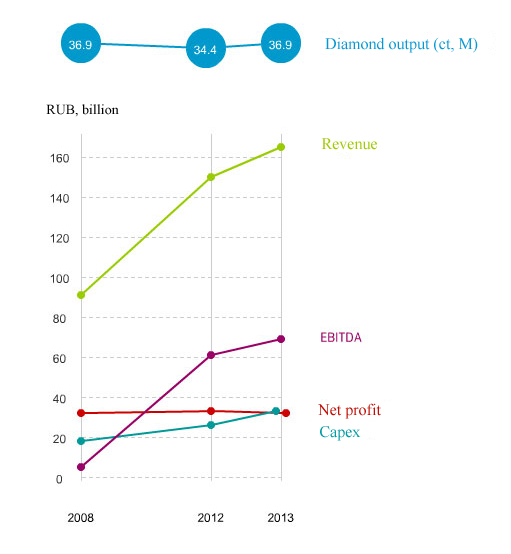
The second half of 2009 was for ALROSA not only the turning point due to the change in its top management and transition to long-term contracts. It was in this period, when the company finally launched its underground mines Mir and Aikhal. Its output, which slumped to 32.7 million carats in the crisis year 2009, went up in 2010-2012 also due to underground mines put into operation. ALROSA’s competitor De Beers carried out a major restructuring of its assets in the same year 2009, selling the least efficient projects and halving production to 24.6 million carats. Since 2009, ALROSA holds the first place in the world by output in terms of carats.
Plans for the future
ALROSA’s priority for the future is to further increase the efficiency of its sales structure, the more so that its projected increase in production and partial sale of its diamond stock will inevitably lead to expansion of its customer base. The company is now focused on large-scale diamond manufacturers and jewelry retailers as the most stable and predictable customers. ALROSA has already signed long-term contracts for the supply of rough diamonds with two large jewelry retailers - Tiffany and China’s Chow Tai Fook. From 2015, the company will start a new three-year contract period. According to ALROSA, it plans to increase the number of long-term customers to more than 50 from the current 41 in the new contract period, taking into account the previous experience of work and the amount of transactions with these clients.
“The company plans to enter into new long-term contracts with jewelry retailers, including those American,” ALROSA’s spokesperson said. The Signet jewelry chain is among the candidates and ALROSA is already in talks with it.
ALROSA may be interested in contracts with both jewelry brands of the premium segment and companies that produce large amounts of goods in the middle price range. “The latter may derive benefits buying boxes with diamonds of various size and quality directly from ALROSA without premiums they have to pay when selecting rough of specific size in the secondary market,” Sergey Goryainov said.
Meanwhile, ALROSA’s customers based in Russia and being diamond manufacturers are afraid that this kind of changing tack in the company’s sales policy can result in final loss of viability for the Russian diamond cutting industry. This process, in turn, can hurt ALROSA itself after a while, according to representatives of the Russian diamond cutting industry. Deprived of “selected lots,” some of the manufacturers – especially on the backdrop of lower prices for polished goods - reduced purchases from ALROSA or started to buy from an inferior product range, which does no good for the profit margin of manufacturers. According to Ararat Evoyan, First Vice President of the Association of Diamond Manufacturers of Russia, “ALROSA, while solving the task of maximizing its profit now, in the long run makes itself hostage to its Indian customers, whose share is dangerously increasing in ALROSA’s sales.”
Besides customer rotation, ALROSA plans to achieve changes in the composition of assortment boxes. Historically, ALROSA had to make up separate boxes using rough diamonds from the company’s “parent” framework, which included major diamond fields in Western Yakutia, and separate boxes of rough diamonds from its affiliated miners - Severalmaz, Nyurba and Almazy Anabara. According to the company’s spokesperson, in December 2013 ALROSA got the right to mix goods from any diamond fields, while making up boxes. Rough diamonds recovered at ALROSA’s different mines vary considerably in quality and color giving the company a chance to be flexible in managing its assortment policy.
This is not the only regulation problem, which the company needs to address. ALROSA is also facing a problem regarding the time it needs for shipment of rough goods purchased by its customers at overseas auctions. The current regulations allow ALROSA to take diamonds for display under temporary export arrangements, but such diamonds may be shipped to customers only after they return to the country to obtain authorization for final export. This mode of double state control increases the time of shipment to 3 weeks, whereas ALROSA’s competitors dispatch diamonds to their buyers within a few days. “Last year, ALROSA carried out a test shipment of rough diamonds directly from Israel and currently the company and controlling state bodies are studying the experience and in talks on a further procedure of paperwork related to rough,” the company told Interfax.
“Further improvement in the customer policy and sales is now more important for ALROSA than further expansion of production,” Sergey Goryainov said. “The company is already ahead of De Beers in terms of output, but they should think about maintaining leadership in the long term.” Therefore, ALROSA has been busy for several years preparing for expansion into Africa where her only rival De Beers is mining diamonds worth more than those recovered in Yakutia.
In summer 2013, ALROSA announced plans to create joint ventures with local exploration companies in Angola and Botswana, which it considers the most promising areas to explore for major new diamond deposits. ALROSA hopes to succeed using its tried-and-true technique proven in Yakutia to search for overburdened deposits located deep underground beneath the layer of other rocks. This kind of exploration has never been performed in Angola and Botswana. The joint ventures will start operating in the prospective areas in 2014. The arrangements with these countries suggest that if new diamond fields will be discovered the joint ventures will have the priority right to mine and sell diamonds from the identified sites.
The development strategy adopted by ALROSA at the end of last year suggests higher production of diamonds in Russia as well - up to 40 million carats in 2023. This growth will be in part driven by the above mentioned construction of underground mines, which now add more than 10 million carats to the total output of ALROSA. To date, ALROSA has to bring its Mir Mine to the nameplate capacity and launch the Udachny underground mine. The launch of the first phase of Udachny is scheduled for summer 2014.
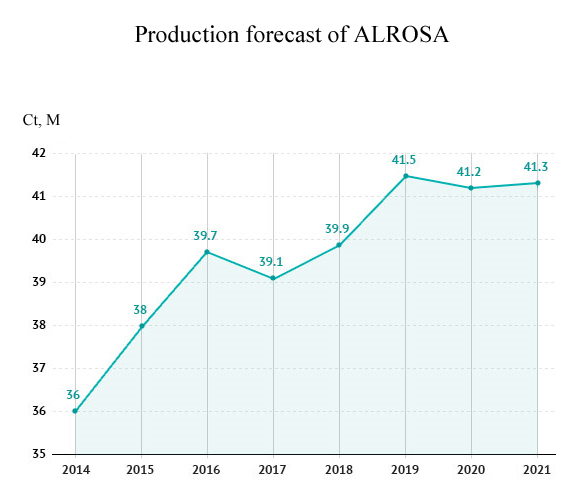
According to the text of ALROSA's development strategy, which is available at Interfax, the company expects to double its revenue to RUB 309 billion by 2023 and increase its net profit 2.5 times, up to RUB 88 billion. By 2021, the company expects to wipe off its debt and to fund its investment program off its own bat.
