The Moscow Kremlin, Russia’s state historical and cultural museum preserve, hosts the ‘India: Jewels that Conquered the World’ Exhibition that will last through the end of July. In the Assumption Belfry and Cross-Vaulting (One-Pillar) Chamber of the Patriarchal Palace, there are displayed about three hundred masterpieces of jewellery art created by the most famous Indian and European craftsmen in the 16th to 21st centuries.
This unique international project demonstrates the pieces of the jewellery art of the Indian and European craftsmen brought to Russia from museums and private collections from Europe, Asia and the US. It shows a wide range and huge variety of the jewellery heritage that had a significant influence on the development of all the world jewellery art.
At the press conference on the occasion of the opening ceremony Elena Yu. Gagarina, director general of the Moscow Kremlin Museums, emphasized that in India the gems are most loved as nowhere else in the world, and the European travelers were always delighted with the plenteousness of adornments. “The unique character and variety of shapes as well as the highest craftsmanship of the local jewellers boggled the imagination. All this made India a mysterious fairyland in the eyes of the Europeans. For the first time we are presenting the exhibition that combines the one-of-a-kind pieces created within the period of five centuries and we sincerely hope that the exposition will open new facets of the jewellery art of India and Europe to the visitors.”
Elena Gagarina thanked all the participants in the exhibition: Alex Popov, president of the Indian-Russian Jewellery Foundation, Professor David Khalili who provided the beautiful jewellery pieces from his own collection, as well as Vnesheconombank and AK ALROSA, the sponsors of the project.
The exhibition is organized by the Moscow Kremlin Museums jointly with the Indian-Russian Jewellery Foundation founded in 2011 in London that cooperates with the world major jewellery houses, Indian royal houses and collectors. Alex Popov, president of the Foundation, the member of the presidium of the World Federation of Diamond Bourses (WFDB), in his welcoming speech drew the attention to the fact that up to the 18th century, almost all the gems coming to Europe originated from India, and their route was laid through Russia: “The idea of the exhibition was to revive the old ties that existed in the world of luxury between India and the West. And Moscow is the only place for this initiative, connecting the two worlds.”
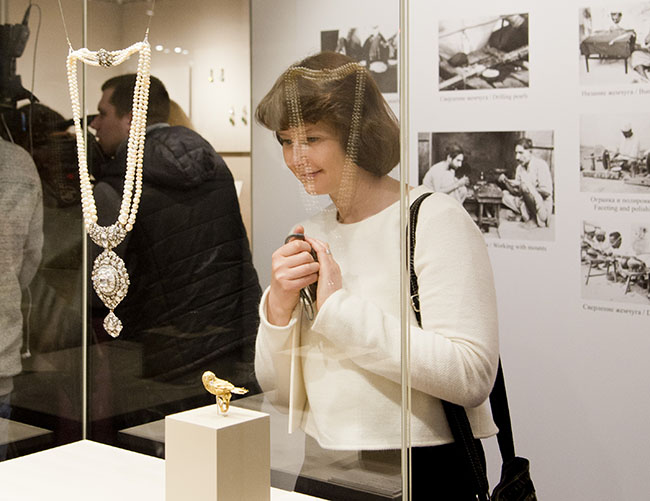
In addition to the masterpieces created by the outstanding Indian and European jewelers for the Indian maharajahs, the graphic arts and photographs are on the display. The exhibits include the ones provided by the British Museum, Victoria and Albert Museum, private collections, for example, the London Collection of Professor David Khalili, Geneva-based Collection of Faerber and Collection of Al-Sabbah from Kuwait. The private collection of Serge Fradkoff (Geneva) exhibited a 17th century unique flat-diamond necklace. Each of the five 17th century pendants in the necklace is a flat diamond obtained by slicing the natural stones of irregular shape. The core stone in the necklace is about 28 carats – the largest among the known similar diamonds.
The famous period of the Indian jewellery art - the times of the Great Moghuls (16th to 17th centuries) - and other periods of Indian history – the epoch of maharajahs (19th to early 20th centuries) are widely represented at the exhibition. The eye-catching and extraordinary jewels of the South India are ample evidence of other centuries-old tradition.
Another important topic of the exhibition is the mutual influence of Europe and India in the high jewellery art that was most pronounced in 19th to 21st centuries. The works of Munnu Kasliwal and Viren Bhagat, renowned Indian jewelers of our time, displayed are also an evidence of the long-term interaction of cultures. The creative perception of the Hindustan traditions is reflected in the fine jewellery pieces of the leading jewellery firms – Cartier, Chaumet, Mauboussin, Van Cleef & Arpels and others – that created their new individual styles under the influence of the Indian jewellery.
As A. Popov noted “The exposition demonstrates not only splendid creations of Indian craftsmen of five centuries but also a broad spectrum of interaction between the jewelers from India and other countries that resulted in the unique mutual penetration of the traditions and cultures.”
Exhibition ‘India: Jewels that Conquered the World’ overwhelms with unbelievable luxury exhibits, masterful implementation of the ancient jewellery traditions and their re-thinking in the modern jewellery art of Europe, as well as the use of precious stones, including uncut and polished diamonds. In general, plenty of jewellery studded with rough and polished diamonds – large-sized, flat, natural and sometimes looking uncut – were displayed at the exhibition. India was the only source of diamonds in the world till the 18th century, and the ancient cutters had special knowledge to skillfully cut the diamonds. No wonder that at present, up to 70 percent of all the polished diamonds in the world are manufactured in India.
The works of Munnu Kasliwal and Viren Bhagat, renowned modern Indian jewelers, are also displayed at the exhibition and demonstrate the contemporary-styled ancient heritage. Some pieces of jewellery – rather modern but delicately ‘golkondastyled’ – have the gems, mainly diamonds and emeralds, taken from the old family jewels. These necklaces, earrings and diadems created in 2000 to 2010 impress with luxury huge diamonds.
Galina Semyonova, Rough&Polished
