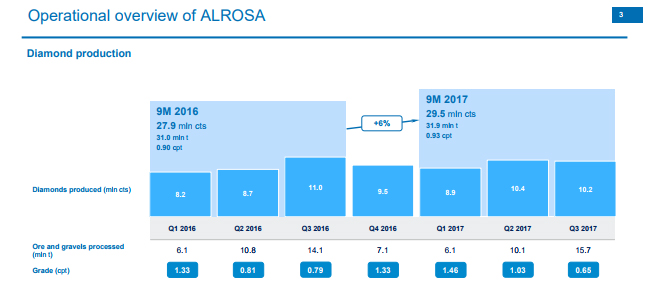
Diamond giant Alrosa released its third quarter operational overview on 23 October, which showed that its output for the first nine months of the year leaped 6 percent to 29.5 million carats compared with 27.9 million carats, a year earlier.
Company First Vice President Igor Sobolev said production grew as a result of more active operations at alluvial deposits and strategic mining assets – Udachny underground mine and Karpinskogo-1 pipe operated by Severalmaz.
The Udachny underground mine output rose 43 percent to 993 000 carats in the first nine months of the year from 692 000 carats, a year earlier.
The Karpinskogo-1 pipe also delivered significant carat growth with output rising from 688 000 ct to 1.03-million carats in the nine months under review.
Alrosa’s third quarter output (as shown in the table below) was 10.26-million carats, down from 10.96 million carats in the corresponding period in 2016.
Source: Alrosa
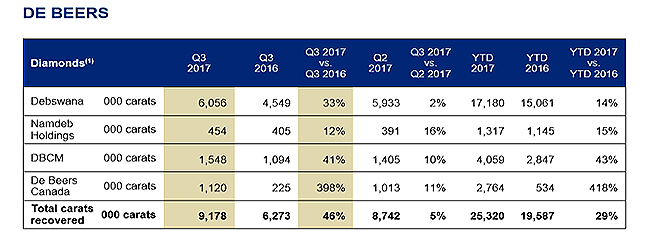
Anglo American, the parent company of De Beers, which was Alrosa’s major competitor, released its third quarter production results on 24 October, which showed that the diamond group improved its third quarter output 46 percent to 9.2 million carats when compared with 6.3 million carats produced, a year earlier.
It said stable trading conditions supported an increase in rough diamond production, driven principally by Debswana in Botswana and the ramp-up of Gahcho Kué in Canada.
Debswana’s production increased 33 percent to 6.1 million carats while output at Gahcho Kué also increased five-fold to 1.1 million carats.
De Beers’ full year production guidance was revised to about 33 million carats from the previous’ 31 to 33 million carats.
In comparison Alrosa’s First VP said the company had reaffirmed its 2017 production plan for a total of 39.3 million carats.
The Russian group produced 37.4 million carats of rough diamonds last year, while De Beers had an output of 27,3 million during the same period.
De Beers took a decision in 2015 to reduce production in response to prevailing trading conditions and this year would be unique for the company as it seeks to go beyond the 30 million carats mark.
De Beers produced 25.3 million carats during the first nine months of the year.
That means both Alrosa and De Beers had collectively produced 54.8 million carats during the period under review compared with 47.5 million carats, a year earlier.
Sales
Alrosa said it sold 7.5 million carats of diamonds during the third quarter, including 4.9 million carats of gem-quality diamonds at an average price of $169 per carat and 2.6 million carats of industrial diamonds at an average price of $9 per carat.
Rough diamond sales amounted to as much as $848 million during the third quarter and $3.3 billion for the first nine months in the year.
“Polished diamond sales for these periods amounted to as much as $13.2 million and $68.1 million, respectively,” said Alrosa.
On the other hand, De Beers’ consolidated rough diamond sales volumes were 6.5 million carats during the quarter or 6.9 million carats on a total 100 percent basis from two sights, compared with 5.3 million carats or 5.7 million carats on a total 100 percent basis from two sights, a year earlier.
The increase, it said, was driven by a normalisation of demand for lower value goods this year.
Consolidated sales volume excluded De Beers’ joint venture partners’ 50 percent proportionate share of sales to entities outside the group of companies from the Diamond Trading Company Botswana and the Namibia Diamond Trading Company, and includes pre-commercial production sales volumes from Gahcho Kué.
No revenue accrued by De Beers was recorded as was the case with Alrosa.
Mathew Nyaungwa, Editor in Chief of the African Bureau, Rough&Polished
