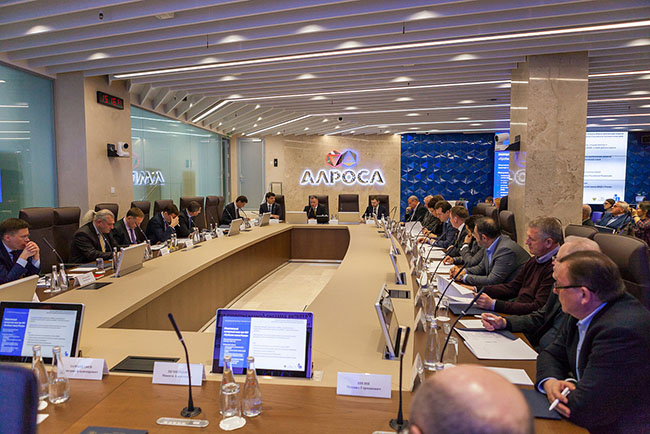
The Assay Chamber of Russia held a regular meeting of the Public Expert Council on the topic: "Vital issues regarding the turnover of synthetic analogues of precious stones in the Eurasian Economic Union (EAEU)". The event was held on March 20, 2018 in the conference hall of ALROSA.
The meeting was attended by 87 participants – the representatives of the State Duma, Council of Federation, Ministry of Finance of Russia, Ministry of Natural Resources of Russia, Ministry of Foreign Affairs of Russia, Federal Customs Service and Federal Tax Service of Russia, Federal Financial Monitoring Service, law enforcement agencies, industry and public organizations, jewelry companies and media.
Alexander Markin, Head of the Assay Chamber of Russia and Chairman of the Public Expert Council, acting as the moderator of this meeting, in his opening remarks said: "The topic of today's round table is due first of all to the fact that currently we are focusing most of our efforts and attention on regulating the turnover of precious metals, so these are protected much better than precious stones. We have convened here experts in the field of synthetic analogues of precious stones, who will say, if there is room for ‘synthetics’ in the jewelry industry, what the role of the State in controlling synthetic analogues is and how to exercise this control. Another important part of this topic on which we work together with our colleagues from the EAEU is the creation of a common market for precious stones turnover, the problems of which are well known to us."
Vadim Serov, Executive Director of the Association of Jewelers of the Eurasian Economic Union, told about the current situation and prospects for joint regulation of the precious stones turnover in the EAEU, noting that, unlike metals protected by hallmarks, precious stones are not protected at all and by and large are not controlled within the EAEU states.
Diamonds account for about 90% in the sales of jewelry with precious stones. The rest is divided between sapphires, emeralds and rubies. The average product sold on the Russian market contains a diamond insert of up to 3 mm in diameter and weighing 0.2 carats. These stones in the wholesale market are priced at about $ 500 per carat, with a downward trend. According to expert estimates, the total volume of the precious stones market in Russia is about 50 billion rubles or 1.8 million carats.
The highest peak in imports of precious stones to the Russian Federation was registered in 2013. That was followed by a decrease in 2015 and a catastrophic drop in imports by 90%. The import statistics for colored precious stones almost repeat the trend of diamonds. Industry experts attribute this to the accession of the Republic of Armenia to the EAEU in January 2015.
Vadim Serov said: "We are pro-actively engaged in collecting all possible data on the turnover of precious stones in the EAEU. Unfortunately, we have to state that the majority of countries have no legal documentation and metrics on import/export and turnover of precious stones. Moreover, there are no unified regulatory norms and full-fledged general statistics on the EAEU."
This brought about a situation, when, according to conservative estimates of market stakeholders, gemological laboratories and certification centers, at least 20% of precious stones in jewelry goods are not genuine, in other words, fakes, since in this context we are talking not only about lab grown diamonds, but also about any fake passed off as a natural stone. Moreover, there is an upward trend in the share of counterfeit goods in the Russian market.
Thus, the shadow market of precious stones is growing giving a possibility to avoid taxes and duties, undermine consumer confidence, expand opportunities for unfair competition and create obstacles for the development of the diamond manufacturing industry in Russia.
Taking into account the current situation, the participants of the meeting formulated a list of issues that require to be addressed as soon as possible.
In particular, there is a need in establishing unified principles of control over the circulation of precious stones in all states belonging to the EAEU, unified standards for their classification and evaluation and a single database on import and export of precious stones in the territory of the EAEU. The responsibility for solving these issues lies with Eurasian Economic Commission.
The state bodies of the Russian Federation need to develop and implement a system of separate control over synthetic and natural diamonds, introduce state control over the importation of synthetic and other precious stones to the territory of the Russian Federation, equip assay inspectorates with devices to verify the authenticity of inserts in jewelry in order to carry out full-fledged and prompt control on-site.
Some of the participants of the meeting proposed to transfer the powers of control over the turnover of precious stones in the market from the Federal Service for Surveillance on Consumer Rights Protection and Human Wellbeing (Rospotrebnadzor) to the Assay Chamber of Russia. To tighten control measures against violations, there were also suggestions to drastically increase the penalties for concealing or misleading information about precious stones set in jewelry pieces and to increase the number of inspections in retail.
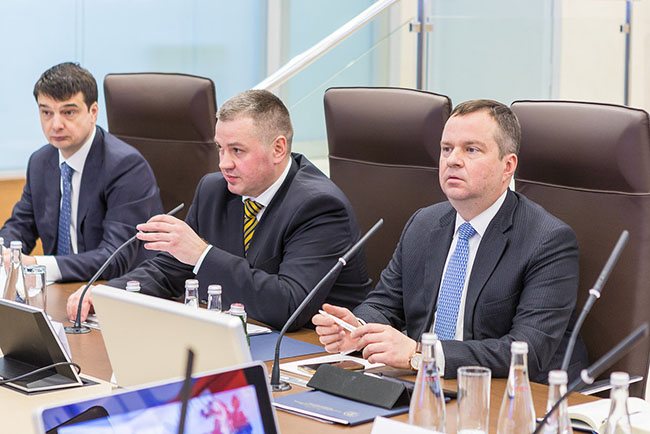
The position of the Ministry of Finance of Russia was expressed by Alexey Moiseev, Deputy Finance Minister, who said: "The situation calls for decisive measures to separate natural diamonds from synthetics. For Russia, the country which is the largest producer of natural diamonds, it is now a chance to regain the precious stones markets, which we were losing step by step in recent years. It is necessary to follow the path of marking and trace the movement of natural stones. We will certainly introduce traceability, this is the main thing that we need to do for the market, and this should be accompanied by marking stones."
The producers of synthetic diamonds taking part in the meeting (TISNUM and Nevsky Diamond) told about the methods used to synthesize diamonds. These are the method of high pressure and high temperature (HTHP) and chemical vapor deposition (CVD). The first one makes it possible to obtain ultraclean diamonds used in exceptionally high technologies - the creation of modern nuclear installations or accelerators of extremely high power. According to experts, diamonds produced for these purposes are hundreds of times cleaner and better than natural diamonds.
The producers of synthetic diamonds noted that the growing production of their goods will in no way compete with natural stones in jewelry production. Vladimir Blank, CEO of TISNUM said: "Synthetics will never replace nature. But at the same time, we must understand that no one can stop the development of high technologies today, because the diamond itself creates completely new opportunities in creating new technology." Thus, the growing demand for synthetic diamonds in optics, quantum electronics, medicine and other industries shifts the priorities of synthetics producers to the high-tech market, where it is expected that demand will reach 150 million carats by 2050, while the need for synthetic diamond jewelry in the same period can reach only 55 million carats.
The producers of natural diamonds have a different forecast. Presumably, by 2030 the share of the synthetic diamond market may amount to 15% of the world's diamond output of gem-quality diamonds, which creates new challenges for producers of natural diamonds.
To date, cooperation on synthetic diamonds with foreign partners in international markets is hampered by the absence in most jurisdictions of terminology and definitions that meet international standards; a common understanding of the terms "rough diamond / polished diamond" and "synthetic rough diamond / synthetic polished diamond," as well as a single standard of objective evaluation of devices for the detection of synthetic diamonds.
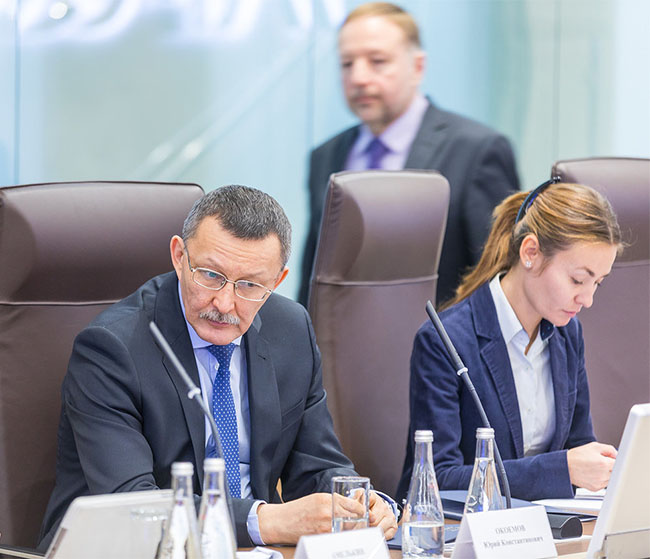
In this regard, ALROSA has developed a number of proposals. In particular, it is proposed to work with the Antwerp World Diamond Center (AWDC) and the World Jewellery Confederation (Confédération Internationale de Bijouterie, Joaillerie, Orfèvrerie des diamants, perles et pierres, CIBJO) to develop an initiative to adopt a joint EU directive on the normative delineation of the concepts "rough diamond / polished diamond" and "synthetic rough diamond / synthetic polished diamond," at the EU level with the aim of creating all-European rules and regulations based on ISO standards. In addition, within the framework of interaction with industry organizations of India and China, ALROSA intends to promote the need to introduce changes in the national industry regulation in order to clearly define the meaning of the concept of "precious stone" and withdraw synthetic rough diamonds / synthetic polished diamonds from this category.
Within the frames of the Kimberley Process work is going on to include unified commodity codes for synthetic diamonds into the Harmonized Commodity Description and Coding Systems at the level of the World Customs Organization. This work should result in the adoption of universal (6-digit) codes for synthetics at the level of this organization by 2022.
Within the Russian Federation, ALROSA stands for the creation of a national standard based on ISO 18323: 2015 standard and the Diamond Terminology Guidelines 2018 (a reference document for the diamond and jewelry industry) as a key element in the delineation of markets for natural stones and synthetics.
At the level of the EAEU, ALROSA is also ready to support this work, in particular to introduce changes in the commodity nomenclature of the EAEU including special sub-items for unprocessed and processed synthetic diamonds, as well as to study the possibility of adopting a single standard for the classification of precious stones in the EAEU.
The company demonstrated to the participants of the meeting its own ‘ALROSA Diamond Inspector’ to identify natural diamonds, which is on par with the world’s best international diamond detection devices by its characteristics and can compete with them both on the Russian market and in the EAEU countries.
In general, in the opinion of the participants of the meeting held by the Public Expert Council of the Assay Chamber of Russia, the discussion was very useful and showed that the problem really exists, and it needs to be solved jointly.
Taking into account the importance of the issue under consideration, it was decided to summarize the proposals for further expert discussion and development of recommendations. The final resolution will be forwarded to the Ministry of Finance of the Russian Federation for consideration.
Elena Koren for Rough&Polished
