The global diamond business beginning with its first chain – diamond mining - and ending with its final stage – diamond jewelry trade – is growing like a tree. Diamonds which are the product of this business go through qualitative and quantitative transformations. In the world economic practice accounting and evaluation of cost characteristics in various segments of the diamond market represent a complex problem which is pressing to be solved especially now. Every subsequent transformation phase in the diamond business brings about its further ramification like in a chain reaction due to increased number of participants, more complicated sales and turnover patterns as well as due to a sharp growth in evaluation characteristics of the product itself. If the first segment of the diamond market – diamond mining - became enough transparent owing to the Kimberley Process it is impossible to say the same about its subsequent stages.
The term of “diamond pipeline” introduced by foreign analysts found a wide application in recent years in the domestic practice in Russia to calculate key quantitative characteristics of the global diamond business. It includes major components of the diamond cycle: diamond mining, diamond trade, diamond manufacturing, as well as wholesale and retail diamond trade. Chaim Even-Zohar, a well-known Israeli analyst, annually publishes estimated data related to the global diamond pipeline at the Diamond Intelligence Briefs web-site.
Proceeding from these data T. Pototskaya, who analyzed the distribution of “accumulated value” at each stage of the diamond pipeline in 1999-2004, defined value increase ratios and their dynamics which allowed her to outline a branch structure in the global diamond business economy. Her work correctly defines three basic segments in the global diamond business: diamond mining, cutting and jewelry branches. According to the author, the latter includes manufacturing and selling diamond jewelry. Analytical research based on such a method of analysis allowed her to estimate the condition of the rough and polished diamond market, as well as to forecast its development.
I. Egorov of the Institute for Regional Economy of the North while studying the added value increase ratios in the global diamond pipeline and a rough and polished diamond complex of the Republic of Saha (Yakutia) in 2001-2005 came to a conclusion that the level of prices for production of major diamond market segments in both cases remains approximately identical which permits to apply existing proportions at a regional level.
But if in a stable market this method permits to give sufficiently exact outlooks, under crisis conditions such estimates result in significant errors. The last economic crisis has cardinally changed the balances which developed in pre-crisis time between companies extracting, cutting and selling diamond goods. Competition between them in crisis conditions became sharply aggravated. Earlier the author of this article used a three-component diagram reflecting three segments of the diamond market.
If the diamond market is analyzed from the point of view of the global pipeline it turns out that the sharp slump in demand for rough and polished diamonds in 2009 led to a significant diminution of indicators and proportions between the sectors of the diamond business were cardinally changed. However, it is noteworthy that in the diamond-mining branch the basic role is played by the four largest companies which having coordinated their policy not only managed to remain sustainable, but also preserved their leading positions in this segment of the market (Tab. 1).
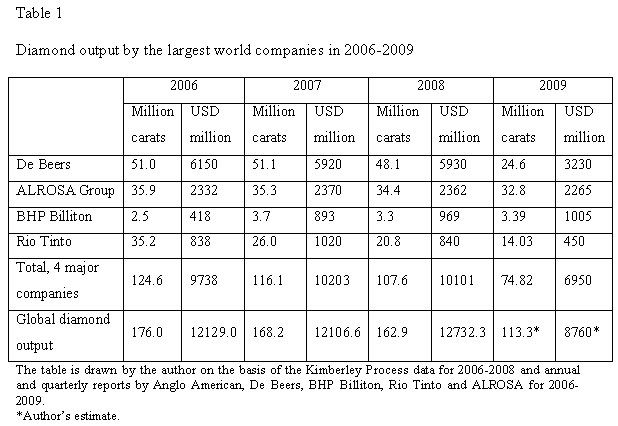
The share of the world’s largest diamond mining companies in diamond output is about 70% in physical terms and about 80% in value terms. Assuming that such proportion, despite the crisis in the diamond-mining sector, remained at their former level it is possible to define the volume of global diamond output. Proceeding from this, the author calculated the parameters of the diamond pipeline in 2009 using the three-dimensional analysis method taking into account the change of balance between the companies in the diamond business (Tab. 2).
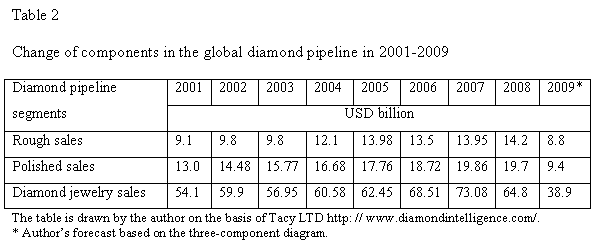
The accuracy of this estimation may be verified when next data related to the global diamond pipeline will be published.
Yuri Danilov, Senior Research Fellow, Department of Rough and Polished Diamonds Complex Economy, Institute for Regional Economics of the North (Federal State Scientific Entity)
