In early March 2010, the German Research Foundation (Deutsche Forschungsgemeinschaft) and Japan Science and Technology Agency launched an innovative research project, Quantum Computing in Isotopically Engineered Diamond, aiming to novel logic devices enabling faster computing and more secure communications. The project is run within the new German-Japanese research initiative “Nanoelectronics.” It is coordinated by Dr. Fedor Jelezko (University of Stuttgart) and Prof. Junichi Isoya (Tsukuba University).
The research consortium includes three German partners - Universities of Dortmund and Stuttgart and Technical University of Munich - and four teams from Japan, which are the Tsukuba University, National Institute of Material Science and Japanese Atomic Energy Agency.
The Stuttgart team is famous for the pioneering work in detecting and manipulating internal states (quantum states) of single atoms in diamond. The Japanese teams are world leading experts in growing synthetic diamond and single atom doping technologies.
In many countries researchers have been investigating various methods of storing data in quantum computers for as long as several years. Significant results were obtained in particular at the Harvard University and Massachusetts Institute of Technology in the United States. Nitrogen atoms embedded in diamond allow encoding quantum bits or qubits, but the process of reading the information results in an extremely weak signal.
In a quantum computer, a single bit of information is encoded as a quantum mechanical system like for instance the spin of an electron. Reading the information stored in diamond-embedded Nitrogen atoms resets the qubit, which means there is only one opportunity to measure the state of the qubit.
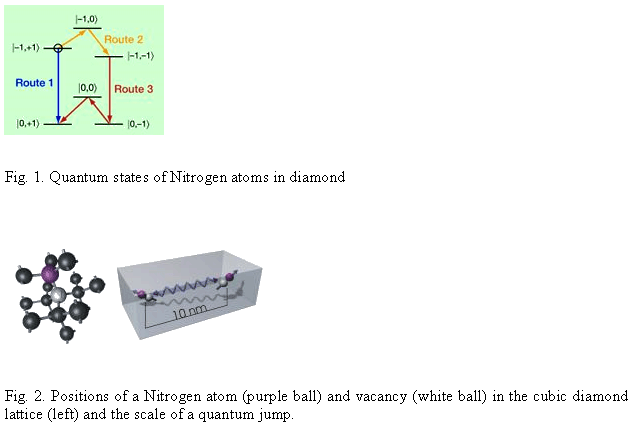
By developing a technique that involves the spin of the Nitrogen nucleus, a group of physicists at the University of Stuttgart has turned the single-step read-out into a multi-step process. Rather than simply resetting the electron-based qubit when the information is read, the researchers learned to change the state of the Nitrogen nucleus twice before the information is erased. The state of the Nitrogen nucleus does not store any useful information - it simply allows the researchers to extend the process of reading the qubit-based information. Eventually, this results in a more elaborate quantum mechanical process that triples the number of steps before information is destroyed, which in turn strengthens the information read-out signal coming from the qubit.
Nitrogen centers are immobile in the diamond lattice. When targeted by a laser, the two Nitrogen centers located at a distance of about 10 nanometers will interact. Their reaction results in a variable superposition of their spin states. The two spin states are comparable with “0” and “1” in a computer.
The resulting signal is still weak, but by combining other methods researchers might one day be able to use impurities in diamond to write and read quantum information at room temperature. This will bring us closer to creating practically feasible quantum computers.
Russian researchers also possess experience in studying Nitrogen impurities in diamonds of various origins. For example, Yakutniiproalmaz, a Russian research institute, has performed a detailed examination of different-quality natural diamonds mined at various diamond fields from the Nitrogen point of view. Extensive research in the field of quantum computers based on diamonds gives an opportunity to experts in ALROSA to diversify their activities.
Vladimir Teslenko for Rough&Polished
