The Editors Office of the Moscow-based Jewelry Review Magazine held a “round table” to discuss the Customs Union regulations governing the turnover of precious metals and gems to be put in force. The discussion was initiated by Flun Gumerov, the coordinator of the industrial section at “Business Russia,” an all-Russia public organization, who had visited Kazakhstan where he met the developers of the Customs Union regulations from the Kazakh side. Actually, only these efforts gave the Russian jewelry industry public organizations and representatives of jewelry business an opportunity to get acquainted with draft documents which will become effective since July of this year.
So, what does it contain, this package of normative acts?
1. What is the situation with precious metals and gems in the countries of the former USSR?
It is essential that the Customs Union normative acts contain documents designated for communication with the outside world and for internal communication inside the Customs Union.
The point is that the three countries taking part in the Customs Union have different legislation for precious metals and gems turnover. Even more different is the industry legislation across the whole range of countries of the former USSR. Table 1 contains the data illustrating legal attitude towards precious metals and gems turnover in the countries of the former USSR.
Table 1
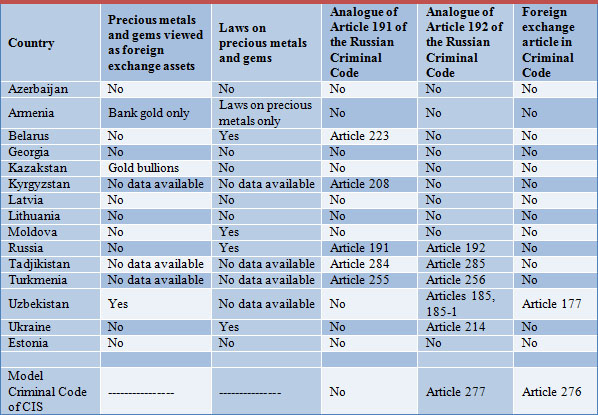
There are no exact data proving whether or not Kyrgyzstan, Tajikistan, Turkmenia and Uzbekistan have separate laws on precious metals and gems but this is not essential for an overall picture.
Currently, the industry legislation of the former USSR countries (except for Lithuania, Latvia and Estonia) is in many respects similar to the Russian industry legislation. However, not in everything. A comparative analysis of major industry enactments and their norms gives the following picture:
1. Gold recognized as bearing “foreign exchange value”: 3 countries (Armenia, Kazakhstan, and Uzbekistan).
2. A separate law on precious metals and gems in national legislation: 4 countries (Armenia - precious metals only, Belarus, Moldova, Russia, Ukraine).
3. An article on illegal turnover of precious metals and gems contained in national criminal codes (similar to Article 191 in the Criminal Code of the Russian Federation): 5 countries (Belarus, Kyrgyzstan, Russia, Tajikistan, and Turkmenia).
4. A separate article on illegal recovery of precious metals and gems and obligatory refining of precious metals contained in national criminal codes (similar to Article 192 in the Criminal Code of the Russian Federation): 5 countries (Russia, Tajikistan, Turkmenia, Uzbekistan, and Ukraine).
It is easy to notice that Russia and Belarus happen to be “leaders” in rigidity of their control over the precious metals and gems market on the part of the state, whereas Kazakhstan, on the contrary, has an industry legislation basis more adapted for a civilized market of precious metals and gems, like the legislation of the USA, Europe, South East Asia and so forth.
A few words about the essence of the above documents. They consist of two basic acts and a whole array of appendices to them. The basic acts are as follows:
- “The regulation on importing precious metals and gems and raw materials containing precious metals to the customs territory of the Customs Union within the limits of the Euroasian Economic Community and exporting them from the customs territory of the Customs Union within the limits of the Euroasian Economic Community”;
- “The regulation on specific features in the turnover of precious metals and gems within the Customs Union.”.”
2. Draft regulation on import-export of precious metals and gems in and from the Customs Union
The “external” document virtually represents an exact copy of Decree of the President of the Russian Federation № 742 as of June 21, 2001 “On importing precious metals and gems to the Russian Federation and exporting them from the Russian Federation.” But - it has some extras. It is curious that a number of additions come into contradiction with the regulatory and legal framework existing in Russia. Thus, the new Regulation contains the following provision:
“35. Physical persons (residents and non-residents) may import into the Customs Union precious metals and gems for personal, family, home and other needs not intended for business in accordance with the customs legislation.”
It is absolutely unclear how to interpret this provision. The point is that if this document should be viewed as “customs legislation” then any person may easily bring in the Customs Union, including Russia, any unsorted and uncertified gems. For instance, for a personal mineralogical collection or for making a jewelry piece to order. It is absolutely normal for Kazakhstan, as well as for all developed countries of the world, but according to the supervising authorities it means infringement of the “turnover rules” for Russia and Belarus (punished by up to 6 years of prison under Article 191 of the Criminal Code of the Russian Federation in Russia and Article 223 in Belarus). Does the appearance of this norm mean that these criminal code articles will be cancelled in the national legislations? Or as it happened before, everything will be left to decide by bureaucratic “concepts” instead of doing it “by the law”?
By the way, the right for non-commercial export of precious metals and gems by physical persons is outlined in Decree № 742 in a very crafty way, saying that such export is possible “among other exported goods whose export is regulated by the legislation of the Russian Federation.” Since a certain legislation (by the way, it is not clear what legislation) has given physical persons the right to possess only certificated gems it means that such physical persons may have the right to export only such gems beyond Russia. The new Regulation does not contain a similar clause just setting a value limit of $25,000. What does it mean?
The Regulation provides that “Customs registration of precious metals and gems imported or exported by physical persons into the Customs Union or outside and not intended for industrial or other commercial activity may be carried out disregarding the requirements established by Clause 30 of the present Regulation.” In other words, such registration may be done in a usual way and not at special customs terminals. In the absence of export customs duties for precious gems brought outside the Customs Union this is absolutely normal.
On the whole, the Regulation and especially its appendices are largely “tuned” to operate with rough and polished diamonds. In general, this is correct but there is a question left unanswered: Will it not be better to set apart ALL the regulating documents of the Customs Union regarding the turnover of rough and polished diamonds into an independent package?
Just imagine: if permits for the construction of small private houses in the countryside were regulated by the same documents and were carried out under the same rules as those given for the construction of skyscrapers downtown, then what would happen? A collapse in private housing construction? But will it not be the same situation on the market of precious metals and gems in the Customs Union - rough and polished diamonds command a market which is ten times larger, to say nothing of its Kimberley certificates rules? And here we have a situation where streamlets of goods on the color gems market are “huddled” under the same regulations!
Among other important innovations in the “external” Regulation of the Customs Union with regard to the precious metals and gems market it is necessary to mention the revival of tolling recently forbidden in Russia, i.e. processing of raw precious metals and gems outside the customs territory.
3. Draft regulation on precious metals and gems turnover inside the Customs Union
The “internal” document on precious metals and gems turnover in the Customs Union is made of extracts from the other document, the Russian Federation Law “On precious metals and gems.” It is important to note that this law has a purely referential character. In other words, to make it work there should be generated a huge number of subordinate legal acts, many of which have not emerged in Russia in the 12 years this law was in force. Actually, the inability to be applied directly is not the only flaw in the Russian Federation Law “On precious metals and gems.” A major drawback is that it still exists, especially taking into account that as early as 2003 all precious metals and gems were legislatively cancelled from the list of foreign exchange assets in the Federal Law “On foreign exchange regulation and control.” Interestingly, the Law “On precious metals and gems” in its time was developed to fulfill the provisions on “foreign exchange assets” in another law, which was the Law “On foreign exchange regulation and control.”
Due to the “death” of the foreign exchange assets status held by precious metals and gems in Russia there was issued Russian Federation Government Decree No. 433 “On changing and recognizing invalid some legal acts of the Government of the Russian Federation in connection with the Federal Law “On foreign exchange regulation and control” on August 24, 2004. This decree has terminated Russian Federation Government Decrees No. 759 as of June 27, 1996 and No. 215 as of March 10, 2000 repressive for the market of precious metals and gems. “On changing and recognizing invalid some legal acts of the Government of the Russian Federation in connection with the Federal Law “On foreign exchange regulation and control” on August 24, 2004. This decree has terminated Russian Federation Government Decrees No. 759 as of June 27, 1996 and No. 215 as of March 10, 2000 repressive for the market of precious metals and gems.
However, although six years passed since these two decrees had been officially cancelled but they are still APPLIED in our courts! For foreign lawyers it would be hard to understand such “specific” approach to the national legislation. Moreover, now they are taken as a basis for the Regulation of the Customs Union.
There is more than enough absurdity in the Federal Law “On precious metals and gems.” For instance, under this law legal entities and physical persons may own precious metals and gems “legally acquired from the subjects recovering and producing precious metals and gems.” The same norm is taken as a principle in the Regulation of the Customs Union. And no one happened to ask simple questions:
- What shall we do with dealers and importers? Will it be impossible to legally buy gems from them?
- What shall we do with banks? They used to sell precious metals without being their miners or producers.
Gems are absolutely freely sold at mineralogical fairs all over the world where legal entities and physical persons can freely purchase them. Will it now also be possible for physical persons in the countries of the Customs Union to own gems as freely? Sorry, no. Clause 4, Section VI, in the Regulation states: “It is forbidden to make transactions involving gems which have no defined classification on the territory of the Customs Union.”
And further, Clause 6, Section VI, of the Regulation reads: «Legal entities and sole traders are not permitted to sell uncertified cut natural gems to physical persons.” As it was said above, the both mentioned norms are rudiments of Russian Government Decree No. 759 cancelled as far back as 2004. As it was said above, the both mentioned norms are rudiments of Russian Government Decree No. 759 cancelled as far back as 2004.
All that said, it should also be pointed out that the document generates problems for internal turnover of precious metals and gems in the Customs Union. The above mentioned Clause 6 of Section VI in the Regulation says that “Certification of cut natural gems is carried out according to national legislation of the states participating in the Customs Union.” While Clause 10 of Section VI in the Regulation states: “The territory of the Customs Union will be subject to state monopoly for assaying and hall-marking jewelry and other household items made of precious metals.”
Does it mean that certificates for precious gems issued in one of the countries of the Customs Union will be accepted by the other countries of the Customs Union? Does it mean that a hallmark of any of the Customs Union’s countries will be accepted by all the other allied countries? Or will it not?
Even more incomprehensible appear to be possible consequences of Clause 1, Section VII, of the Regulation if it goes effective: “Persons who violate the order established by the present Regulation shall bear responsibility in accordance with the legislation of the member state taking part in the Customs Union on the territory of which such violation will occur.” In other words, what is possible to cost you 6 years of prison in Russia (Article 191 of the Criminal Code of the Russian Federation) or Belarus (Article 223 of the Criminal Code of the Republic of Belarus) may be done without any fear in Kazakhstan.
Vladimir Zboikov for Rough&Polished
