The recent global economic crisis has produced an essentially negative impact on the state of the world diamond business, but in Russia and Yakutia, diamond output decreased to a much lesser extent compared with foreign companies due to the considerable support rendered by the central government to domestic diamond-mining enterprises (Table 1).
Table 1
Diamond output of Russian Federation diamond-mining companies and their divisions in 2001-2009, $M
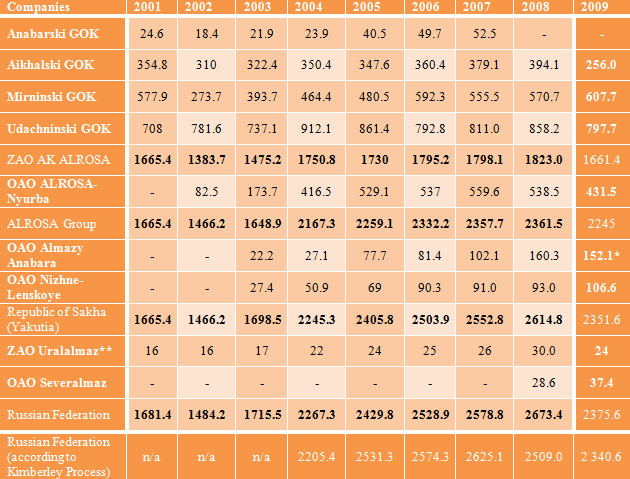 The table is compiled by the author and based on company reports and Kimberley Process data.
*From 2009, Almazy Anabara’s performance data is included in ALROSA Group’s results.
**Author’s estimation.
Thus, in 2009 ALROSA Group and the Russian Federation won the first place in terms of carat and value output, $M (Table 2).
Table 2
Diamond output in major diamond-mining countries in 2007-2009 according to Kimberley Process
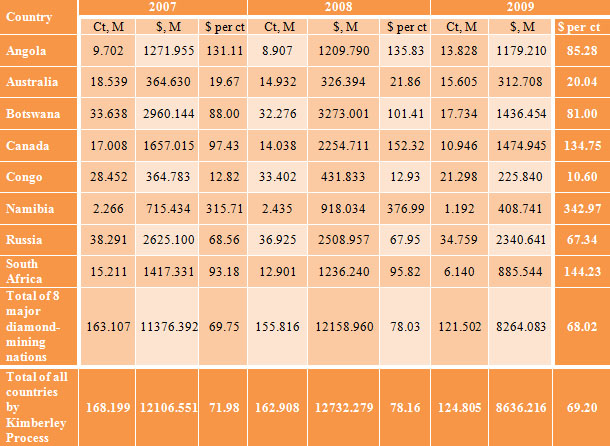
The table is compiled by the author and based on Annual Global Summary: 2007, 2008, 2009 Production, Imports, Exports and KPC Counts.
According to Kimberley Process, in 2009 Botswana’s diamond output plummeted more than twice as low in terms of value which resulted not only in ceding the first place to Russia, but also the second place which was occupied by Canada. Besides, it should be noted that Angola has considerably increased its diamond output in physical terms (up 55%), but this could not offset the slump in value output due to lower prices triggered by the crisis. Generally, the average price of recovered diamonds in 2009 went down by 11.5% in comparison with the previous year and reached $69.2 per carat. The total global output for the year was 124.8 million carats (down 23.4%).
The rough and polished diamond complex of the Republic of Sakha (Yakutia), including all the basic segments of diamond business, competes at global, national and regional levels. It is noteworthy that if the companies of the republic’s diamond-mining industry are competitive in the international market and occupy its considerable share and a leading position, the regional-level companies in the diamond-cutting industry compete basically in the internal Russian market. In the most profitable segment of diamond business – diamond jewelry trade - the Yakut companies occupy only an insignificant share not only in the global market, but also in the Russian market as well and so far can compete only at a local level (Table 3).
Table 3
Market share and sales within the Rough and Polished Diamond Complex (RPDC) of Yakutia and the Russian Federation by diamond industry segments in 2001-2009, $M/%
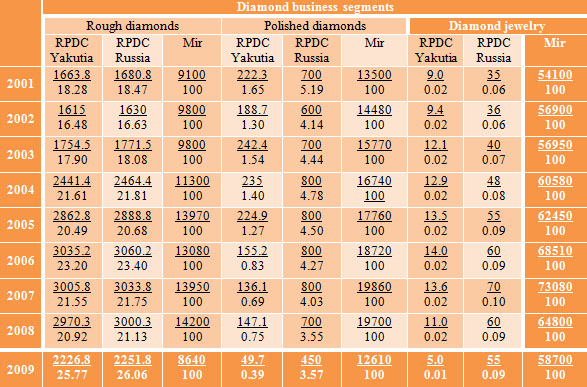
The table is compiled by the author with regard to proportions existing in the global diamond business.
It is obvious that Rough and Polished Diamond Complex (RPDC) of Yakutia and Russia possess a considerable potential for development (see Fig. 1).
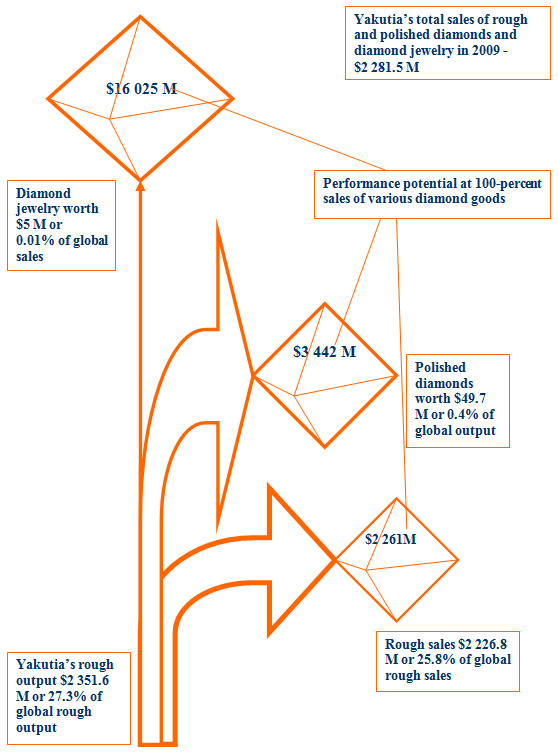
Fig. 1. A Diamond Tree Model illustrating the potential of the Rough and Polished Diamond Complex of the Republic of Sakha (Yakutia) in 2009.
To implement the existing possibility of developing the regional and national rough and polished diamond complex will require a further boost in competitive ability of companies operating within this industry so they could compete at the international level which will permit to increase their share in other segments of diamond business besides mining rough including the diamond cutting industry and diamond jewelry sales.
Yuri Danilov, Senior Research Fellow, Department of Rough and Polished Diamonds Complex Economy, Institute for Regional Economics of the North (Federal State Scientific Entity)
