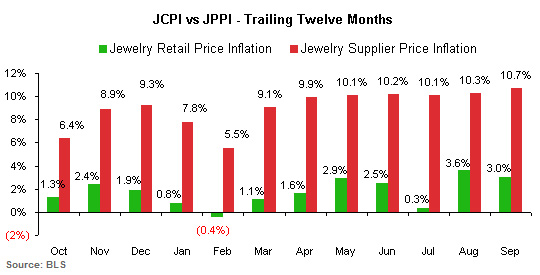
Retail jewelry prices rose notably in September for the second consecutive month, based on the latest price inflation data from the BLS, writes Ken Gassman in an analysis posted on www.idexonline.com. For the past year, he says, suppliers’ wholesale prices have been soaring, but those higher prices did not translate into higher retail prices.
Because specialty jewelers’ inventory turns only about once a year, retail jewelers have been selling low-cost, older inventory for most of the past year. Now, the inventory they are selling to consumers reflects higher costs which suppliers have been charging over the past year.
IDEX Online Research has been predicting that one of two inflation scenarios would unfold: 1) retail prices of jewelry would begin to rise; or 2) suppliers would be forced to roll back prices. Based on August and September inflation data, there has been no slowing of price inflation at the supplier level. Rather, retail prices have finally begun to move up.
Here are the highlights of the U.S. government’s price inflation report for the month of September 2010:
Retail jewelry and watch prices rose by 3.0 percent in September, well above last year’s average of 1.8 percent gain for the full year, and above a 1.7 percent inflation rate for 2010 year-to-date.
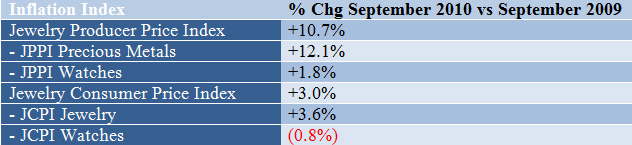
Retail prices of watches fell by 0.8 percent in September, after rising modestly in August. August was the only month this year that watch prices have edged ahead, and it appears to be an aberration.
Suppliers’ jewelry prices surged by 10.7 percent in September, far above last year’s average of +3.3 percent (revised) and above 2010 year-to-date’s inflation rate of 9.3 percent.
For the past year, jewelry suppliers’ prices have been rising steadily and sharply, but jewelry prices at the retail level have shown little inflation. This has caused a margin squeeze, particularly among retailers. In August and September, retail jewelry prices have finally begun to reflect the higher-cost goods that retailers are receiving from suppliers. In part, this may be due to retailers’ low inventory turn: the typical U.S. jeweler store turns its inventory only about one time annually. It has taken roughly one full year for higher supplier prices to show up in jewelers’ retail prices.
Most of the industry’s price inflation pressure is coming from higher precious metals prices. Gold is selling for over $1,360 per ounce, and appears headed for $1,400 later this year, according to consensus forecasts.
Platinum has averaged between $1,500 and $1,600 per ounce for most of 2010, but has pushed toward $1,700 in recent days. While this is below the levels of just over $2,000 that were experienced in 2008, today’s prices are still well above historic platinum price levels over the past decade.
The table below summarizes the JPPI and the JCPI and their major components for September 2010 as compared to the same month a year ago.
The IDEX Online Research outlook for jewelry price inflation: retail and supplier prices are headed higher. As the global economy recovers, demand for precious metals for all producer and consumer sectors will increase. Further, though demand is choppy, there are already signs that consumers are returning to their former buying habits for discretionary goods, including jewelry. This means that demand will increase, and price increases will inevitably follow.
