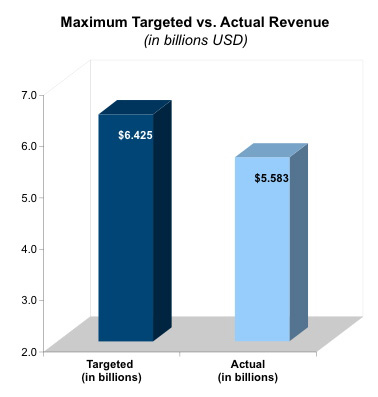
$5.58 billion raised to date, despite weak demand and underperforming share prices.
Russia and CIS IPO issuers and investors should “proceed with an abundance of caution” according to The PBN Company’s latest analysis of its IPO Tracker for Russia/CIS (www.pbnipotracker.com).
“Results of 14 IPOs from Russia and Ukraine in 2010 have been a mixed bag at best,” said Peter B. Necarsulmer, Chairman & CEO of The PBN Company (www.pbnco.com), the financial and strategic communications firm specializing in the former Soviet Union. “While a total of $5.58 billion has been raised so far this year, many of these new listings have underperformed in terms of generating demand, hitting financial targets and maintaining share prices.”
 A total of 11 Russian companies have gone public in 2010, five in the first half of the year and six in H2 2010. Three Ukrainian companies, all from the agricultural sector, have also gone to the equity capital markets. Russian companies took 95% of the total money raised. There were no IPOs from companies based in other CIS countries.
Mail.ru’s (MAILRq) recent $1 billion IPO was an exceptional success. However, more than half of the other flotations either failed to hit their announced fundraising targets or were at the lower end of their pricing ranges. For example, Russian seafood company Russkoye More (RSEA) generated $90 million after its IPO compared to its initial goal of $130.2-173.5 million. Construction company Mostotrest (MSTT) generated $388 million compared to its goal of $496 million. Non-precious metals producer IRC Ltd (1029.HK) halved the size of its IPO due to weak demand. IRC’s shares, which debuted in Hong Kong, dropped 8% on their first day of trading, and are down 13% of its initial share price as of November 22.
Stocks Declined After IPOs
Many newly public companies also saw their stock prices decline after listing. Shares of Russian pharmaceutical company Protek (PRTK) have fallen 41%, while Russkoye More (RSEA) stock has dropped 62% since both companies listed in April. Rusal’s (0486.HK) share price, which fell as much as 38% after its January opening on the Hong Kong exchange, has rebounded somewhat and closed at $1.21 on November 22, 12% below its initial share price.
“It is too early to say that a rather strong November is a harbinger for a sustainable return of the Russian and CIS IPO market next year,” said Necarsulmer. “There are too many unclear economic signals, including the state of the global economy, Russia’s real 2010 GDP and how the market will respond to Russia’s $55 billion, five-year Russian privatization program. The IPO traffic light is still bright yellow, in our opinion.”
The PBN IPO Tracker for Russia/CIS shows that of the 130 Russian, Ukrainian, Kazakhstani and other CIS companies that have reported this year an interest in going public, only 14 have actually proceeded with their plans. Five companies — Monochrystal, Rusagro, SUEK, Uralchem and Olimp — postponed or cancelled their 2010 IPOs, citing adverse market conditions. Two more companies, Pharmsynthez and EuroSibEnergo, are expected to IPO before year’s end, which would bring the total number of 2010 Russia and CIS IPOs to 16.
“While 16 companies going public in 2010 is a marked improvement from 2009, when only two companies — Exillon Energy (EXIL) and the Human Stem Cell Institute (ISKJ) — went public and raised $100 million and $5 million respectively, we are still a far cry away from the heights of 2007,” said Necarsulmer. In 2007, 33 Russian and CIS companies raised more than $34.3 billion, seven times more than the amount projected for 2010.
Strong Performance of Non-Resource Companies
Another distinguishing feature of the 2010 IPO market is the number of non-resource companies from the region that have gone public. Besides Rusal’s (0486.HK) $2.2 billion IPO in January, two other resource companies issued IPOs in 2010 — metals & mining sector player Kuzbass Fuel Company (KBTKI), which raised $163 million, and IRC (1029.HK), which raised $205 million.
“Non-resource companies, including those in the technology and innovation sectors, are pioneers of the post-crisis return to the capital markets,” said Necarsulmer. “Investors appear increasingly interested in companies with high-growth potential that can take advantage of growing consumer purchasing power and Russia’s emphasis on economic diversification and modernization.”
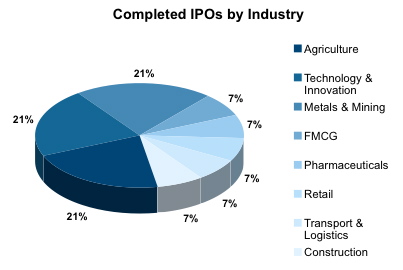 This year, three technology and innovation and three agriculture firms went public followed by one each from the retail, construction and real estate, pharmaceutical, transport and logistics, and FMCG sectors. Mail.ru (MAILRq), Russia’s leading internet company, was the best performing IPO so far this year. It placed at the top of its price range, the only Russian issuer to do so this year, and its share price has risen 33% since its November 5 IPO.
Nevertheless Necarsulmer noted, resource companies will continue to be a strong play in 2011-12. More than two dozen metals & mining, oil & gas and other resource companies have indicated that they may issue IPOs in the near term, including corporate giants Alrosa, Gazprom Neft, Interpipe, KazMunaiGaz, Lukoil, Metalloinvest and SUEK.
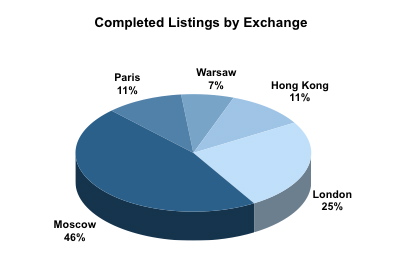
Moscow and London continue to be the IPO destinations of choice, with Hong Kong coming in third. Resource companies in particular are considering the Hong Kong stock exchange due to its access to Chinese investors and markets. No Russian or CIS companies have expressed an interest in the U.S. as an IPO destination unlike Chinese firms, which have raised almost $1.8 billion in New York in the first nine months of 2010.