By the end of the year, a new industry player and a new ‘blue chip’ may emerge on the Russian market, which may be ALROSA, writes Timur Vildanov, an analyst of “Investcafe”. In this contest, the evaluations given to this company make us recollect the recent placements carried out by companies doing their business in the Web.
ALROSA is a diamond miner, a virtual monopolist in Russia and the world’s leader in diamond output. The company chalked up its top ranking in 2009, when its output reached 32.8 million carats, while the former leader, South African De Beers, drastically cut its production due to the crisis. In 2008, the South African company’s output was 48 million carats.
ALROSA inherited the USSR diamond mining industry (NPO Yakutalmaz). The USSR started diamond mining much later than South Africa. The first industrial diamonds were mined in 1957 and that is why the Russian deposits - unlike the South African ones - are far from being depleted. Taking into consideration the huge reserves and their exploitability, the Yakut company can hold its leadership in the years to come.
The company overcame the transition period from 1980 to 1990 without appreciable losses and shocks. Starting from the Soviet time, De Beers was involved in the sales of Yakut diamonds on the world markets, so for the Russian company it was not difficult to start operating in the market economy environment. Since 2009, its cooperation with De Beers ceased. ALROSA started to export its diamonds on its own. Right now, over 70 percent of sales are made under long-term contracts with diamond end-users. The company also manufactures polished diamonds, although their contribution to the revenue is not significant.
The global diamond market is not that big. In 2009, it was estimated at $10-$14 billion. Before World War 2, De Beers completely dominated the world market. Nowadays, the South African company is losing ground to many new players, the Russian company being the key one among them.
In May 2011, ALROSA posted the data on its reserves which turned out to be 1.23 billion carats. The reserves of De Beers are not known, but ALROSA by far outstrips the other market players. The combined reserves of De Beers, Rio Tinto, BHP and Petra Diamonds amount to 735 million carats.
Several trends govern the situation in the company. The first one is the depletion of the Soviet resource base. According to the estimates given by the Vedomosti Daily, starting from 2013 ALROSA’s major mine, Udachny, will face lower yield, while it currently accounts for 40 per cent of the company’s total output.
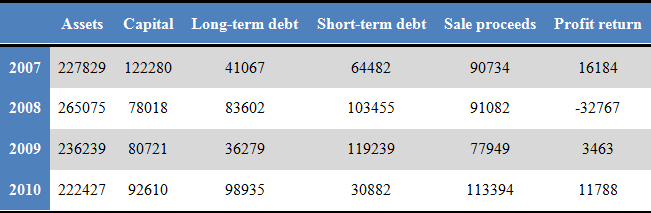
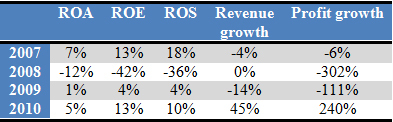
To replace the depleting capacities, the company is implementing a huge investment program. Thus, in 2010, ALROSA’s investments reached RUB 11.28 billion. According to experts, the geological prospecting performed by ALROSA exceeds the results reached in the Soviet time. At the existing mines, ALROSA is switching over to underground mining which will extend diamond production at these mines. As a result, according to the company plans, it will be able not only to stay at the present levels of output, but also increase its production by 16.8 per cent by 2018.
The second trend is the company’s plans declared in 2005 to become a global mining corporation. ALROSA, like Rio Tinto, started to acquire gas, oil, iron ore projects and took part in the development of oil fields in Angola and in the construction of a hydropower plant there. However, this made the company short of investments in Russia, a problem it is now trying to mend.
The only line of activities, except diamond mining, which the company wants to preserve, is iron mining. ALROSA owns the TIMIR Company holding 4 licenses for the iron fields whose total reserves reach 5 billion tons. The only weak point of these assets is that their development requires a $10 billion investment.
ALROSA’s significantly increased debt was the consequence of higher investments into diamond mining and diversification. In 2008, the company’s net debt reached RUB 134.4 billion being mostly short-term.
The results of the first quarter in 2011 are very promising. ALROSA was able to decrease its net debt down to RUB 86.892 billion, and its short-term debt amounts to RUB 12.266 billion only. As for the revenue and diamond production, this year will most probably be a record one. From January through March, 10 million carats were mined, and if the company is able to raise the production at the same rate, these results will not be matched by its competitors.

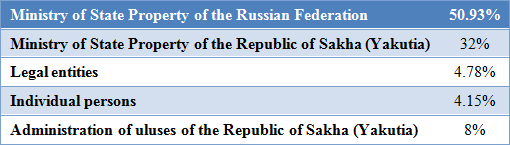
For several years, the company has been thrilling the market by its probable IPO. The IPO dates are once again announced, this time earmarked for the end of 2011. And every time experts give higher evaluations of its capitalization. In 2005, one such evaluation ordered by the Federal Agency for State Property Management, priced the company at $6.4 billion. In 2010, JP Morgan valued ALROSA at $7.3 – $9 billion. Now, on the threshold of IPO, Fyodor Andreyev, President of ALROSA, says $10-12 billion to be a fair price. And he adds that by 2015, the capitalization can reach $15 billion.
If we consider ALROSA in comparison with BHP and Rio Tinto, which are valued at four EDIBTAs, then the fair price is $4-5 billion. But most probably, the company will be priced much higher.
Investors are inclined to value narrow-purpose and highly specialized and unique companies much higher than diversified holdings. There exist not so many mineral deposits like the Russian ones in terms of their size and that is why if the world’s new leader in diamond mining will float its shares this may make Yandex turn green with envy.
