In 2010, Russia ceded its leadership to Botswana by the value of diamonds produced, but retained the first place in terms of their physical output.
On August 1, the Kimberley Process released its annual report for 2010. The data taken from this report is given below (Table 1).
Table 1
Diamond production by country in 2010
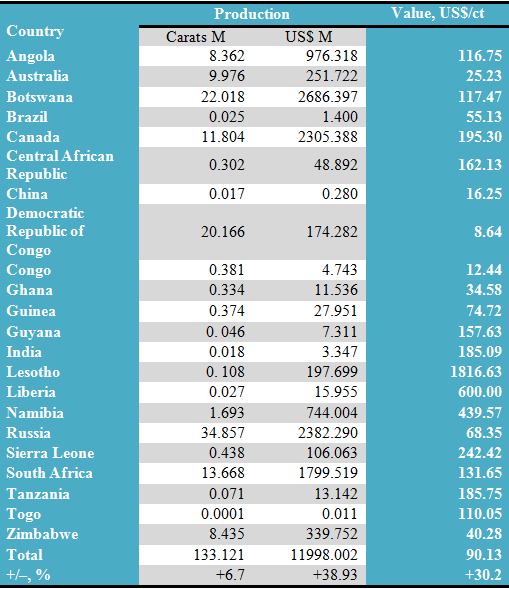
Kimberley Process data, 2011
Overall, diamonds produced in 2010 went up in their average price by 30%. Botswana, despite the fact that it recovered one and a half times less diamonds than Russia, won back its leadership by the value of rough diamonds selling them for a total of $2,686.4 million. The value of diamonds grew to be much higher compared to the crisis level of 2009. Canada’s performance is also noteworthy since this country surpassed pre-crisis levels having sold almost as much diamonds as Russia (US$2,305,390,000), although its output was more than three times lower. The most expensive diamonds were produced in Lesotho, where the cost per carat averaged nearly US$1,817. Significant amounts of diamonds have been mined in the Democratic Republic of the Congo - more than 20 million carats, at the lowest average value of US$8.64 per carat.
The greatest amount of rough was produced by 8 countries, which extracted about 84% of diamonds by volume and over 94% by value (Table 2).
Table 2
Diamond output in major producing countries in 2007-2010, according to Kimberley Process
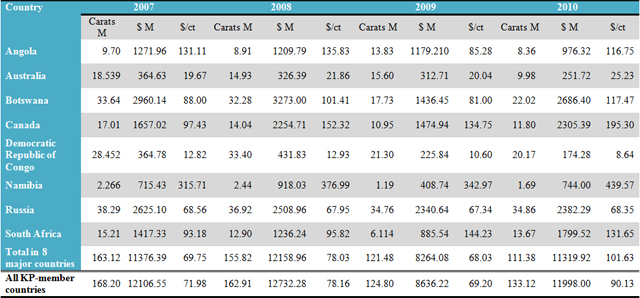 The table is compiled by the author and based on the data from Annual Global Summary: 2007, 2008, 2009, 2010, Production, Imports, Exports and KPC Counts
After reaching maximum output in 2005-2006, world diamond production in 2007 fell to 168.2 million carats. The global economic crisis, despite a decline in demand and prices for diamonds at the end of 2008, had no time to have a significant impact on annual diamond production, as evidenced by annual growth of 5.2% in value terms, but during the acute phase of the crisis in 2009 diamond output dropped to 124.8 million carats. The data for 2010 indicate that recovery in production is slow, which is explained by the depletion of rich and easily accessible deposits and a large-scale shift to less productive and more costly underground mining. However, the increased demand in the first half of this year has led to a sharp rise in diamond prices and improved the financial performance of mining companies.
Starting from 2004, the Russian Ministry of Finance annually provides information on production of natural diamonds and the structure of their exports and imports, which is included into the consolidated annual report of the Kimberley Process. In addition, every six months the ministry's website provides data on the volume and value of diamonds mined in the country. Table 3 summarizes the results of diamond output and export in the Russian Federation in 2003-2010.
Table 3
Diamond output and export in the Russian Federation in 2003-2010
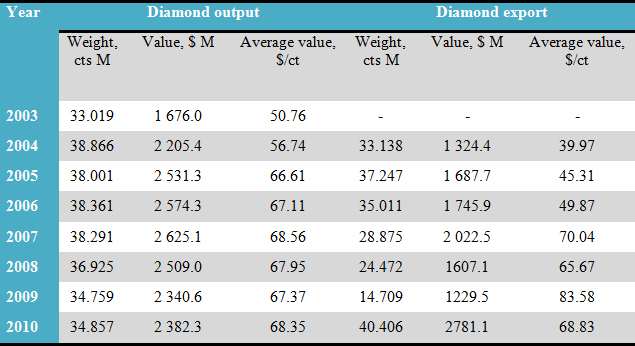 The table is compiled by the author and based on the data provided by the Ministry of Finance and Kimberley Process
The analysis of the Kimberley Process data shows that before 2005 rough diamonds mined in Russia, as well as around the world, significantly increased in their value. The average value of mined diamonds in U.S. dollars remained almost flat in 2005-2010 ($66-68 per carat). Prices for exported rough grew until 2007. Further fluctuations in the value of diamonds exported from the Russian Federation in 2008-2010 were likely to have been caused by a change in qualitative characteristics of exported rough, rather than by an increase or decrease in prices for natural diamonds. In 2009, Russian companies sold diamonds mainly to Gokhran of Russia, the state repository, while the average export price of rough diamonds was maximal for the period under review.
In 2010, there was a price reduction to the level of the average cost of production, which was probably due to the export of low-grade or small diamonds. Otherwise, it may be explained by a very weak marketing strategy or sales of rough through a chain of intermediaries.
Yuri Danilov, Ph. D., Senior Research Fellow, Institute for Regional Economics of the North
