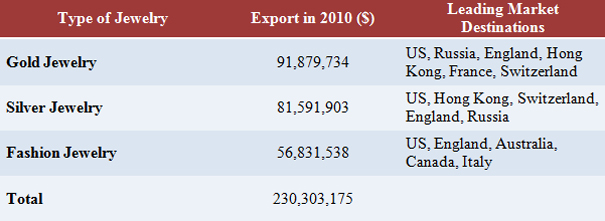
2010 was not a great year for the Israeli jewelry industry. The annual export figure - about 230 million dollars -represents a slight decline compared with 2009. Will the market recovery in 2011 bring about brighter developments?
The Israeli jewelry industry has known ups and downs over recent years, and despite the challenges it has managed to maintain its position among the world’s jewelry centers, writes Rachel Bezalel, Acting director of the Jewelry Division of the Diamond, Precious Stones and Jewelry Administration, Israel Ministry of Industry, Trade and Labor, on www.israelidiamond.co.il. This can be credited to the industry’s advantages over other countries, derived from agreements that allow duty-free trade with signatories, the diverse activity of the industry and its members (modern shops that engage in R&D and employ innovative techniques), the use of diamonds and other gems polished in Israel, a world manufacturing and trade center in this field, the industry’s original, innovative designs and its diversity (longstanding, experienced professionals alongside a young generation of designers) and, together with all these, adaptation of manufacturing and designs to international demand.
Despite these relative strengths, we cannot ignore the impact of the global economic crisis on Israel, as well. The crisis affected the industry mainly because of the tightening of credit limits, which led to a considerable decline in consumption, investment in Israel and around the world and a decline in the scope of export.
In addition to the crisis, many Israeli jewelry makers and designers who sought to make an international name by exporting encountered numerous barriers, including difficulty maintaining a cash flow to finance export activities, inability to compete with the prices of foreign manufacturers, the cost and logistics of operating a sales and marketing network, uncertainty regarding business with parties overseas, lack of know-how in entering new markets and others.
As a result, many jewelry manufactures began directing their resources to the local market and some changed their mix of products in order to increase sales profits in Israel and survive the crisis overseas.
Scope of Export
The export of jewelry from Israel in 2010 totaled approximately 230 million dollars, a slight decline of about 4% compared with the 2009 figure of 238 million dollars. The greatest decline was recorded in silver jewelry, while the export of gold and fashion jewelry increased.
The United States was, and still is, the main export destination. However, the data indicate a shift in the trend, with growing focus on Europe and the Far East.
Segmentation of the scope of export by blocs of countries indicates that jewelry export to the US dropped by about 10% in 2010 compared with last year, while jewelry export to Europe increased by 6% and to the Far East by 4%. In comparison with the impact of the global crisis on other countries, the Far East market remained stable. This explains the considerable increase in the gold jewelry market.
Diamond jewelry is considered an exclusive product, particularly in India and China, and the market is growing, especially in the field of wedding jewelry. Along with a rising standard of living and growth of per capita income, many women are purchasing large quantities of gold jewelry, especially for engagements, weddings, births, holidays and other special occasions. With the strengthening of the middle class, there is greater demand than in the past for jewelry set with diamonds and precious stones, leading to a rise in the number of consumers and buying power.
Consumers in the Israeli and the international market are strongly influenced by the design of the jewelry and not the material from which it is made. Therefore they generally prefer fashion and silver jewelry, which cost significantly less than gold jewelry. However, gold jewelry has recently become available in more fashionable and delicate designs with less gold content, accounting for the increase in gold jewelry purchases and its preference over silver, which is considered less exclusive. However, as design becomes more important, leading to livelier demand for fashion and silver jewelry, the trend of buying jewelry as a financial investment is declining.
Government Assistance
As part of its multi-annual work plan, Israel’s Ministry of Industry, Trade and Labor has undertaken to promote the Israeli jewelry industry and increase the export of jewelry from Israel. We offer the following measures to encourage export and assist the jewelry industry:
Industry-wide cooperation by means of government-financed marketing consortia, which are intended to enable several companies to market products to new markets together, creating a critical mass for market penetration and sharing marketing costs;
Sponsorship and exposure at the Israeli Jovella Jewelry Exhibition, which has become an attractive venue for jewelry manufacturers and diamantaires to display their designs to buyers, wholesalers and owners of jewelry stores and chains from Israel and abroad;
Government-guaranteed loans to finance marketing activities;
Training and guidance in exports;
Increased access to economic attaché offices abroad;
Professional assistance, consultation and supervision.
In summary, the trends suggest that within a year or two the United States will recover from the crisis and continue to be the main destination of Israeli jewelry export.
As our industry is involved in luxury products, the forecast for the next two years is one of increased consumption of fashion jewelry, which is less expensive than exclusive jewelry.
Nevertheless, jewelry consumption in Europe and the Far East is on an upward trend and it is reasonable to assume that demand in these markets - especially for gold jewelry set with gems - will continue to grow. It would be wise to pay special attention to the change in international fashion trends, which are directed more towards the middle class in China and India. This is because of the fast economic growth and exposure to the influence of the West, which are leading to increased buying power in the young middle class and, ultimately, to growth in the demand for jewelry.
We hope that the optimistic forecasts and the government measures will help the jewelry industry recover its level of activity before the crisis.
Jewelry Exports from Israel 2010