Strong winds are blowing dark clouds over Europe. The continent's collective economic situation is feared to be on the brink of a major collapse, one that may lead to the disbandment of the Eurozone, Edahn Golan says at www.idexonline.com. Some of the most talented and farseeing economists are warning that a drop into a major recession is almost inevitable. Greece and Italy took so much attention recently that outside of Europe very few still mention Portugal. They have captured everyone’s attention so much that who even remembers that it was Ireland that started the wave of collapses only two years ago? With Spain joining the fray, it is no wonder that some are wondering if Germany shouldn't simply admit that the unified currency experiment has failed and walk away from it.
To borrow an illustration from engineering, imagine a building whose pillars are shaking. A small quiver is unpleasant while a bigger shake may result in some cracks in the wall and items falling off shelves. If the pillars are wobbly, the many small twists and waves can bring down a major structure. That is the fear many have for Europe. The financial fundamentals are rocking and everything its supporting just might crash to the ground.
The U.S. economy may enjoy greater flexibility, but it too has its issues, including the almost inevitable decline into another recession. If the West is hurting, the producing countries that depend on the West's buying power will also hurt, making a global economic recession a tangible possibility.
This raises the question of how commodity prices will react. In less then a decade, platinum prices have doubled, oil prices have tripled and silver has skyrocketed by nearly 600 percent. Gold, a traditional “safe harbor” commodity, shot up some 450 percent.
This means that, if someone had bought gold every time they had a child, by the time the child grew up and was ready to go to college, their parents would have a very nice return on their investment. That is a long-term investment. What happens if we urgently need money – as often happens in a time of economic crisis? In that scenario, oil, gold and other major commodities see their prices drop, making the return on investment far less attractive.
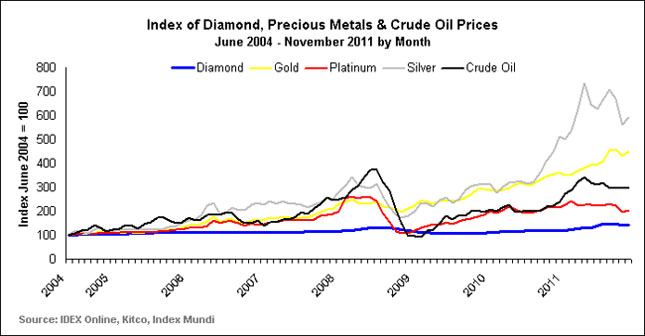
Between July and November of 2008, gold dropped 14.2 percent, crude oil lost 45.7 percent, yet the asking prices of polished diamonds declined by less than 1 percent.
Long-term, the average price of diamonds has increased by about 40 percent since June 2004, when IDEX Online started tracking prices. Diamonds are a far more stable, less volatile store of value. Surprising?
The wholesale diamond industry naturally thinks in terms of jewelry. In a downturn economy, who wants to spend money on expensive jewelry when holding on to your house is a battle? However, during the global economic downturn of 2008-2009, diamond prices did not drop that much because the diamond industry is small, and speculative buying – of the kind that exists for gold, for example, is not a major issue for polished diamonds.
Moreover, in December 2008, consumers bought diamond jewelry despite the crisis.
Several conclusions can be drawn from this situation. For example, if diamond prices were less of a secret, and buying and selling was easier, then maybe diamonds could become a safe harbor where some savings are used to protect value at a time of economic stress. Today that is impossible for consumers, and very difficult for financial institutions.
A number of attempts to establish diamond funds have been made, with more in the works. A diamond derivatives market, for example, would offer investors the opportunity of tracking real prices.
At a time when markets are unstable, the need for transparent pricing becomes very clear. Once that is achieved, the diamond industry will enjoy an infusion of outside money, allowing it to grow, prosper and expand.
To reach transparency, the industry will need to display confidence, and the financial markets foresight, and this is the best time to do it – just as the ground starts to shake beneath our feet.
