Jwaneng fact sheet
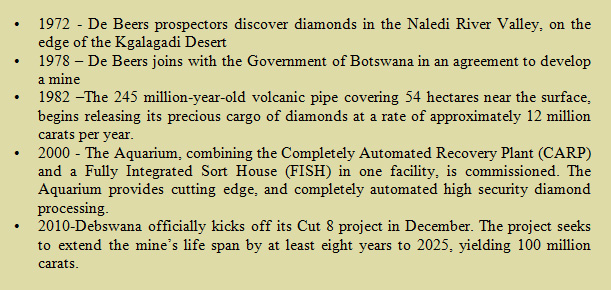
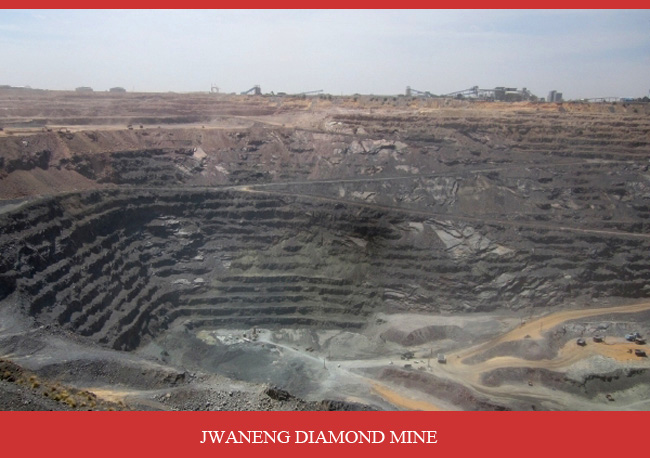
Situated about 160 km southwest of Botswana’s capital, Gaborone is a diamond mine called Jwaneng.
The Jwaneng pipe was discovered in the Naledi River Valley in 1972 by De Beers, but mining operations fully commenced in 1982.
Owned by Debswana, a joint venture between De Beers and the government of Botswana, Jwaneng, which is considered the richest diamond mine in the world by value, contributes about 60-70 percent of the mining company’s total revenue.
Jwaneng mine’s geology
The mine sits atop the convergence of three kimberlite pipes. These pipes cover 128.5 acres at ground level, and meet just below the earth’s surface; hence, the diamonds are mined from an open pit.
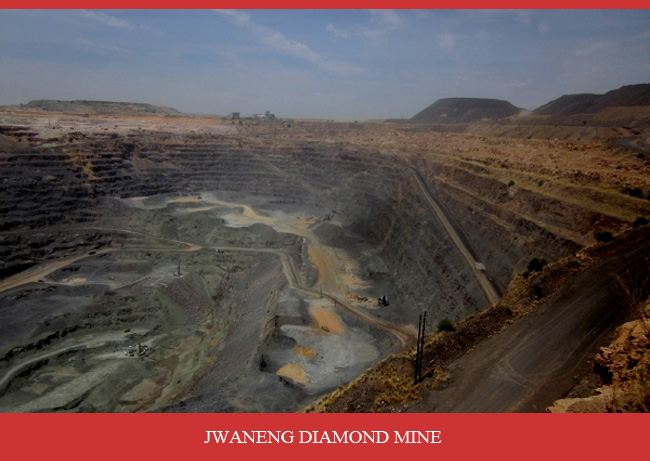
The kimberlite pipes at Jwaneng intruded shales of the Transvaal super group about 150 million years ago, and were older than most kimberlites in southern Africa.
They are filled with crater-facies material to a depth of 600 metres.
In-pit crushing
The Jwaneng mine Aquarium plant was the first of its kind in the diamond mining industry. It has the completely automated recovery plant (CARP) and the fully integrated sort house (FISH).
The plant maximises diamond security while optimising recovery through the use of the latest x- ray machine technologies.
The Aquarium project reached full capacity during 2003.
Cut 8 project
With the lifespan of the current Cut 6 and Cut 7 projects nearing an end, Debswana saw the need to extend the life of Jwaneng.
In November 2009 the company’s shareholders approved an extension project, which they dubbed Cut 8.
The $3 billion expansion project was meant to extend the life of the mine out to 2025 and gain access to an additional 100 million carats.
"Without it (Cut 8), mining at Jwaneng would be severely curtailed post 2017 as ore from Cuts 6 & 7 would almost be depleted," said group public and corporate affairs manager Esther Kanaimba-Senai.
She said diamonds from Cut 8 would only come on stream in 2017.
The project was set to strip 713 million tonnes of waste, exposing an additional 75 million tonnes of diamond bearing ore.
Debswana chief executive Jim Gowans said 28 million tonnes of waste material had already been moved in 2011, adding that the removal was expected to last about five years before commercial mining can commence.
His projections expected the Cut 8 project to be completed end of June.
However, the mine’s public relations officer Allan Molefhe told Rough & Polished during the last week of June that construction progress of Cut 8 was close to target and almost 100 percent complete.
Jwaneng general manager Balisi Bonyongo said two further cuts were possible to enlarge the size of the Jwaneng pit and deepen it to 850 metres, the financial limit of the open-cast operation.
He said studies for Cut 9 which will take the life of mine to 2030 and add a potential 40 million carats to the life of mine were under review.
However, Gowans said that a decision whether to invest in a Cut 9 extension would be made by 2016.
“The decision to do Cut 9 is all going to be driven by price and cost differentials,” he said. “Then you would have to look at underground but that resource won’t be so significant because the fact that we can do a deep open pit doesn’t lend itself to a deep underground mine.”
Safety issues
Jwaneng Mine had been in a position to maintain an “excellent” safety record and officials said that the mine had since 1984 achieved one of the lowest disabling injury incident rates in Botswana.
However, in June 2011 a contractor was electrocuted during the commissioning of a new drill rig at the mine.
This year, the month of June also proved to be another disaster month for Jwaneng, as it was forced to suspend all production activities following an accident, which claimed the life of its employee.
Kanaimba-Senai said Motshwari Raseiteo met his death when the mine pit experienced a slope failure at Cut 6.
Sources say 15 other workers that had been trapped together with the deceased were successfully rescued.
Diamond output
Production at Jwaneng normally varies according to mining plans of approximately 12.5 to 15 million carats per year.
In 2008 Jwaneng produced 13.674 million carats from 15.766 million tonnes treated, and in 2009 Jwaneng produced 9.04 million carats from 6.06 million tonnes treated.
With the global economic recession, 2009 was still considered to be an exceptional year in that production was reduced in line with demand for diamonds from the Diamond Trading Company sight holders.
However, output leaped to 11.5 million saleable carats in 2010 before it dropped to 10,641 million carats the following year.
The drop in production at Jwaneng was deliberate as the company concentrated on the Cut-8 project as well as due to the global economic uncertainties.
Debswana was also focusing on waste mining and carrying out care and maintenance during this period of softness in the diamond market.
This, it said, would help the company position itself to ramp up production towards the end of the year, or in 2013, when the market is expected to recover.
Mathew Nyaungwa, Editor in Chief of the African Bureau, Rough&Polished
