The end of the diamond century
Since 2000, the global diamond business went through epochal changes which now determine the prospects for its development in the foreseeable future. First of all, they are related to the globalization of the world economy, which led to fundamental transformations in the structure and organization of trading in rough diamonds by the world's two leading diamond mining companies: De Beers and ALROSA.
De Beers, which used to be a monopolist in the rough market during the last century, has consciously chosen a strategy focused on modern market competition, and thus has defined a long-term development vector for the the diamond business. First of all, De Beers was transformed into a private company from a public corporation. In 2000, the company was valued at $17.6 billion. Then, after the Oppenheimers sold their 40-percent stake to Anglo American for $5.2 billion closing the deal in 2012, the diamond miner turned to be wholly dominated by the above-mentioned mining holding. Today, the company’s shares are distributed as follows:
- Anglo American plc - 85%;
- Botswana’s government - 15%.
Currently, the diamond asset held by Anglo American may be valued at $13 billion. If we consider that earlier De Beers produced 38.7 million carats of diamonds, as well as the existence of a single-channel marketing system, then the sale price was probably quite justified given the decline in production to 25.8 million carats in 2012 (over 33%). On the other hand, for the global diamond industry this was the first wake-up call raising the question why the Oppenheimers preferred to quit the diamond business after being its owners for almost 90 years. Perhaps, this was due to increased risks for the global diamond mining inflicted by the development of technologies making possible the synthesis of high quality artificial diamonds, which may trigger a sharp decline in production of natural diamonds in the world.
Slump or planned rundown?
If you look at the quarterly dynamics in diamond mining by Beers in 2010-2012 (Figure 1), you will see that it is seasonal with a decrease in winter and reaching a maximum in the summer quarters. However, it can be noted that diamond mining steadily declined in recent years, as indicated by the trend graph. In 2012, the slump in production started in the second quarter and it will be offset by a rise likely to begin a little earlier, in the first quarter of next year. De Beers is constantly monitoring the situation in the diamond market, and depending on market conditions can easily increase diamond production to 8-9 million carats in a quarter, but the company is set to stabilize it at 28-30 million carats per year. Its revenue growth will be achieved due to growing rough prices.
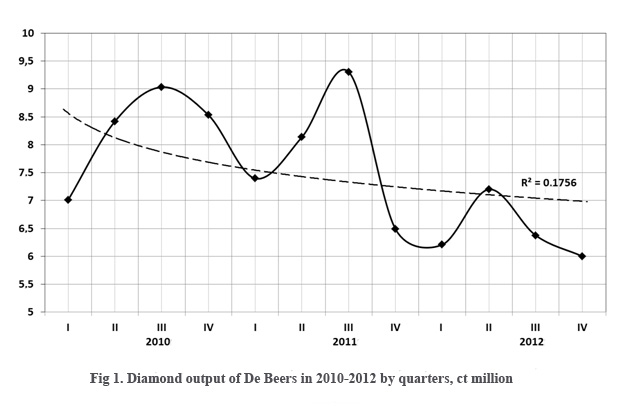
Fig. 1. Quarterly diamond output by De Beers in 2010-2012.
Diamond output forecast for De Beers companies in 2012
Based on the current trend, the author offers a diamond output forecast for De Beers and its subsidiaries (Table 1).
Table 1
Diamond output and ore processing by De Beers companies in 2011 and forecast for 2012
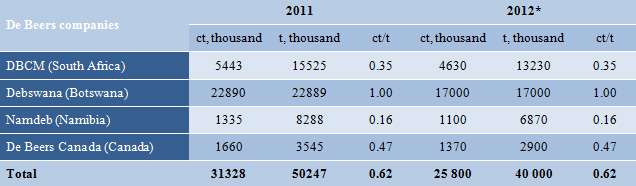
* Author’s forecast
Thus, De Beers’ diamond output in 2012 will not exceed 26 million carats, and Russia’s ALROSA will maintain its position as the world’s top diamond producer by volume. However, De Beers will remain the leader in terms of value since DTC’s sales appear to be slightly over $ 5 billion.
Options for further development of De Beers’ diamond business: sale of core assets, stabilization, IPO
Unlike ALROSA, which started to get rid of non-core assets, De Beers was selling out depleted mines. In 2006, the company stopped ore extraction at the Koffiefontein Mine, which yielded the first diamonds as early as 1870, and in 2009, it closed Cullinan, which was then sold to Petra Diamonds. In 2011, De Beers Consolidated Mines sold Namaqualand diamond mines located in South Africa to Trans Hex Group Ltd.
Although, potentially, De Beers can produce up to 36 million carats a year, it seems more likely that it will level production at 30-32 million carats depending on market conditions and trying to prevent a decline in diamond prices from the reached record levels. The deficit of rough diamonds expected in the period up to 2020 will permit to maintain rising prices for sold rough on the background of an almost fixed global diamond output.
Anglo American, now the owner of an 85-percent stake in De Beers, has an opportunity to turn public its diamond assets to float some of their shares in the free market (IPO).
Yuri Danilov, Ph. D., Director of the Department of Regional Subsoil Management Economics, Institute for Regional Economics of the North at Ammosov North-Eastern Federal University
