The International Gemological Institute (IGI) is the world’s leading and largest independent gemological center, whose certificates are a guarantee that a diamond or some other gem or jewelry piece you buy is genuine and of good quality.
In addition to Antwerp, IGI laboratories are opened in 17 cities in Europe, the United States, Canada, India, China, Israel, the UAE, Japan and Thailand.
Michael Majorovic, the IGI representative for public relations and media, has kindly explained the inner workings of the IGI laboratory in Antwerp to the correspondent of Rough&Polished.
As you enter the Antwerp branch of the Institute you see a reception area, where customers bring their diamonds for examination. It is here that all the necessary information is entered into the computer, including the customer’s requests as to the format of grading reports. It can be full-size (like the A4 paper format), medium (the size of a passport) or small (the size of a bank card).
Once all the registration information is entered, the customer is issued a receipt, and the diamonds are submitted for analysis at the laboratory. Here the stones are first of all measured using laser technology. This process takes only 30 seconds, while all the pertinent data are processed and put out by computers.
After measuring, the diamond is identified by means of special equipment, which is Diamondsure manufactured by DTC, De Beers’ arm selling rough diamonds. Diamondsure is used to determine whether your stone is natural or synthetic.
The next step is to grade diamonds by color and clarity against a set of masterstones. If the diamond is big, gemologists evaluate it under the microscope twice and sometimes it takes them even three times.
"For the diamond market, speed is a key factor. In the current economic environment, people want to get results quickly. And we cannot afford to let stones idle in the lab for weeks," Majorovic says.
According to him, the laboratory receives 700 to 2,000 stones for examination every day. As for the cost of grading services, it depends on the carat weight. Thus, if a diamond is 0.5 carat in size you will have to pay 40 euros, if it’s one carat - 57 euros, two carats - 114 euros.
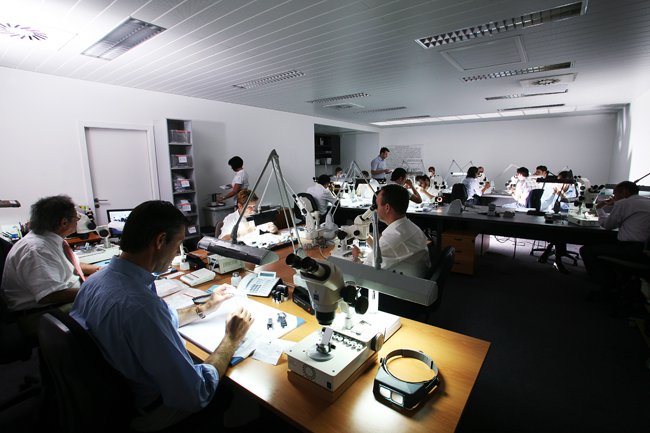
To make an expert assessment of diamonds, which, for example, came from Turkey, will take you 5-7 business days. Once the stones come out of the lab, they are transferred to the back office, where all the data are summarized on the computer and e-mailed to the customer so that he or she could immediately see the results. After that the lab sends the grading report itself, which may be full, medium or small depending on the request made by the customer when the stone was accepted for examination.
The IGI laboratory provides customers with additional services, such as marking diamonds with a laser beam. Usually the lab engraves the number of a grading report on the diamond girdle, but you can also put phrases like "I love you" or capture the date of your wedding or birth, but not the characteristics of the stone. The marking, which is produced by a cold laser, does not affect diamond clarity.
The report includes a mandatory photo or text of the produced marking. To make this kind of marking will cost you only 10 euros.
In addition, the IGI laboratory offers its customers services to correct flaws existing in their diamonds. In the current economic situation, diamonds are cut and polished in the countries having cheap labor - in China or India, where one stone is usually processed by up to eight people handling different parts of the diamond and these people are not gemologists.
"When we propose to fix a diamond, most customers agree. We improve its clarity, cut and symmetry," Majorovic says.
IGI also organizes introductory courses for those wishing to work in the diamond industry. Thus, a 10-day training course for future diamond sorters, after which they get a diploma, costs 1,150 euros.
Getting a job at IGI, the new employee will undergo additional training, which lasts from six to twelve months before he or she will be entrusted with making grading reports in some area.
The IGI Gemology Schools are now opened not only in Antwerp, but also in 17 other cities around the world.
The IGI lab in Antwerp employs about 50 people, while globally the Institute has 600 people working in its laboratories.
Alex Shishlo, Editor in Chief of the European Bureau, Rough&Polished, from Antwerp
