The economic crisis has dramatically changed the balance between diamond mining, diamond manufacturing and diamond trading companies, which prevailed before the downturn. Under these conditions competition between them has sharply aggravated. Reduced demand for diamonds and diamond jewelry in 2012 led to a change in the proportions across the diamond business sectors and performance in the global diamond pipeline in 2012 was different from one year ago.
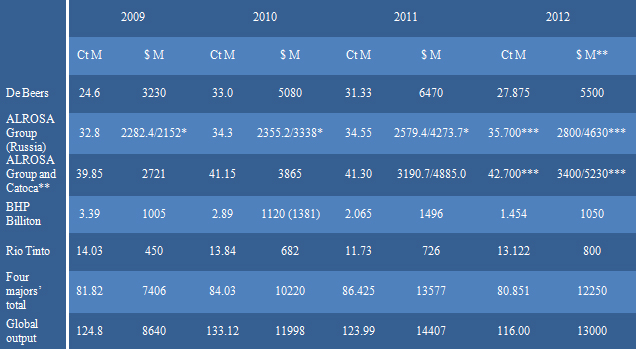
That said, it should be kept in mind that the major role in the diamond mining industry is played by four major companies, which pursued a coherent policy and not only managed to maintain stability, but also their leading position in this segment of the market (Table 1).
Table 1
Diamond production by the world's largest mining companies in 2009-2012
The table is compiled by the author based on the annual and quarterly reports from De Beers, BHP Billiton, Rio Tinto, OAO ALROSA and Sociedade Mineira de Catoca for 2009-2012.
* Diamond output / diamond sales
** Estimate
*** Nizhne-Lenskoye included
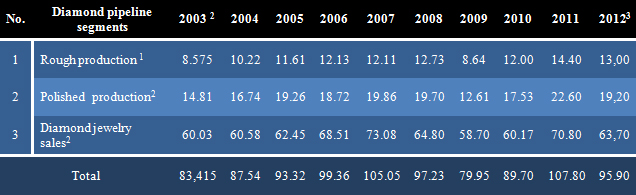
The world's diamond mining majors account for about 70% of output by volume and more than 94% by value after this sector recovered from crisis. Using these proportions we can roughly determine the world's diamond output. However, if in a stable market this method allows to produce reasonably accurate forecasts, this kind of assessment may result in significant errors in times of crisis. A while back, to reach a more accurate estimate we used the ternary diagram, which reflects all the three segments of the diamond market. Based on this, using the method of three-dimensional analysis and taking into account the assessments of the diamond business segments we calculated the diamond pipeline metrics in 2012 (Fig. 1, Table. 2).
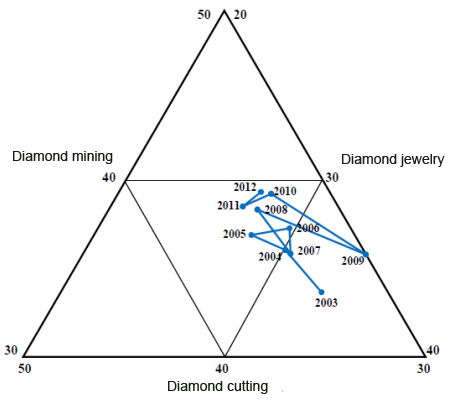
Fig. 1. Changes in the diamond pipeline structure in 2003-2012.
The triangular diagram shows a gradual growth of the diamond mining industry on the backdrop of an almost constant share maintained by the diamond manufacturing industry, while the segment of diamond jewelry sales is decreasing. The global financial crisis dramatically changed the correlations in the diamond pipeline in 2009 due to a sharp decline in performance in the first two segments of the diamond market. Obviously, the diamond cutting industry is directly dependent both on the cost parameters set by diamond mining and on demand for diamond jewelry and therefore appears to be the most exposed to crisis manifestations. On the other hand, there are prospects to maintain global diamond production at the level of 115-125 million carats a year, but with demand overwhelming supply mined rough diamonds will be growing in value. As the global economy tends toward recovery from crisis, the diamond cutting industry and jewelry industry will also ramp up their performance.
Table 2
Global diamond pipeline in 2003-2012
$ Billion
1 According to the Kimberley Process (2003 - According to Chaim Even-Zohar Diamond Pipeline 2003).
2 According to Chaim Even-Zohar Diamond Pipeline 2003-2011.
3 2012 - Author's estimate.
Using the three-component diagram and taking into consideration the current trends in the global economy and in the diamond pipeline segments we made a forecast of further changes in the segments of the global diamond business for the period until 2030 (Table 3).
Table 3
Projected values of the world diamond pipeline in 2013-2030
$ Billion
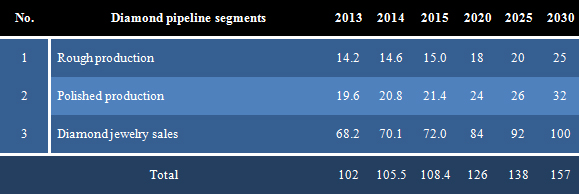
Based on the projected values it may be said that mined rough diamonds will go up in their value almost two times by 2030, whereas manufactured polished goods and diamond jewelry sales will add only two thirds to their value.
Yuri Danilov, Ph. D., Director of the Department of Regional Subsoil Management Economics, Institute for Regional Economics of the North at Ammosov North-Eastern Federal University
