Good news, bad news for the jewellery business. The good news is that the average price of gold has been dropping for the fifth consecutive month; the bad one is that strong oscillations are making purchases very risky.
The average price of gold has constantly declined during the past months. Such situation has unfolded despite the warning of many analysts, who thought that a series of crucial international events would have pushed gold up again.
First it was the Fiscal Cliff debate in the United States when, among fear of severe budget cuts and tax raise, December prices were expected to rise up to $1730 per ounce, while in fact they fell under $1690.
Then it was China, which, after the Lunar New Year holidays in February, was expected to harvest underpriced gold to increase its stockpiles. That just did not happen.
Finally, it was the fear for an inconclusive election in Italy on February 25th-26th, which could have strained the resilience of the Euro currency, resulting in a panicked assault to gold as a safe haven. Well, yes the Italian elections proved to be inconclusive and yes, as a result investors turned to gold. But just for one day. After a brisk rise on the 26th, gold plummeted to pre-election levels the day after and kept going down until the end of the month.
The reason why gold is not doing as well as forecasted is that the global economy is finally recovering. In the last months the Wall Street stock market has performed above expectations, with the Dow Jones index setting its new record high at the beginning of March. As a consequence investors feel now confident enough to sell their gold and bring the money back into the stock market again.
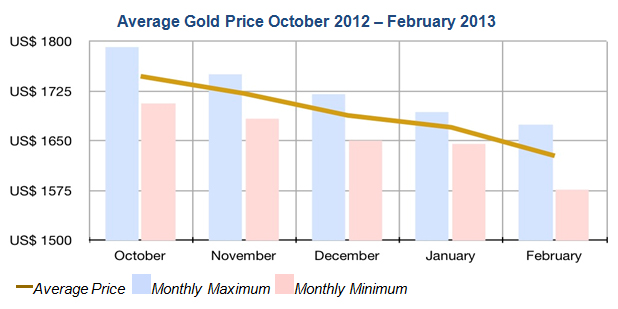
Between October and February the average price of gold per ounce has declined over 100$, from 1750 to 1630, losing around 7% of its value. Such result was so unexpected that Goldman Sachs had to release a heavily modified forecast of the price of gold for 2013, according to the Wall Street Journal. From the anticipated rise to $1800 in 2013, gold is now expected to drop down to1550$ and to keep falling through 2014, down to $1450.
Long-term forecasts have been reviewed because, should gold price keep its steady decline, the market could reach the “death cross” threshold, a situation where the 50-day moving average falls below the 200-day moving average. Such an event often signals the beginning of a sharp and prolonged price crisis.
Contrarily to what one may think, this is not necessarily good news for the jewellery business. Yes, jewellers have been complaining for years about customers running away from gold products because of their price, so in the long term a price reduction could benefit them all. Yet this unexpected fall is creating more problems than it solves.
First of all, after a 400% increase in the last eight years, it is quite unlikely that a -7% drop in the last six months will push flocks of customers back into the stores; gold is still too expensive for many common consumers. These fluctuations are relevant for investors and professionals who deal with large quantities of gold, but the benefits for final users are almost imperceptible. Even if prices dropped another 10 or 20% it would not make much difference.
Second, the fact that this drop has been so sharp and unexpected wrong-footed not only investment banks, but also many jewellers who relied on optimistic forecasts and decided to stockpile gold just few months ago. Now many of them see their gold reserves becoming less valuable every day, with no substantial increase on demand for gold jewellery.
Ideally, the solution would be to buy only small quantities of gold, make jewellery and sell it as soon as possible, so that it does not stay too long in banks, stores or jewellery shops. But the truth is that volatility is not only a long-term problem, but also a short term one. The chart below shows that while the average price drop has been steady, there have also been strong oscillations between monthly maximum and minimum prices; moreover, the fact that every month’s maximum price has been sensibly above the previous’ lowest, indicates a series of unpredictable bounces in gold price. This means that delaying purchases might not always be the best strategy. Buying in the wrong period of the month, week, or even of any given day could result in a substantial loss of money.
In conclusion: Gold will not stop giving headaches to the jewellery business. Only few months ago everyone was asking for it to stop climbing; Now that it finally has, everyone seems to be begging: “stop shaking!”
Matteo Butera, Rough&Polished
