“Wipe your feet thoroughly, please! Especially, when you are leaving!” That was both the request and order the Rough&Рolished correspondent heard in all of the ALROSA units: at the factory of Nyurba GOK (mining and concentrating mill), and at the Mirny-based Internatsionalny mine, and in the Diamond Sorting Centre (DSC). «So that none of our products could stick to your soles,” joked the people working at the Russian diamond mining giant. And they added quite seriously: “Not a bit of diamond dust should get outside!” Probably, such careful attention to cleanness and thrift could help in achieving the top-priority task set by the ALROSA management - to make the Company a leader in the global industry by 2018. However, it is difficult to foresee whether the diamond miner requires this noble but heavy burden so much.
Rattling Screen Racks
“Ann, take them under your supervision,” we hear from the whispering handie-talkie carried by the Nyurba GOK security woman-guard accompanying the group. “Confirmed. Switch off the alarm system”, our strict escort replies. The doors of the Processing Factory could be open only after the automated security system has been cut off. Earlier, we passed through the checkpoint surrounded by a barbed wired high fence, a ‘walk-through metal detector’, walked through the open GOK territory accompanied by the security officer (mainly women work there) and passed under the unsleeping vigilance of watching cameras set all along the factory security perimeter.
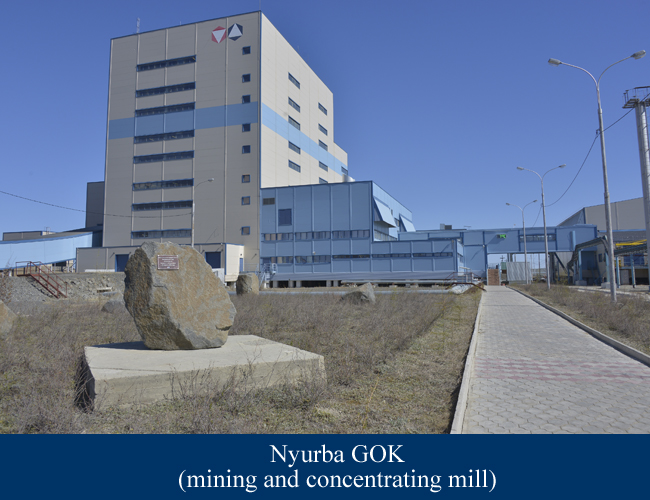
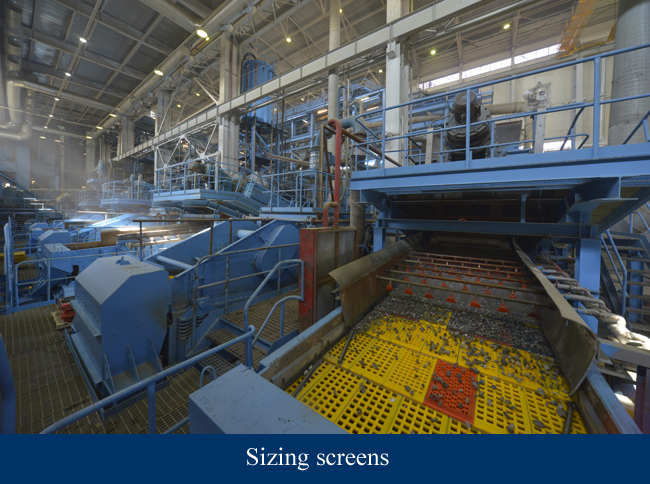
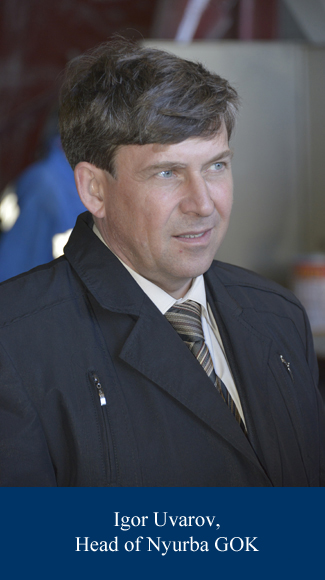
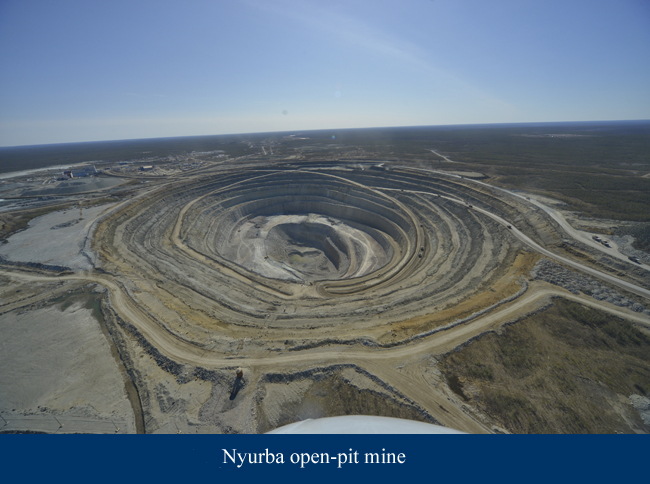
“Actually, Factory No. 16 was completed in a record-breaking time. It was put into operation within 530 days,” proudly says Igor Uvarov, Director of the Nyurba GOK. “All the world expertise was used in its design and development.” “Please, look out! Do not fall down into the mill! Put on your safety helmet!” says the director helping the careless and awkward reporter. The ore comes to the mill after it has been brought by dump trucks from the pits of the Nyurba and Botuobinskaya Pipes to the bins and then it proceeds to the crusher. After the edge stones, the ore goes to the multilevel ‘screen’ rack for heavy medium separation. ‘Screen’, a loud sieving unit, separates the ore. X-ray luminescent separation and froth flotation are used to condition the concentrate. The diamond containing ore pieces detected by photoelements are cut off by air. “After the crisis of 2009, when the price for fine diamonds grew, we used our own technology permitting to trap the fines. This enabled us to add 100,000 carats to the total production output,” explains Igor Uvarov.
The Nyurba GOK treats 2 million tonnes of ore per year: 1.5 million tonnes are treated at main Factory No.16 operating all year round, and 500 tonnes – at the seasonal one. Eight million carats of diamonds are extracted with a grade of about 4 carats per tonne. According to Igor Uvarov, taking into account the explored alluvial reserves till 2042, soon 2 to 2.5 million carats more could be added. The GOK director put his high expectations on the tailings but this is the task ‘for the future generations’, right now his headache is their disposal and the construction of the tailings thickening facility based on their dewatering. Three other most critical challenges facing Igor Uvarov include strict observance of the environmental regulations, pumping of brine out of the pit that comes at the rate of 200 cubic meters per hour and is able to destroy all the surrounding flora and fauna forever, and a seasonal nature of deliveries of fuel, oil and lubricants, spares and equipment: all the Liebherr and Caterpillar equipment is supplied dismantled and is assembled at site.
‘Mills’, ‘sieves’ and ‘screens’ roar around the clock all the year round. Twenty four persons manage to maintain all these facilities. “Automation!” explains the GOK director. A shift lasts 12 hours. A shift team of 1,533 GOK employees are brought here from three Yakut local uluses (settlements) for a 15-day shift. “Thirty percent of workers are under 30 years,” says Igor Uvarov gladly. “Great assistance is rendered by manpower training centres.”
“May we go there?” “Do, please, but change your clothes first and you’ll be thoroughly checked while entering and leaving. This is a “red sector” – a shop where people work with high-concentration diamond ore, they work manually here as well.” The smile of an accompanying lady-security and the “narrow search” promised put us off getting into the restricted area.
The sign at the factory exit reminds ‘Wipe your feet, please!’ “So that nothing would stick!” – laughs Igor Uvarov. It is criminal to pick up any stones, sand, grains from the road, ground, factory floor.” “And if anything ‘sticks’ – then could one be charged with a ‘theft’ or ‘stealing of State property’?” I asked the director. “Charged? Hung high and short. We are at the restricted area,” says the factory leader looking like a conspirator. “It’s a joke!” smiles the GOK Director when he saw a frightened reporter’s face. You know, many a true word is spoken in jest, but it is the fact that not a single case of a diamond theft was committed since the onset of the Nyurba GOK.
“The Mine Forgives Only Twice”
“Turn on the self-rescuer!” “At this command, if the smoke is spread in the mine, you should hang the device on your neck, press its lower part under your arm or between your legs, apply force to open it, breath in and bite it, blow out into the pipe, put the clamp on your nose and proceed to the nearest intake workings,” finishes Head of Labour Protection Department, Internationalny Underground Mine, his safety briefing. “Don’t worry. Our mine is a good one,” adds he optimistically. And he is absolutely right, why should you worry when someone puts a mule skinner’s mining caplamp on your helmet (a miner’s flashlight, which got its name from the profession of a mining mule skinner, a worker accompanying underground hauling trains driven by mules), hangs a self-rescuer on your neck and let you go 600 meters down underground in a two-level cage with a capacity of 120 persons. That is the depth where Block No. 4 of the Internationalny diamond mine, the most productive in Russia, is being developed. The miners, including the newcomers, call this mine ‘Inter’. Further down, to the depth of 1,000 meters, the worked out and operating blocks are located, as well as Block No.10 that is under construction.
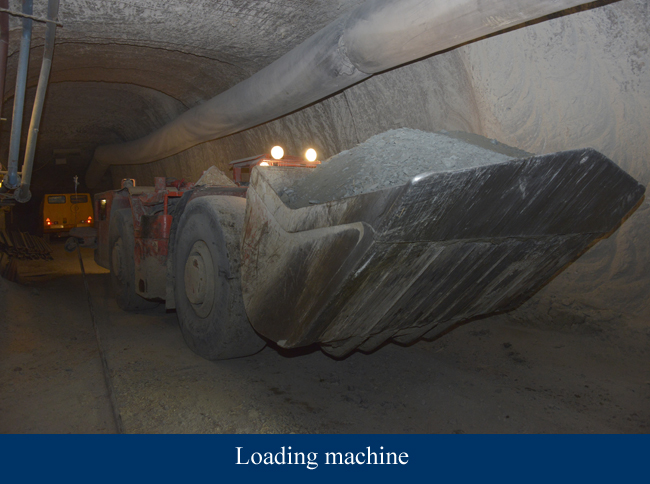
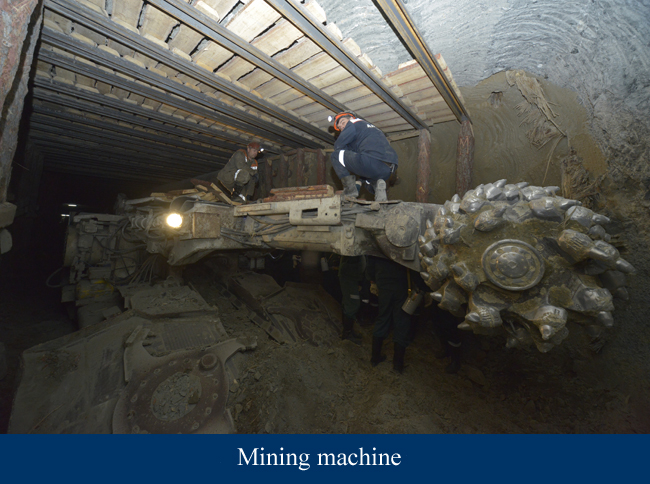
“Red-and-yellow banners along the walls indicate the walk-area. Every 25 metres apart there are safety niches – earth cut-out in the wall. When we see the vehicles approaching us we hide there,” explains the drift miners team foreman. The vehicles running about along the horizontal working look like minivans for transferring miners, and four mining units each consisting of a heading machine and a loading machine with a total cost of US$2.5 million. Only loading machines are electrical, and heading machines are diesel, so exhaust gases ventilation is carried out based on a number of cubic metres of air per each machine.
The heading machine bites into the rock while approaching the ore body in the perimeter of 3 m by 3.5 m, the working in the body is up to 5 m high and 6 to 7 m wide. For a 7-hour shift, one heading machine and one loading machine mine about 1 metre and for 24-hours - 3 to 3.5 metres. At present, the total length of workings at Inter is above 35 kilometres. The ore goes by belt from the heading machine to the loading one that takes it to the receiving bin. From there, the ore is transferred in 13.5 tonnes skips via 1 000 m long skip shaft to the ore storages, and then it is brought by dump trucks to the Processing Factory. This is how 500 tonnes ore per year are extracted from Internationalny mine.
With this production output, the proven ore diamond reserves down to the depth of 1 200 metres will last for another 27 years of operation. Simultaneously with the miners, geologists work there. According to the estimates of the operational exploration, the Inter reserves are sufficient to last at least till 2050.
“Here it is!” caved the foreman to requests of the reporter asking to show it least one rough diamond in the diamond mine, and points to a small dirt pile under his feet. It was a failure to find a sparkling stone with an inexperienced eye. Then a miner bent over and picked up a piece of ore as small as a match head and of the same colour seen in the light of miners’ lamps. “Here the rough diamond is,” explains he. Only a wanton imagination could help see a ‘symbol of love and commitment’ in this small piece of ore. However, it has become clear how much work and how many efforts are exerted by miners, engineers, sorting operators, cutters and jewellers to make the hardest mineral sparkle on a beautiful finger. Meanwhile, the foreman has thrown the stone away behind the heading machine “to avoid the questions of the security officers.” “By the way, losses of ore are practically excluded,” explains the miner. “When the work is completed, the miners use shovels to clean the area and the geologists check on cleanness.” Close to the hoisting cage, there is a trough and brushes. “Do not forget to clean and wash the boots,” reminds the foreman. “To avoid the ore losses?” “No. To make our cleaner’s work easier,” says the miner smiling.
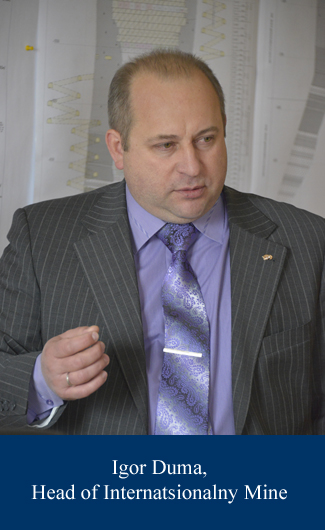
“Most of the miners here used to be coal miners,” tells Igor Duma, Manager of the Internationalny mine. “Because the specific character is practically the same. Self worked at Donbass mines for 9 years, 2 years at the coal mine in Spitsbergen and in the mid-90-ies came to Mirny with two suitcases in hands. Here, I started as a foreman and worked until I was promoted to the post of a manager.” “To be a miner is in my blood,” explains the Inter Manager. “My father was a miner, I followed in his wake. After all, the mine warns twice, the third time – finish.” Probably, that is why Igor Duma is thorough and bread-in-the-bone in everything he does: when he eats a thick red-beet soup and harsh brown potatoes with sour cream in the workers’ canteen, and when he makes spice-salted tomatoes for the New Year party, but the main thing is that he strictly observes safety precautions at his hazardous production facilities. This explains his pride when he shows the award ‘Best mine in labour protection’ and tells that from 2010 to 2012 no one has suffered in an accident and there has been no crashes.
 Cullinan, ‘Black Orlov’, Anastasy, Gena, Khasanovna
The Diamond Sorting Centre (DSC) is not a big building in Mirny, there is nothing special in it except the grilled windows, but goods worth about US$4.5 billion per year go through it. That is the place where all the diamonds produced in Yakutia are sorted out, which makes 97% of the total Russian rough diamonds.
To enter the DSC, it is necessary to go through a security revolving door, hand in your passport, put on a uniform overall without pockets, and overboots. Those working here change their shoes.
Most men in the DSC greet each other in a soldierlike manner, which reveals they are active security officers or active reserve officers. It stands to reason, because the State as the ALROSA majority shareholder starts to keep a close watch over its reserves right here.
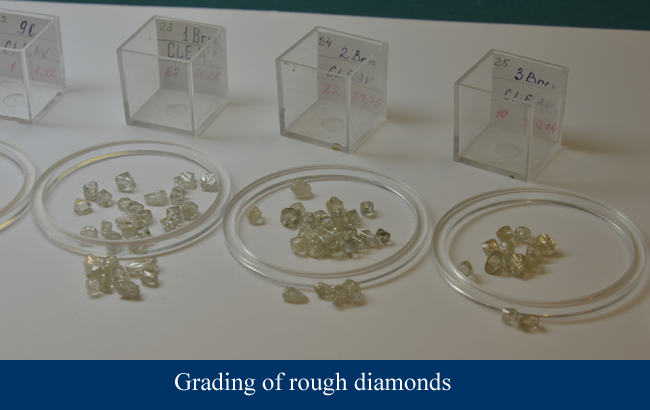
Diamonds come to the DSC already treated in 4 classes. At first, they are preliminary classified into 16 size groups. The largest gems are distributed using automated equipment. From the hopper diamonds get into the cups through the pierced disk (various diameters of holes). From outside, this small and plain assembly is reminiscent of dining sets, which in Soviet times were used to be carried and offered to passengers from the dining car.
Smaller diamonds are sorted out by hand using the screens. These consist of eight vertical metal disks with various mesh-size grids to sieve the ore through. This is a simple structure.
The batches from different mines, allotments and deposits are treated individually. Based on weight groups are selected, then samples are taken from them and sent to the expert group for evaluation. According to Anna Yefremova, Head of this unit, “out of 81 000 positions we do evaluation by 300 main positions.” “I have been working with diamonds since 1978 and keep on being surprised at this wonderful stone. Both an 82-carat octahedron and a 342-carat diamond (non-gem) have gone through my hands. There were crystals in the form of a rock candy, fish, flower,” tells the expert. “However, none of us would call this precious gem a ‘piece of glass’. This would be offensive. This stone is our life. While working with it, we observe some special form of worship, some ceremonial.”
“And what classification is this?” ask I pointing at the sheet of paper on the wall with pictures of large diamonds and their names ‘Anastasy, Tatiana, Ghena, Khasanovna’. “People are joking,” smiles Anna Yefremova. “They give their names to large diamonds. Humorists work here.”
Out of about 100 DSC employees, 40 are busy in sorting the gems. That is they who classify the diamonds. Based on the results, an evaluation report is issued. The batch is weighed, and a computer produces the price. The parcels are marked by colour and other parameters and shipped to Moscow to the United Selling Organization where boxes are made that are mainly sent abroad, to Yakutsk, and the smallest-size gems are sold here, in Mirny.

The bestseller ‘The World of Diamonds’ by Timothy Green describes about one hundred ways of diamond smuggling, starting from the banal heels and ending with a container in an artificial eye. But not a single word is told about the legal transportation of precious gems. The ALROSA’s logistic scheme is covered by the similar secrecy. One thing is known: the transportation of diamonds from the deposits to the DSC, then to the United Selling Organization and other agencies is performed by the Special Communications Service of Russia. The Chief Centre of Special Communications, which is a federal state unitary enterprise, was founded on August 1, 1939; this is the date when the Special Communications Service started its operation under the Decree of the Council of People’s Commissars of the USSR ‘On the Reorganization of Field Courier Service of the NKVD of The USSR’. The functions of the organization have not changed over its long history: in addition to conveyance of confidential correspondence and goods, it also stores and transports precious metals, gems and jewellery. The goods are transferred in armoured cars that are allowed to approach the airplane on the airfield, and couriers have a right to carry and use firearms.
“But a private security agency would, probably, be more efficient in coping with this task?” asked I the DSC employees. They flatly stated that “It was a private security company that let the robbery happen in the Brussels airport, when polished diamonds worth US$50 million were robbed from the airplane within 3 minutes. But we had not a single case like that.” “And do not forget to stamp the dust from your boots and wipe your feet before you leave!” adds the security officer.
Market Leader or Leaders Market?
By June 25, the decision should be taken whether the privatization of 14% of ALROSA’s shares will be carried out this year or will be postponed till the next year. The officials and experts consider November to be the most probable time. However, while the analysts argue about the expected prices for block of shares and shares, there are discussions – not so wide but at least public – how the IPO revenues would be used. Igor Sobolev, First Vice-President, Executive Director, answered the Rough&Polished reporter’s question that the company had already submitted the tentative offers to the shareholders. In few words, these include the investment of the future revenue into the development of infrastructure projects, in particular, in the reconstruction of the Mirny Airport runway and upgrading of housing and public utilities, pipelines and networks with the subsequent transferring of these assets to the State. At present, these ‘utilities‘ are on the books of the Company and, certainly, require a lot of efforts and money. If ALROSA’s offers are approved, then the shareholders’ money will be used to upgrade the problem-plagued facilities, the Company will get rid of them but will be able to use them. This is the benefit the diamond giant can get from the IPO.
According to Igor Sobolev, “liquidation of non-core assets is among the main ways to neutralize the impact of possible crises.” At least, that was the lesson drawn from the last financial collapse. The company works actively in this regard: the buyers for Viluyi GES-3 (hydro power plant), Irelyakhneft, ALROSA-Gas, Timir iron-ore project and agricultural assets have been found or their search is in progress.
Having got rid of the non-core assets, the Company could focus on the core activities and invest in the development. And there is much to be developed. During the first three months of this year, RUB 1.8 billion - out of the total investments into the fixed capital of RUB 4 billion - were allocated for the construction of the Mir, Aikhal and Udachny underground mines.
In the first quarter, the budget of the ALROSA’s geological prospecting and operational exploration projects amounted to RUB 1.33 billion. Total increase in reserves of 13.6 million carats was reached thanks to the exploration at the operational deposits and those that are under preparation for operation.
Certainly, all the ALROSA’s investment programmes are linked to the diamond price expectations on the global market. According to Igor Sobolev, “three percent growth in the price allows our sustainable development and increase in the production output.” He is of opinion that the market is “stable enough and the plans are based on the moderate growth.”
The company has ambitious plans. According to Igor Sobolev, “by 2018, ALROSA will become a leader in the world diamond industry not only in terms of carats but in terms of value, too.”The First Vice-President of the Company believes that this can be achieved through the increase in the proven reserves of roughs and their quality.
Being a leader is not only a merit, but also a serious responsibility. De Beers that has been a leader in the industry for many years not only produced diamonds but also built the rough and polished diamonds market. Will it hand over the leadership crown of laurel together with its burrs of the mission? Is ALROSA ready to function as a marketing driver and a product regulator? Has the Russian monopolist the resources for this and the understanding – which is most important – that the current market state does not allow it to boast its mining component only? Is the industry itself to take ALROSA in its new capacity? If the answers to this and many other questions are positive, then the Russian company will take its unique place on the unique market. If not, then ALROSA’s leadership will turn to be just mere participation in socialist competition in the capitalist world. And instead of multibillion dividends it will content itself with a Certificate of Appreciation only.
Alexander Shaburkin, Rough&Polished, Мirny – Nakyn – Моscow
