Did you know that diamond mining in Zimbabwe started more than three decades ago?
You are probably not in the know as you are only aware of Marange diamond fields, which had been in the news since 2006.
However, diamond mining in Zimbabwe is not only Marange rather there is more to talk about than you often read or hear in the media.
River Ranch
River Ranch, in Beitbridge (which borders Zimbabwe and South Africa’s Limpopo province) is the country’s first (kimberlite) diamond mine, according to Equity Communications.
Diamonds at River Ranch were discovered in 1971 (nine years before Zimbabwe’s independence) by Kimberlitic Searches, a subsidiary of De Beers.
De Beers relinquished its rights to the area in 1991 after a dispute with the government over the marketing of the diamonds.
When De Beers left the country, Auridiam Consolidated – an Australian and Canadian joint-venture – obtained a permit to develop the River Ranch diamond concession at a cost of about $12 million.
The company completed its exploration services in 1992, confirming that diamonds had been found at the concession, said Equity Communications.
It then announced plans to build a small-scale production plant.
A 500 000 tonnes-per-year processing plant at River Ranch was commissioned two years later and the mine was also expected to reach 1.5 million tonnes of ore annually in 1996 and produce 500 000 carats per year during its projected 10 - year life span.
However, the company haemorrhaged money per every ore mined due to low diamond prices and it was forced to shut down in 1998.
It was re-opened in 2004 under a different ownership structure: Limpopo Mineral Resources, 80 percent (Saudi Arabian) and Khupukile Resources, 20 percent (Zimbabwean).
Last known production figures were released in 2009 and the company had produced 75 000 carats.
The mine was currently mothballed and Limpopo Mineral Resources announced last year that it was selling its stake.
There were reports that ZMDC was planning to buy the stake but it was not known whether the deal sailed through or festered.
Murowa Diamonds
Another diamond mine in Zimbabwe was 78 percent owned by Rio Tinto and it’s known as Murowa Mine. It’s a kimberlite.
Equity Communications said that Rio Tinto Zimbabwe discovered the Murowa kimberlite cluster between 1997 and 1998. It commenced mining in 2004.
The deposit consisted of three kimberlite pipes in close proximity to each other. Mining operations are a combination of small open pit and underground construction.
An expansion programme to increase ore processing capacity to 2 million tonnes per annum was planned in 2007 but the operating environment made the project unworkable.
“Capital costs of expansion would have been in excess of $200 million. However, reserves at Murowa were recently decreased following a pit redesign and re-classification of material,” Equity Communications said.
DTZ-OZGEO
There was also the little-known DTZ-OZGEO, a joint venture between Zimbabwe and Russia, which was awarded a special grant to explore for diamonds in Chimanimani, east of Zimbabwe.
Diamond deposits in the area were officially discovered in 2008 on a farmland.
Trial mining started in 2010 while full production began in late 2012.
Equity Communications claimed that the diamond resource in Chimanimani was richer than that in Marange but substantially smaller.
The average diamond price from the mine was $60 - $180 per carat.
Marange
De Beers’ subsidiary Kimberlitic Searches was also responsible for the discovery of Marange diamonds in the 1980s.
Their Exclusive Prospecting Order (EPO) expired in 2006 and exploration rights were taken up by African Consolidated Resources.
The Zimbabwean government subsequently took over these rights via the Zimbabwe Mining Development Corporation (ZMDC) at the end of 2006.
This was after a diamond rush in September 2006 that saw thousands of Zimbabweans taking up artisanal mining in the Marange area.
Government then set its security forces to drive out the artisanal miners from the lucrative diamond fields and it was alleged that some lives were lost in the process.
Harare denied these claims and argued that the non-governmental organisations that made such accusations were being used by the West to discredit the country’s diamond industry following a diplomatic fall out in 2000.
This, however, did not stop the Kimberley Process from suspending the country’s diamonds in 2009.
KP alleged that diamonds were being mined under conditions that gravely violated basic human rights.
A Kimberley Process Review Mission later visited Marange to assess conditions in the region, including compliance with the minimum trade standards for rough diamonds.
Zimbabwe was found to be in breach of some trade standards and pledged to undertake corrective measures.
In mid-2010 an agreement was reached for Zimbabwe to resume rough diamonds exports. Under the terms of the agreement, Zimbabwe was allowed to export its diamonds stock-pile including a limited quantity of diamonds produced in 2010.
Zimbabwe was finally given the green light to freely resume export of diamonds from Marange, within the Kimberley Process framework in November 2011.
However, because of economic sanctions on Zimbabwe, diamonds from Marange cannot be traded in Europe and USA.
Marange diamond fields cover about 120 000 hectares in Eastern Zimbabwe.
The diamonds are mostly alluvial and the concession area was held under at least four special grants belonging to ZMDC, with about 20 percent of the total concession area comprised of diamond prospects.
A proper scientific study was yet to be completed; hence it was still not possible to ascertain the longevity of the reserves available.
Here is a list of companies that are currently operating in Marange, according to Equity Communications:
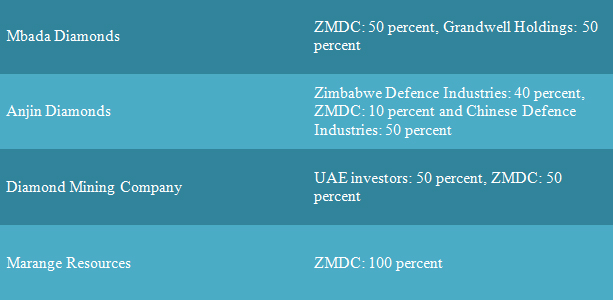
Apart from the above well-established diamond companies, emerging diamond producers had also been identified in Marange.
Equity Communications cited Gye Nyame, a partnership between ZMDC, South African, Zimbabwean and Ghanaian investors, as well as Jinan Investments, Kusena Diamonds and Rera Diamonds. No ownership details were given on the other three companies.
Equity Communications said that at least 70 percent of the diamonds in Marange are coarse, very low-to-medium quality resembling rounded pebbles, with colours ranging from dark green to dark brown and black.
The rest, it said, are near gem and gem quality diamonds with mostly greenish and brownish colours.
Production statistics from the Kimberley Process show that Zimbabwe officially produced 3.8 million carats of diamonds valued at $174.8 million between the years 2003 to 2009, and 8.5 million carats in 2010.
“However these statistics are misleading as there is no accounting for diamonds smuggled out of the country in the days of free-for-all diamond mining between 2006 and 2008,” said Equity Communications.
Exploration
Zimbabwe was believed to have diamond reserves across the country that remain largely unknown owing to the high cost of exploration and the socio-economic problems the country has experienced in the last fifteen years, said Equity Communications.
More than two-thirds of Zimbabwe’s total surface area lies on a craton which was very stable and conducive for the deposit of kimberlites.
Moreover, the Orapa Kimberlite Track – where the world’s largest diamond mine was located - extends from Botswana into Zimbabwe.
More than 200 kimberlites had been discovered in the country.
Mathew Nyaungwa, Editor in Chief of the African Bureau, Rough&Polished
