The history of diamonds in the Netherlands has been often portrayed as a story of decline. It is the story of the largest diamond centre of the world, Amsterdam, that in just over one-hundred years has shrunk to the level of a marginal player. While this story is undoubtedly true, it is not all of the truth. There is something more to say about the relationship between Amsterdam and diamonds, something that goes beyond mere sales figures.
Amsterdam became a relevant polishing centre back in the 18th century. Thanks to an extensive trade network with Portuguese merchants, the city was able to secure a monopoly on newly discovered Brazilian diamonds. Entrepreneurs could count on an advanced banking system and easy credit to develop a solid industry. In a matter of years the city gained enough expertise and infrastructure to process the large amount of rough diamonds shipped from South America.
Such was the extent of the Dutch primacy in the business that Amsterdam was often dubbed as ‘The City of Diamonds’, and so it remained for almost 200 years. Amsterdam resisted a major crisis provoked by the exhaustion of the Brazilian pits in the early 1800s, and made itself ready to receive the large amount of rough made available by the discovery of the Kimberley mine in South Africa in 1867. By the beginning of the 20th century, Amsterdam could count on nearly 10,000 active polishers.
But then the city began to lose competitivity against its historical competitor: Antwerp. A series of causes contributed to this decline: traders in Belgium could count on a sensibly lower tax regime, labour costs were more competitive, and labour unions were traditionally less aggressive than in Holland. By the 1920s Antwerp had taken the sceptre of largest diamond market in the world.
The final blow to the dying Dutch industry was given by the German invasion of the country at the beginning of World War II. The largely Jewish workforce was forced to flee Amsterdam or deported in concentration camps. In 1945, at the end of the war, the number of people involved in the diamond business had fallen below a thousand units. Since then, despite an upswing in the 50s, the industry never returned to its glory days.
What is left today of that glorious heritage? Not much, if we look at statistics. The Amsterdam diamond exchange market, the World’s oldest diamond bourse, is now shadowed by the one in Antwerp. Its historical building in the city centre is no more in use, and the bourse now moved to more modest headquarters some seven kilometres south of Old Amsterdam. Production has plummeted, and diamond polishing is not a popular profession in town, anymore.
And yet, such a bleak picture does not say the whole truth. The other part of the truth is that diamonds in Amsterdam are not just a thing of the past. It is the tale of a handful of traditional diamond companies that fought the decline and literally opened their doors to tourists and visitors who want to understand how diamonds are processed from rough stones to precious jewels.
Today, in the global commodity industry that most of the diamond business has become, diamonds are processed in anonymous industrial sheds in the outskirts of Surat and other rapidly-growing towns in East Asia. It is the last place where you would want tourists to put their nose in. The Idea of never-ending rows of polishers working long hours under neon lights would take away all the magic from diamonds, rather than encourage new customers.
In Amsterdam, though, you get a different feeling. Polishers work in plain sight, behind protective glasses, for everyone to see their craftsmanship. And their workshops could not look more different than modern, unpleasant prefabs. Whether they are employed at the traditional Dutch architecture of Coster Diamonds or the monumental 19th century diamond factory where Gassan established its headquarters, the setting is always astonishing.
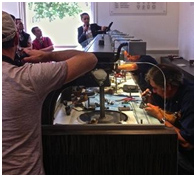 Visits to the factories are free of charge. Companies rely on visitors to buy jewellery – not only diamonds, but also watches, costume jewellery and souvenirs – as a source of income. Guided tours in multiple language leave continuously from the main hall. Tourists are explained where diamonds come from, how they are mined and shipped all across the world, and on what bases experts decide what cut should be performed. Then they are shown polishers at work, using their grinders to slowly transform translucent minerals into sparkling gems (in picture).
And of course, a large part of the visit is actually dedicated to guiding potential customers in choosing their diamonds. It is not just about trying to sell a product, though. It is about giving ideas. Then some will buy, some will not, someone will maybe come back in the future.
At Gassan, customers can sit down in a quiet showroom inside the factory, where they are given a detailed explanation of what the 4Cs are. It is a rather unique experience, as actual samples of diamonds in different size, clarity colour and cut can be seen and examined with magnifiers.
Cut, the only of the 4Cs where human skills and creativity actually play a role, is given particular attention in Amsterdam. Companies have invested a great amount of resources and expertise into developing innovative shapes – all of which have been patented – and in training top-level polishers. All major Dutch brands propose their own signature cuts that surpass the traditional products in terms of shape and number of facets. The Gassan 121, the Coster Royal 201, the Royal Asscher cut, are among the most exclusive cuts available on the market.
Companies in Amsterdam also developed their own way to deal with clients. Skilled multilingual personnel guide potential customers in choosing their products, with targeted offers aimed at addressing regional preferences. Thanks to their strategic positioning close to the diamond hub in Antwerp, salesmen can rapidly accommodate the request of their customers. Under request, diamonds can be shipped from Belgium in a matter of hours, polished, mounted on a jewel of choice, and delivered straight to the hotel where customers sojourn.
 Lost its pre-eminence in production and trade, Amsterdam has shaped for itself a unique role: it has become the cultural capital of diamonds. And the use of the word culture is not an exaggeration, because a whole series of aspects are covered: from history to innovation, from marketing to arts. All this is summed up in the Diamant Museum of Amsterdam. After a brief introduction to the geological, physical and morphological characteristic of diamonds, the museum offers an extraordinary panoramic on their social value. A thematic exhibition is dedicated to precious stones as a symbol of power in royal crowns and sceptres; another one digs into the role of diamonds in contemporary fashion and cinema icons; then there is the theme of arts and diamonds, with some unique pieces such as a Japanese katana sword made of Murano glass and diamonds, and a diamond-studded ape skull inspired by Damien Hirst's masterpiece "For the Love of God". Even sports have their own space, with the magnificent 1.5 million dollar Diamond Racquet (in picture), crafted in gold and studded with 2008 diamonds, that will be given as a prize for the first player to win the Antwerp international tournament three times over a five years period.
In a decade that saw many challenges – from conflict minerals to environmental issues – threatening the prestige of diamonds, Amsterdam is doing something extraordinary: every year it welcomes nearly one million visitors, takes them by the hand and shows them a culture. This practice has an impact that goes well beyond the city boundaries: it affects the way millions of people from all corners of the World perceive diamonds, and that is for the benefit of the whole industry.
This by itself is enough of a reason to define Amsterdam, today just like one hundred years ago, the City of Diamonds.
Matteo Butera, Rough&Polished
