The fundamental scarcity of platinum-group metals is still not enough to have an impact on prices. Even the fact that platinoids this year look more confident than gold and other metals is explained by the accumulated underestimation of platinum and palladium. This underestimation stems from prices, which are mainly dependent on financial investors obsessed with fears of an economic slowdown and a slump in the car industry. Questions about when the platinum market will be more receptive to the fundamentals and when palladium will approach the price of platinum are controversial and belong to a relatively distant future. Meanwhile, prices for PGMs are correlated with gold and only remotely react to reports about the strikes in South Africa, the world’s pace setting producer of platinum.
According to Johnson Matthey, the world's largest distributor of platinoids, the industry accounts for about 60% of demand for platinum and for 91% of demand for palladium. The main driver of demand for platinum is the increased production of autocatalysts, and therefore, the outlook facing the automotive industry has a direct impact on the investment attractiveness of these metals.
According to LMC Automotive’s forecast, car sales in 2014 will grow at a higher pace of 4.8% from 2.7% this year, while the growth rate in the Chinese auto industry is still maintained at double digits, as it follows from the survey released by Renaissance Capital.
Norilsk Nickel, the world’s largest producer of palladium (holding a 41-percent share in the market) and the fourth-largest platinum producer, says that demand for palladium to be used in autocatalysts is growing steadily since 2009 and will reach 6.1 million ounces this year (an increase by more than 50% versus 2009 and by 11% versus 2011). Another factor of growth is the development of the Chinese jewelry industry: in 2016 its needs will shape a total demand of 2.9 million ounces in the jewelry sector (up 20% to 2012).
The largest producers of platinum and palladium, the share of Norilsk Nickel and the size of the market

Eventually, after a surplus in 2011 the market will experience a permanent shortage of palladium, Norilsk Nickel believes: the supply shortage, which is currently estimated at 940,000 ounces, will go up to reach 1.22 million ounces in 2016.
Platinum supply to the market is under constant threat due to strikes at mines in South Africa, which accounts for 73% of platinum output and for 36% of palladium output. According to Norilsk Nickel, production capacities in South Africa shut down in 2011 and 2012 resulted in reduced supply of these metals to the market by 11% and 16%, respectively. So far, South African companies are not reducing their output drastically, among other things due to the weakening of the local currency. But the South African rand may soon reach its devaluation bottom, while the effect of the strikes factor sooner or later will become significant, according to Renaissance Capital.
On the other hand, there is a potential threat to PGM prices from palladium released to the market by the warehouses in Switzerland owned by speculators, traders, as well as by industrial consumers and automakers. The size of stock kept by these warehouses is debatable. According to Johnson Matthey, the palladium market balance tracked from 1980 shows a cumulative trade surplus of 10 million ounces (which is 1.5 times higher compared to what was produced in 2012). The Standard Bank Group estimates the reserves of palladium as equivalent to 2.4 years of production.
A positive factor for prices is the gradual depletion of stocks held by Gokhran, which accumulated palladium in Soviet times - Norilsk Nickel says that exports from the state reserve will be reduced 2.5 times compared to one year ago and will reach 100,000 ounces. As it is estimated by Norilsk Nickel, exports from the state reserve will virtually stop in 2014.
At the moment, palladium is much cheaper than platinum, although in the early 2000s, the situation was quite the opposite and the metals had similar production costs. In many ways, the price gap is associated with marketing campaigns, which were run by the South African platinum producers over the last 40 years. Being the largest producer of palladium, Norilsk Nickel has long been mulling about the need to start similar ventures to promote palladium. According to forecasts offered by Renaissance Capital, the difference in price in the coming years will be reduced, and the market is already moving in this direction. Norilsk Nickel is cherishing similar hopes.

Meanwhile, prices until recently did not fully reflect the fundamentals, being under the pressure of negative forecasts for the European economy and, consequently, a drop in demand from the European car industry. The prices for the platinum group looked much more confident than gold prices, which fell by 20% compared to the beginning of this year, and this is mainly because these precious metals are underestimated.
In October, prices for platinoids balanced between the downside caused by the weakened gold prices and the upside created by the threat of strikes in South Africa.
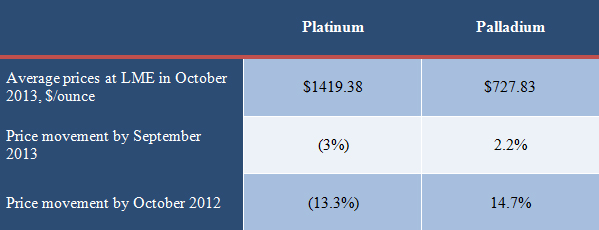
In the first week of October, platinum went down in price by 2.9%, reaching the lowest level since the end of July, while palladium fell more significantly - by 3.8%. This was the impact of the Chinese Golden Week festivities (the holiday celebrated on October 1 to mark the formation of the People's Republic of China) during which precious metals, including platinum and gold, lost their support from Asian investors. Another factor was that investors were closing their quarterly positions. Most of the week the position of palladium was confident due to reports that regulators supported the creation of the first palladium ETF (exchange investment fund) in South Africa, but by the end of the week palladium was ahead of platinum by the depth of its dip. PGMs clearance sales did not turn higher only because of a strike threat at American Platinum, which said it was going to reduce 4,800 jobs.
For the week of trading from October 7 to 11, platinum remained at the closing point of the previous period, while palladium rose by almost 1%. Despite the fact that platinum has received short-term support from Chinese investors, who returned to work after the holiday week, the precious metal fell by the end of the week due to a stronger U.S. dollar, which hit gold and platinum. In turn, the U.S. dollar rose in price amid the tensions between the Republicans in the Congress and the U.S. President Administration over the debt limit. These events overshadowed the significance of the settlement reached between Anglo Platinum and their workers on strike against job cuts.
For the week of trading from October 14 to 18 platinum went up 5%, while palladium rose 4%. The growth was due to the U.S. decision to raise the debt ceiling - the dollar fell and gold and PGMs soared. Prices for platinum and palladium were also supported by strong data on economic growth in China in the 3d quarter (an increase of 7.8% compared to the same period of 2012), which can trigger higher demand for cars and for palladium catalysts, accordingly.
Palladium and platinum prices for the next two weeks of October were not subject to great changes. On the one hand, they were supported by the threat of a strike from workers of South African platinum mines. The employees of Lonmin and Northam announced their intention to go on strike. On the other hand, PGM prices were affected by weaker gold prices due to the discussions of a possible cut in the U.S. quantitative easing program (QE), which were positive for the U.S. economy, but negative for the gold market.
Boris Ashkenazi for Rough&Polished
