The Arkhangelsk Region is the second most important diamond province after Yakutia in Russia accounting for 23% of total diamond reserves possessed by the Russian Federation. In the 1980s, six kimberlite pipes located within an area of 9.5 kilometers were discovered in the Primorsky District of the Arkhangelsk Region. Their in-place reserves totaled 355 million tonnes of ore and 200 million carats of diamonds. The aggregate value of diamonds they contain is estimated at $ 13.4 billion. The depth of placing the diamond pipes reserves on the balance sheet is set at 460 meters.
The Arkhangelskaya and Karpinski-1 Pipes constituting the southern group of diamond deposits are explored better and more convenient for mining than the northern group of pipes including Pionerskaya, Karpinski-2 and swamp-based Lomonosovskaya. Therefore, mining operations are now conducted only on the two southern fields.
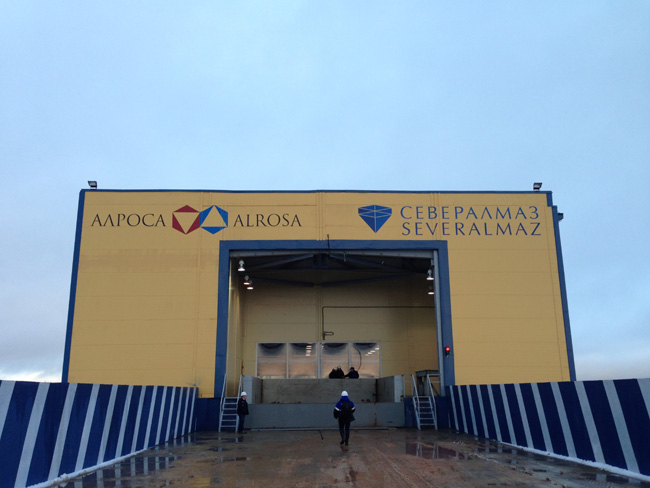
The first stage of the concentrator factory in the Arkhangelskaya diamond field with a capacity of 1 million tonnes of ore per year was put into operation in 2005. After Arkhangelskaya, an open-pit mine 1,100 m in diameter and 110 m deep, was brought into action, it yielded 4,000,000 carats of diamonds.
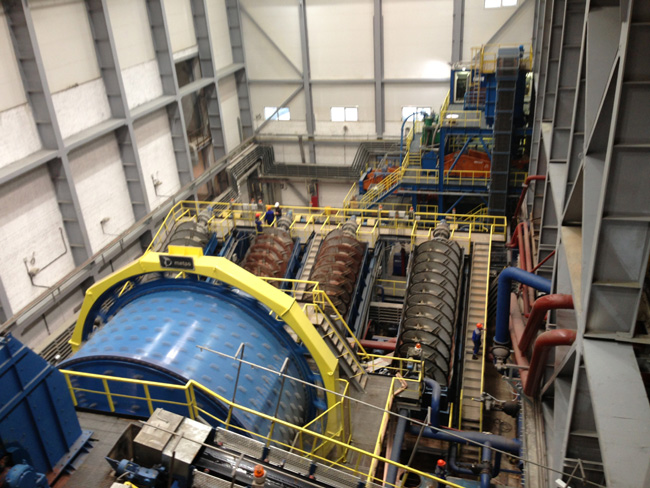
Currently, the concentrator factory is setting up the second stage of equipment designed to process 3 million tonnes of ore.
The concentrator will have a production capacity of 4 million tonnes, but the second-stage mill itself is designed to process this amount; in other words, together with its first stage the concentrator will be able to process as much as 5 million tons of ore. "Five million is our maximum, we won’t be able to milk anything else," says Sergei Gerasimov, CEO of Severalmaz.
"The existing resource base allows developing this mine field for 60 years at the rate of 4-5 million tonnes without any problems," he adds.
Initially, the concentrator will process only the ore coming in from Arkhangelskaya, but at the end of 2014 Severalmaz will start mining at Karpinski-1 (840 m in diameter and 40 m deep).
The Arkhangelsk diamond pipes are more difficult to mine compared to those in Yakutia, where kimberlite is located closer to the surface. "In order to reach the kimberlite it is necessary to ‘go down’ to a depth of about 100 meters stripping a 60-80 meter thick overburden,” Sergey Gerasimov says. “Now the depth of Arkhangelskaya is 110 meters, but it does not mean that we "sat" on kimberlite, since we have yet to go through slightly diamondiferous sandstones. This will happen in 2016-17, not earlier, and only then the diamond grade will start growing.”
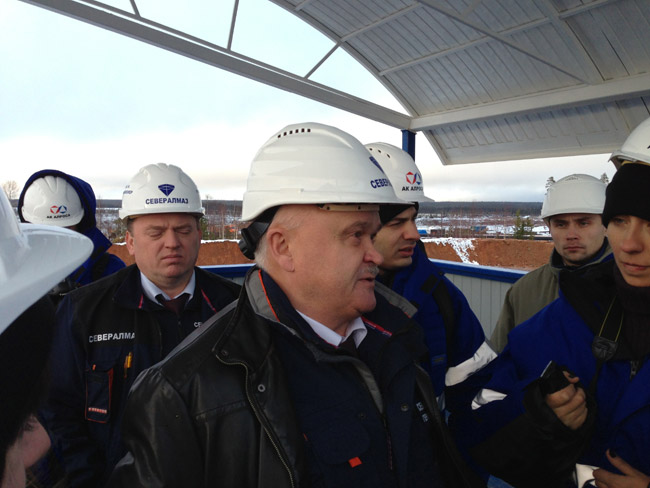
Now the ore from Arkhangelskaya has a maximum diamond grade of 0.4-0.5 ct/t, while Karpinski-1 has it equal to 1 ct/t. Production at Arkhangelskaya will reach its peak in 2016, when it will yield its first batches of kimberlite ore. Karpinski-1 will demonstrate its best performance after 2020, when the company will strike the richest ore of 1.7 ct/t bringing it into production, Ilya Zezin, Severalmaz’s lead geologist said elaborating the picture.
When Severalmaz will reach its design capacity, this will significantly increase its proportion in the total output of ALROSA, from 2% to 10% in 2019. During this period Severalmaz will increase its production to 4.3-5 million carats from the current 630,000 carats.
This projection implies mining operations involving only Arkhangelskaya and Karpinski-1, excluding the northern group of diamond fields. Right now ALROSA is working on a development strategy to be pursued by Severalmaz and the possibility of expansion based on full-scale exploitation of the deposits belonging to Lomonosov GOK, a mining and concentration works, depends on the degree of ambitiousness put into this strategy.
In this case, Severalmaz may increase processing to 5-8 million tonnes of ore per year. "If the company will start a scenario involving the northern group of diamond deposits, it will need to build another concentrator bay able to consume 4 to 5 million tons of ore in the vicinity of the Pionerskaya Diamond Field, Sergei Gerasimov explains. Another scenario is to process the ore coming from northern diamond fields using the existing concentration facilities. A feasibility study for a possible expansion of production is being prepared by the Yakutniproalmaz Institute and it will be ready in the second or third quarter of 2014. "Everything will depend on the diamond market conditions,” Sergei Gerasimov emphasized.
Development of the northern group of diamond deposits was already considered in 2008-2009, when Severalmaz was planning the construction of a new concentrator in the Pionerskaya Diamond Field for 5-6 million tons of ore, but this was prevented by the crisis. After this, Severalmaz lapsed into a state of stupor, according to its CEO. In 2010, ALROSA planned to attract an investor for its most troubled mining subsidiary selling to it a 50-percent stake in Severalmaz. One of the bidders was mining giant Rio Tinto, but on the background of a bouncing market and Severalmaz’s steadying performance ALROSA dropped the deal deciding to develop its daughter company.
"The company will come to a money-making level in one and a half or two years," its CEO Sergei Gerasimov says. Currently, the miner has no profit, because it is continuously investing, while its production is small. "If we had no construction works going on and could reduce our staff and costs, then we could be profit-making, but in that case we would be processing one million tonnes of ore extracting 400 carats a year," he explained.
In 2012-2013, Severalmaz had capital expenditures reaching $ 325 million mostly spent to complete the second stage of the concentrator, including the costs not only for the factory itself, but also for the necessary industrial and social infrastructure, including the industrial site, tailings, drainage system, worker's village, as well as stripping works at Karpinski-1. Still earlier, from 2004 to 2011 Severalmaz invested $ 385 million to launch an open pit at Arkhangelskaya and the first stage of the concentrator factory. Financing came from the loans of the parent company.
There is a more radical scenario for the development of the entire Arkhangelsk diamond province, which involves the acquisition by Severalmaz of the Grib Diamond Pipe located 8 km away, the license for which is held by LUKOIL, an oil company. This option was not analyzed in detail, according Sergei Gerasimov, but ALROSA’s top managers have repeatedly voiced the company’s interest towards the Grib diamond field. Despite the declaration of intent to develop the diamond business, the oil company de facto does not have the appropriate maximum of expertise, especially in the Arkhangelsk province, not very rich in professional staff. Severalmaz also faces a shortage of personnel, but partly it can be solved by a group of experts from ALROSA - for example, the director of the concentration factory was transferred to the company from ALROSA Nyurba operating in Yakutia. Grib’s reserves are two times lower compared with the stock held by Lomonosov GOK – their estimated total is 98.5 million carats. Industrial production at Grib is to begin in late 2013 - early 2014.
Arkhangelsk gem-quality diamonds lose to those mined in Yakutia and their average price is lower - this is the main reason that Severalmaz was on the verge of a shutdown when the market was difficult. "Our diamonds are not yet fully appreciated. We do not have a collection, and it's a big problem. It can appear when we shall be producing 2.5 million carats, not the current 500 carats," Sergey Gerasimov says.
Severalmaz’s production range includes nearly 82% of gem-quality diamonds, while the remaining 18% is ‘bort.’ There are fancy diamonds, dominated by yellow, smoky-brown, gray, green, pink and purple colors.
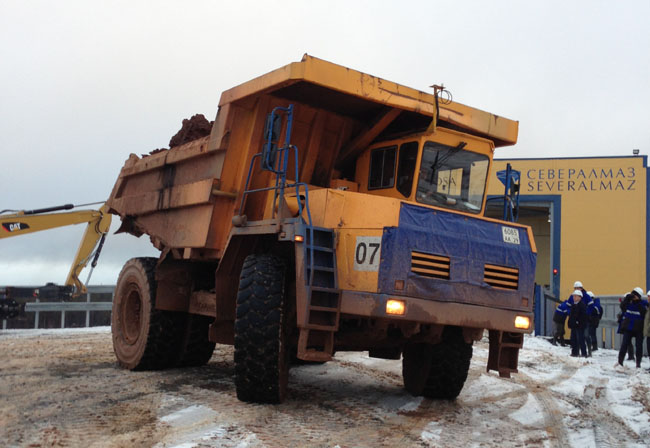
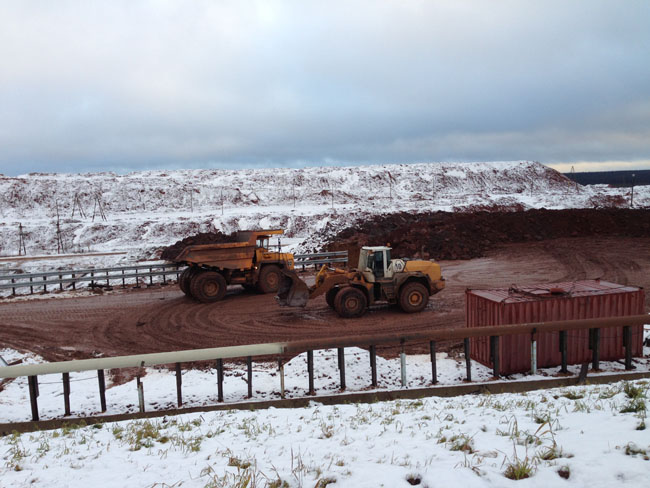
Currently, Severalmaz completes the construction of wells in the drainage circuit around the Arkhangelskaya open pit to protect mine openings from groundwater and precipitation. The company employs 1,500 people working in shifts each 2 weeks long. The equipment includes 23 90-ton Caterpillar dump trucks and six 45-ton BelAZ dump trucks. Severalmaz is subjected to environmental inspections almost every month, with no significant complaints filed. After a recent check the miner was not given any improvement notices. Severalmaz spent 12 million rubles for environment protection measures in 2012.
Alexander Shaburkin, Rough&Polished, Arkhangelsk - Moscow
